


I sprung for a new 2005 Hyundai Elantra tonight.
It was $10,750 with all applicable discounts.
That was the price in the ad but I had a hard time getting it.
The salesman told me it included a $750 loyalty bonus and that since I was not trading in Hyundai I did not qualify.
I told him I wasn't buying it then.
The ad did not say for sure but it really appeared as if there was an extra $750 for existing owners. Purposely misleading?
I also had to mention the ad price before the dealer dropped to that price. Then there was confusion over whether or not the ad price applied to the car I got because the serial number did not match the ad serial number even though the car was identical except for color. Ad color car was black.
When I threatened to walk, the salesman had a talk with the manager who then came over with an apology saying that I was reading that ad correctly and they took the $750 off. The manager explained that the salesman worked in the Mazda dealership (for the same owner) and was unaware of all the discounts and how they worked. $10,750 seemed reasonable enough for the car with a 60K miles bumper to bumper and 100K power train warranty, AC, power windows, remote entry, cloth seats, etc.
They gave me $200 for my old car. Perhaps they can sell it for $500. Perhaps not with a cracked radiator and power windows that do not work and 102K miles on it and was generally in bad shape except for a brand new $120 battery in it. What a waste. I was hoping for $500 but expected about $250.
Reason for quick decision to buy a new car today:
I was driving old car today and all of a sudden the car got extremely hot inside like from 70 to 90 degrees in seconds. I thought the AC stopped working but a quick look at my gauge and I could see it was a deep in the red as it could get. Stopped at the first place I could (couple miles away) and it took a whole bottle of radiator fluid and then some. It had all steamed out thru a crack. 102K miles on a Olds 97 Achieva.
Power windows did not work (drove it that way for a year)
$500 to fix.
Radiator installed $350
Tires fair at best
Brakes good but.... replaced twice in last two years so something is chewing them up too quickly
Battery brand new (less than 1 week old). Car would not start a week ago.
Transmission was lurching all day today (not sure if related to overheating or not).
I have literally driven two cars to where they would not run at all (stopped dead at side of road to be towed to junkyard) and a third that had numerous problems including a clutch going out that would not likely have lasted another week.
I am sort of an expert on driving cars into the ground.
Anyway, that was that.
Dealer suggested I sell old car myself but who could I sell that to and even if I could I would not want to.
I did not get the Hyundai color I wanted, but silver was acceptable, and the dealer absolutely would not attempt to trade it with another dealer for that price. Silver would have been my second choice so I took it.
4 door sedan - 5 speed
Clutch is extremely smooth.
Lumbar support adjustments in the seat, power windows, AC, remote entry, AM/FM cassette player (why do they put those in instead of CD player?) but there is a ready made slot for a CD player.
BTW the radio pickup is great.
Chicago cancelled their only oldies station couple weeks ago but I could pick up Milwaukee station. Old car could not and wife's relatively new grand am certainly can not pick up that station.
Seems like a lot of car for $10750.
That is a lot less that I paid for new Toyota Corolla many many many years ago and it has far more features to boot.
Inflation anyone?
Not in cars, unless you insist on trendy names.
Mish
Tuesday, 12 July 2005

Monday, 11 July 2005
Leading Indicators
OECD Composite Leading Indicators shows weak performance in May 2005
Slowing activity lies ahead in the OECD area according to the latest composite leading indicators (CLIs). May data showed weakening performance in the CLI’s six month rate of change in each of the Group of seven major economies except the United States and Canada. The CLI for the OECD area in May 2005 was 103.0, unchanged from its value in April. Its six-month rate of change was also stable following four months of declines.
The CLI for the United States rose by 0.1 point in May and its six-month rate of change, while still negative, rose after falling sharply for the previous three months.
The Euro area’s CLI decreased in May by 0.2 point and its six-month rate of change has continued to fall since December 2003.
In May, the CLI for Japan fell sharply by 1.0 point and its six-month rate of change was down for the sixth month in a row.
The CLI for the United Kingdom decreased by 0.4 point in May and its six-month rate of change fell for the seventh consecutive month.
The CLI for Canada rose by 0.4 point in May and its six-month rate of change has risen since February 2005.
The CLI for France decreased by 0.2 point in May and its six-month rate of change has fallen since March 2004.
The CLI for Germany also decreased by 0.2 point in May and its six-month rate of change has shown a downward trend since January 2004.
The CLI for Italy fell by 0.6 point in May and its six-month rate of change was down for the seventh month in a row.
More data and charts in the above link.
Mike Shedlock / Mish
http://globaleconomicanalysis.blogspot.com/
Slowing activity lies ahead in the OECD area according to the latest composite leading indicators (CLIs). May data showed weakening performance in the CLI’s six month rate of change in each of the Group of seven major economies except the United States and Canada. The CLI for the OECD area in May 2005 was 103.0, unchanged from its value in April. Its six-month rate of change was also stable following four months of declines.
The CLI for the United States rose by 0.1 point in May and its six-month rate of change, while still negative, rose after falling sharply for the previous three months.
The Euro area’s CLI decreased in May by 0.2 point and its six-month rate of change has continued to fall since December 2003.
In May, the CLI for Japan fell sharply by 1.0 point and its six-month rate of change was down for the sixth month in a row.
The CLI for the United Kingdom decreased by 0.4 point in May and its six-month rate of change fell for the seventh consecutive month.
The CLI for Canada rose by 0.4 point in May and its six-month rate of change has risen since February 2005.
The CLI for France decreased by 0.2 point in May and its six-month rate of change has fallen since March 2004.
The CLI for Germany also decreased by 0.2 point in May and its six-month rate of change has shown a downward trend since January 2004.
The CLI for Italy fell by 0.6 point in May and its six-month rate of change was down for the seventh month in a row.
More data and charts in the above link.
Mike Shedlock / Mish
http://globaleconomicanalysis.blogspot.com/
Saturday, 9 July 2005
UK / US Housing and the upcoming liquidity trap
Wilson Bowden, Britain's fifth-biggest housebuilder, sees job threat to house market.
Wilson Bowden (WLB.L) said on Tuesday that fears of unemployment could further undermine the country's fragile house market, compounding a first half in which the housebuilder completed 10 percent fewer sales.
"Housing market conditions have remained subdued since the AGM (on April 27), and reservation levels have not recovered," Wilson Bowden said in a statement.
Chief Executive Ian Robertson said the market had been buoyed by news that two of the Bank of England's nine interest rate setters had voted for a cut this month. But retail weakness and high profile job layoffs like that seen at MG Rover had triggered job concerns.
"Clearly there are pleasantly encouraging noises coming out on interest rates," said Robertson. "The dilemma for me is whether these encouraging noises on interest rates will outweigh what I think is an underlying concern on the job front that hasn't been there for some years."
Economists and estate agents have warned that a rise in unemployment could lead to a sharp correction in the housing market, in contrast to the gradual slowdown seen so far.
Earlier this month, official data showed the number of people in the country out of work and claiming benefits rose for a fourth month in May, the longest stretch of increases in almost 13 years.
This is interesting because just a few weeks ago I proposed the theory that housing would not lead the decline in jobs down, but that other job losses would lead the decline in housing down.
Eventually the weight of losing manufacturing jobs, telecom jobs, banking jobs, and all sorts of other jobs and replacing them with more real estate broker jobs (all fighting to sell the same house), and "greeting" jobs at your friendly Wal-mart store is just not going to cut it.
What's happening in the UK right now is a harbinger of what is going to take place in the US with some unknown lag time. It's no secret that employment in this "recovery" is both unprecedented and amazingly weak. Yet Greenspan remains in a conundrum about long term interest rates. Is he really that stupid or is he trying to talk the economy up or both? IMO, the long bond can spot the upcoming debacle. I do not accept the theory that yields are low solely because of Chinese and Japanese intervention.
The yield curve is now as flat as a pancake. A flat yield curve is hardly conducive for tremendous profits at financial institutions. To "make up" for declining carry trades it seems banks and other lenders keep taking on riskier and riskier housing loans with lower and lower credit standards in the face of higher and higher prices. No risk is too great to keep the party going.
Indeed, BusinessWeek is reporting on this phenomenon in an article entitled "Mortgage Bankers are Desperate to Lend".
"Refinancing volume has tumbled, as has profitability, so these lenders offer increasingly sweet deals in a scramble for market share.
Why have lenders been so liberal when they run the risk that many of their marginal customers will go into default? The answer is surprising. Sure, long-term interest rates have at times continued to defy conventional wisdom and decline or hold steady even while the Fed hiked short-term rates. This gives lenders a lot of room to keep their rates to customers as low as possible.
But it turns out that's just part of the reason lenders are offering such unbelievable deals to their customers. Many lenders are just plain desperate for business, according to some experts. In a bid for market share, mortgage lenders are offering highly favorable terms to borrowers. That's forcing the rest of the industry to match their terms or lose customers.
The industry's underlying problem is simple: Overcapacity and a drop in profitability from its all-time high of 2003. And that's not the claim of an industry gadfly. It's the analysis of the sector's own top economist, Douglas Duncan, the chief economist of the Mortgage Bankers Assn. Duncan told BusinessWeek on June 23 that profits fell by 70% from 2003 to 2004 among 70 lenders that supply their internal data to the trade group."
Yes Mish readers, as silly as it might sound, we actually have an overcapacity in lending.
It now seems that all the bulls are counting on Greenspan to "save the day" with a pause in interest rates at the appropriate time. If that does not work so the theory goes, Greenspan will "save the day" by cutting interest rates. Here is a prediction for you in advance. Once Greenspan pauses the party will be over. Perhaps long over. I have another prediction for you. The next big conundrum question on the minds of economists and stock bulls will be this: "Why is the economy is not picking up with the FED cutting rates?". Here is my answer, in advance: "Just as a interest rates rising at a 'measured pace' indicated the party was still alive, falling interest rates will be a signal that the economy is falling apart faster than anyone thought it could". After all, the market rose along with interest rate hikes, is it supposed to rally when they fall too? Is everything good for stocks? Thinking about this right now, I am wondering if we get some enormous gap and crap as soon as Greenspan pauses.
Meanwhile there is little sign of significant job pickups in the US.
Let's take a look at June Layoffs in the US.
I am sure I missed some layoffs, perhaps even lots of them.
Scroll down that list. It seems staggering to me.
By the way, that was a list I complied on my Silicon Investor stock message board.
If anyone is interested in day-to-day macro economic chat feel free to join me there.
At any rate, the jobs we are adding barely keep pace with immigration and population growth. The current and likely unstoppable trend due to global wage arbitrage as well as increases in productivity is to lose high paying jobs and replace them with lesser paying service jobs. Real wage growth is negative, and that unfortunately includes pay raises for CEOs, bankers, brokers and other fat cats at the upper ends of the scale that are doing phenomenally well. On balance, I suggest wage data is far worse than it looks. Supporting evidence for this theory is increasing debt and consumer spending furnished by cash out refis.
Bear in mind we have not yet felt the mammoth layoffs announced earlier this year in banking and telecom mergers. Nor have we felt the affects of upcoming GM layoffs. Tens of thousands of announced job cuts will start filtering thru in the second half of the year.
Of course the cheerleaders on CNBC and elsewhere keep touting unemployment without mentioning the participation rate, wage growth or anything else that I talked about in the following blogs:
Where the hell are the jobs?
Searching For Jobs
Making Sense of April Payroll Numbers
Outsourcing the Soul of the US
Real Inflation Adjusted Wage Growth
Very few mainstream economists are taking a good hard critical look at the job situation. Paul Kasriel and Asha Bangalore, both from the Northern Trust in Chicago are two of the best hard-hitting exceptions.
Consider the following charts by Paul Kasriel from an excellent Northern Trust article entitled Labor Market Continues To Show Less Vigor.
Initial Unemployment Claims

Continuing Unemployment claims

Instead of looking at seasonally adjusted data on top of ridiculous birth/death assumptions, on top of falling participation rates in a "recovery", on top of people running out of benefits so they are no longer considered unemployed, on top of whatever political bias someone may have to distort the adjusted numbers, those charts are where the rubber meets the road. Neither chart is very pretty, unless you are a housing or stock market bear. Take a good hard look at the trends.
Greenspan and Snow and cheerleading economists everywhere want you to believe that a flat yield curve "is different this time" and that although we created no jobs to speak of with interest rates at 1% (note that private sector job growth under Bush is still net negative or perhaps just recently slightly positive), that somehow job growth is just around the corner. Get real.
If 1% rates could not produce jobs what can? Of the jobs that we did create, Asha Bangalore had this to say: "Employment in housing and related industries accounted for about 43.0% of the increase in private sector payrolls since the economic recovery began in November 2001."
Wow. What happens to those jobs when housing turns down? Most economists want you to believe the housing party can last forever. Well I have news for them. The party is almost over.
If you want to see a strong correlation between consumer spending and home prices look no further than UK Headed for Recession.
Inflationists believe that consumers will keep spending with the job losses and wages losses in the upcoming housing debacle. I don't buy it and consumers in the UK don't seem to buy it either.
Regardless of what any of the cheerleaders want you to believe, the tightening of the yield curve is not good for profits or hiring or anything else for that matter. The anemic job growth we are seeing now is eventually going to spill over into the last strong sector we have left: housing.
The question is not whether or not the US will follow the UK. The pertinent question is: "exactly how big is the time lag?" I think the lag will be about 6 months to a year. But judging from housing and job action in the UK and Australia, we are probably 4-6 months in already. In other words, I look for things to get worse, a lot worse, sometime within the next 6 months or so. Perhaps it has already started.
Once wage and job losses start affecting housing sales, our economy will fly apart like a Hostess crumb-cake tossed into a dishwasher. This will start a mammoth Japanese style liquidity trap from which Greenspan and the FED will have no escape.
Mike Shedlock / Mish
http://globaleconomicanalysis.blogspot.com/
Wilson Bowden (WLB.L) said on Tuesday that fears of unemployment could further undermine the country's fragile house market, compounding a first half in which the housebuilder completed 10 percent fewer sales.
"Housing market conditions have remained subdued since the AGM (on April 27), and reservation levels have not recovered," Wilson Bowden said in a statement.
Chief Executive Ian Robertson said the market had been buoyed by news that two of the Bank of England's nine interest rate setters had voted for a cut this month. But retail weakness and high profile job layoffs like that seen at MG Rover had triggered job concerns.
"Clearly there are pleasantly encouraging noises coming out on interest rates," said Robertson. "The dilemma for me is whether these encouraging noises on interest rates will outweigh what I think is an underlying concern on the job front that hasn't been there for some years."
Economists and estate agents have warned that a rise in unemployment could lead to a sharp correction in the housing market, in contrast to the gradual slowdown seen so far.
Earlier this month, official data showed the number of people in the country out of work and claiming benefits rose for a fourth month in May, the longest stretch of increases in almost 13 years.
This is interesting because just a few weeks ago I proposed the theory that housing would not lead the decline in jobs down, but that other job losses would lead the decline in housing down.
Eventually the weight of losing manufacturing jobs, telecom jobs, banking jobs, and all sorts of other jobs and replacing them with more real estate broker jobs (all fighting to sell the same house), and "greeting" jobs at your friendly Wal-mart store is just not going to cut it.
What's happening in the UK right now is a harbinger of what is going to take place in the US with some unknown lag time. It's no secret that employment in this "recovery" is both unprecedented and amazingly weak. Yet Greenspan remains in a conundrum about long term interest rates. Is he really that stupid or is he trying to talk the economy up or both? IMO, the long bond can spot the upcoming debacle. I do not accept the theory that yields are low solely because of Chinese and Japanese intervention.
The yield curve is now as flat as a pancake. A flat yield curve is hardly conducive for tremendous profits at financial institutions. To "make up" for declining carry trades it seems banks and other lenders keep taking on riskier and riskier housing loans with lower and lower credit standards in the face of higher and higher prices. No risk is too great to keep the party going.
Indeed, BusinessWeek is reporting on this phenomenon in an article entitled "Mortgage Bankers are Desperate to Lend".
"Refinancing volume has tumbled, as has profitability, so these lenders offer increasingly sweet deals in a scramble for market share.
Why have lenders been so liberal when they run the risk that many of their marginal customers will go into default? The answer is surprising. Sure, long-term interest rates have at times continued to defy conventional wisdom and decline or hold steady even while the Fed hiked short-term rates. This gives lenders a lot of room to keep their rates to customers as low as possible.
But it turns out that's just part of the reason lenders are offering such unbelievable deals to their customers. Many lenders are just plain desperate for business, according to some experts. In a bid for market share, mortgage lenders are offering highly favorable terms to borrowers. That's forcing the rest of the industry to match their terms or lose customers.
The industry's underlying problem is simple: Overcapacity and a drop in profitability from its all-time high of 2003. And that's not the claim of an industry gadfly. It's the analysis of the sector's own top economist, Douglas Duncan, the chief economist of the Mortgage Bankers Assn. Duncan told BusinessWeek on June 23 that profits fell by 70% from 2003 to 2004 among 70 lenders that supply their internal data to the trade group."
Yes Mish readers, as silly as it might sound, we actually have an overcapacity in lending.
It now seems that all the bulls are counting on Greenspan to "save the day" with a pause in interest rates at the appropriate time. If that does not work so the theory goes, Greenspan will "save the day" by cutting interest rates. Here is a prediction for you in advance. Once Greenspan pauses the party will be over. Perhaps long over. I have another prediction for you. The next big conundrum question on the minds of economists and stock bulls will be this: "Why is the economy is not picking up with the FED cutting rates?". Here is my answer, in advance: "Just as a interest rates rising at a 'measured pace' indicated the party was still alive, falling interest rates will be a signal that the economy is falling apart faster than anyone thought it could". After all, the market rose along with interest rate hikes, is it supposed to rally when they fall too? Is everything good for stocks? Thinking about this right now, I am wondering if we get some enormous gap and crap as soon as Greenspan pauses.
Meanwhile there is little sign of significant job pickups in the US.
Let's take a look at June Layoffs in the US.
I am sure I missed some layoffs, perhaps even lots of them.
Scroll down that list. It seems staggering to me.
By the way, that was a list I complied on my Silicon Investor stock message board.
If anyone is interested in day-to-day macro economic chat feel free to join me there.
At any rate, the jobs we are adding barely keep pace with immigration and population growth. The current and likely unstoppable trend due to global wage arbitrage as well as increases in productivity is to lose high paying jobs and replace them with lesser paying service jobs. Real wage growth is negative, and that unfortunately includes pay raises for CEOs, bankers, brokers and other fat cats at the upper ends of the scale that are doing phenomenally well. On balance, I suggest wage data is far worse than it looks. Supporting evidence for this theory is increasing debt and consumer spending furnished by cash out refis.
Bear in mind we have not yet felt the mammoth layoffs announced earlier this year in banking and telecom mergers. Nor have we felt the affects of upcoming GM layoffs. Tens of thousands of announced job cuts will start filtering thru in the second half of the year.
Of course the cheerleaders on CNBC and elsewhere keep touting unemployment without mentioning the participation rate, wage growth or anything else that I talked about in the following blogs:
Where the hell are the jobs?
Searching For Jobs
Making Sense of April Payroll Numbers
Outsourcing the Soul of the US
Real Inflation Adjusted Wage Growth
Very few mainstream economists are taking a good hard critical look at the job situation. Paul Kasriel and Asha Bangalore, both from the Northern Trust in Chicago are two of the best hard-hitting exceptions.
Consider the following charts by Paul Kasriel from an excellent Northern Trust article entitled Labor Market Continues To Show Less Vigor.
Initial Unemployment Claims

Continuing Unemployment claims
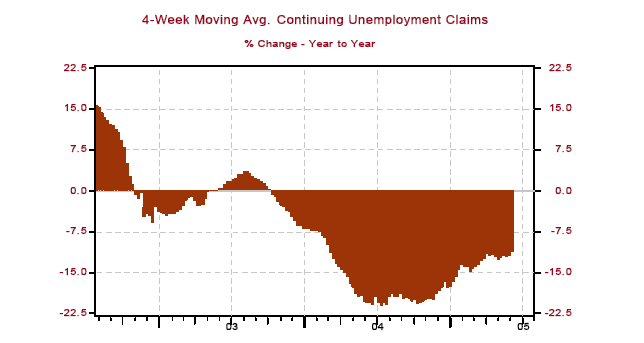
Instead of looking at seasonally adjusted data on top of ridiculous birth/death assumptions, on top of falling participation rates in a "recovery", on top of people running out of benefits so they are no longer considered unemployed, on top of whatever political bias someone may have to distort the adjusted numbers, those charts are where the rubber meets the road. Neither chart is very pretty, unless you are a housing or stock market bear. Take a good hard look at the trends.
Greenspan and Snow and cheerleading economists everywhere want you to believe that a flat yield curve "is different this time" and that although we created no jobs to speak of with interest rates at 1% (note that private sector job growth under Bush is still net negative or perhaps just recently slightly positive), that somehow job growth is just around the corner. Get real.
If 1% rates could not produce jobs what can? Of the jobs that we did create, Asha Bangalore had this to say: "Employment in housing and related industries accounted for about 43.0% of the increase in private sector payrolls since the economic recovery began in November 2001."
Wow. What happens to those jobs when housing turns down? Most economists want you to believe the housing party can last forever. Well I have news for them. The party is almost over.
If you want to see a strong correlation between consumer spending and home prices look no further than UK Headed for Recession.
Inflationists believe that consumers will keep spending with the job losses and wages losses in the upcoming housing debacle. I don't buy it and consumers in the UK don't seem to buy it either.
Regardless of what any of the cheerleaders want you to believe, the tightening of the yield curve is not good for profits or hiring or anything else for that matter. The anemic job growth we are seeing now is eventually going to spill over into the last strong sector we have left: housing.
The question is not whether or not the US will follow the UK. The pertinent question is: "exactly how big is the time lag?" I think the lag will be about 6 months to a year. But judging from housing and job action in the UK and Australia, we are probably 4-6 months in already. In other words, I look for things to get worse, a lot worse, sometime within the next 6 months or so. Perhaps it has already started.
Once wage and job losses start affecting housing sales, our economy will fly apart like a Hostess crumb-cake tossed into a dishwasher. This will start a mammoth Japanese style liquidity trap from which Greenspan and the FED will have no escape.
Mike Shedlock / Mish
http://globaleconomicanalysis.blogspot.com/
Thursday, 7 July 2005
Seasonal Adjustments to Jobless Claims
Today we have more nonsense on seasonal adjustments coming from the labor department.
First-time claims for state unemployment benefits rose by 7,000 to 319,000 last week, the Labor Department said Thursday.
The gain was in line with expectations on Wall Street.
A "significant" portion of the gain was due to annual auto plant retooling and to schools closing for the summer, a Labor Department spokesman said without providing more details.
Seasonal adjustments by the government statisticians attempt to account for recurring events such as school vacations and plant closings for retooling, but the process is inexact.
I have two questions for the labor department
1) If the process is inexact then how do you know that a "significant portion" was specifically due to plant retooling and schools closing for the summer?
2) If you do know that a "significant portion" was specifically due to plant retooling and schools closing for the summer, then why didn't you seasonally adjust for it in the first place?
Of course this is one of the reasons top economists like Paul Kasriel at Northern Trust does not put much stock in any of these "adjusted numbers".
Let's take a look at what Paul Kasriel has to say:
"I’m not a big fan of the monthly Employment Situation Report. It’s a one-week snapshot of payrolls. It has all kinds of estimates (e.g. small business “birth/death” model) built into it. Being that seasonal adjusting is an art, not a science, I am skeptical of the adjusted data. And the revisions are massive.
Conversely, I am a big fan of the state unemployment data on an unadjusted basis. Folks who have been laid off have an incentive to get in line and be counted. There are no well-intentioned-but-impossible-to-accomplish assumptions in the unadjusted data. Those who are in line get counted. Moreover, the Conference Board puts initial jobless claims in its index of leading economic indicators whereas nonfarm payrolls are relegated to the index of coincident indicators."
Here are a couple of charts courtesy of Paul Kasriel.
Initial Claims - 4 Week Average
Continuing Claims - 4 Week Average
I would have to concur with this statement by PK:
"The state unemployment data are sending an unambiguous message that the labor market is losing its forward momentum."
Those trends are far more important that a statement made by some clown at the labor department trying to explain why they know both how and why the adjusted numbers are wrong yet they failed to do their job properly adjusting the numbers in the first place.
Mike Shedlock / Mish
http://globaleconomicanalysis.blogspot.com/
First-time claims for state unemployment benefits rose by 7,000 to 319,000 last week, the Labor Department said Thursday.
The gain was in line with expectations on Wall Street.
A "significant" portion of the gain was due to annual auto plant retooling and to schools closing for the summer, a Labor Department spokesman said without providing more details.
Seasonal adjustments by the government statisticians attempt to account for recurring events such as school vacations and plant closings for retooling, but the process is inexact.
I have two questions for the labor department
1) If the process is inexact then how do you know that a "significant portion" was specifically due to plant retooling and schools closing for the summer?
2) If you do know that a "significant portion" was specifically due to plant retooling and schools closing for the summer, then why didn't you seasonally adjust for it in the first place?
Of course this is one of the reasons top economists like Paul Kasriel at Northern Trust does not put much stock in any of these "adjusted numbers".
Let's take a look at what Paul Kasriel has to say:
"I’m not a big fan of the monthly Employment Situation Report. It’s a one-week snapshot of payrolls. It has all kinds of estimates (e.g. small business “birth/death” model) built into it. Being that seasonal adjusting is an art, not a science, I am skeptical of the adjusted data. And the revisions are massive.
Conversely, I am a big fan of the state unemployment data on an unadjusted basis. Folks who have been laid off have an incentive to get in line and be counted. There are no well-intentioned-but-impossible-to-accomplish assumptions in the unadjusted data. Those who are in line get counted. Moreover, the Conference Board puts initial jobless claims in its index of leading economic indicators whereas nonfarm payrolls are relegated to the index of coincident indicators."
Here are a couple of charts courtesy of Paul Kasriel.
Initial Claims - 4 Week Average
Continuing Claims - 4 Week Average
I would have to concur with this statement by PK:
"The state unemployment data are sending an unambiguous message that the labor market is losing its forward momentum."
Those trends are far more important that a statement made by some clown at the labor department trying to explain why they know both how and why the adjusted numbers are wrong yet they failed to do their job properly adjusting the numbers in the first place.
Mike Shedlock / Mish
http://globaleconomicanalysis.blogspot.com/
Wednesday, 6 July 2005
King Copper and Steel
Steel prices have collapsed.
The chart in that link shows it.
Could copper be next?
I think so, in spite of inventory concerns.
Let's look at a few charts.
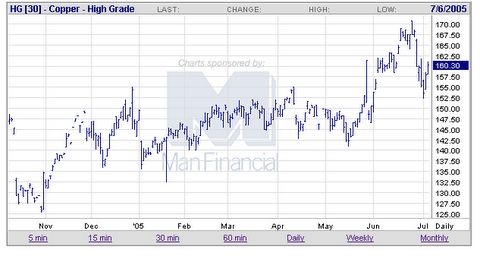
Here is a daily chart of copper:
Here is a weekly chart of copper:
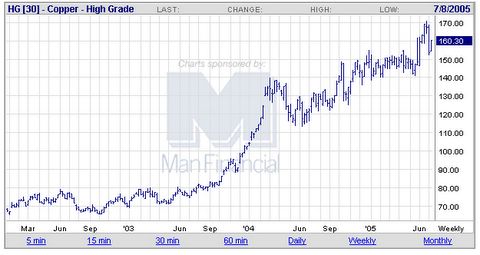
Those charts revealed little so let's take a look at the copper monthly chart.
Here goes:
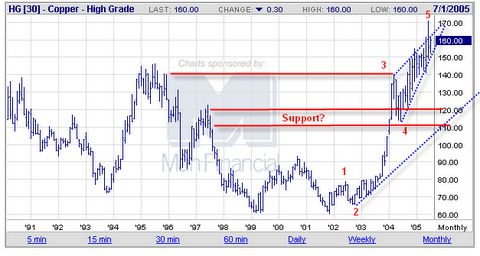
That looks a lot more revealing.
Arguably we have traced out 5 waves up and are due for a correction.
I also do not like the look of that rising wedge and potential blow-off top.
But what about supplies Mish? Aren't CME inventories extremely low?
Yes they are. Some suspect we might run out. I suggest that supplies are almost always tight at the peak. My contact at Alaron thinks there are additional supplies available at non-CME approved inventories. There is also a reasonable chance of hoarding physical copper, hoping for higher prices. If higher prices do not appear, perhaps we see some big inventories becoming available.
It's tough to call tops but if the world economy is slowing and US housing stumbles (I think both are happening), barring one last blowoff I am inclined to think the highs are in or will soon be in. Those interested can watch day-to-day copper movements here.
The question is "how to play it".
Shorts would be fighting extreme backwardation.
This chart shows it:

Given the backwardation, option players would be fighting not only time but backwardation as well. At a minimum, taking profits off here, if one has been long for quite some time sure seems like the right move to me.
I believe that wedge breaks will break down hard with first support near 140. I do not think 140 will hold except for a short bounce. Ultimately I think copper corrects back to the 110-120 area that I highlighted on the chart. Perhaps the nature and length of the decline will indicate the next move.
Mike Shedlock / Mish
http://globaleconomicanalysis.blogspot.com/
The chart in that link shows it.
Could copper be next?
I think so, in spite of inventory concerns.
Let's look at a few charts.
Here is a daily chart of copper:
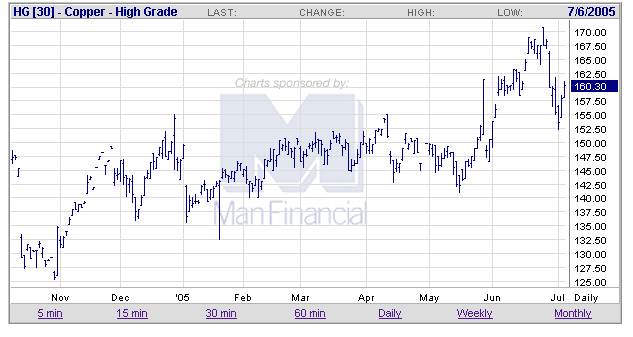
Here is a weekly chart of copper:
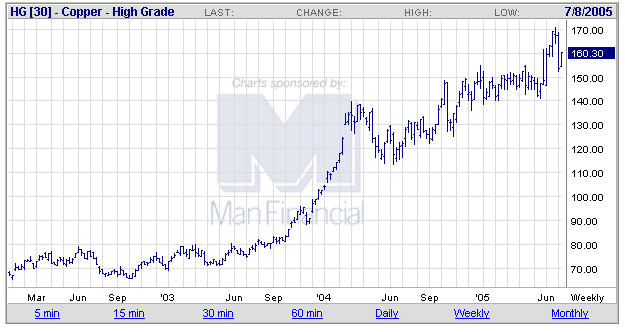
Those charts revealed little so let's take a look at the copper monthly chart.
Here goes:
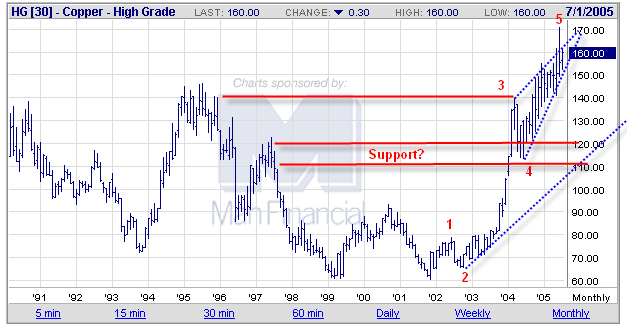
That looks a lot more revealing.
Arguably we have traced out 5 waves up and are due for a correction.
I also do not like the look of that rising wedge and potential blow-off top.
But what about supplies Mish? Aren't CME inventories extremely low?
Yes they are. Some suspect we might run out. I suggest that supplies are almost always tight at the peak. My contact at Alaron thinks there are additional supplies available at non-CME approved inventories. There is also a reasonable chance of hoarding physical copper, hoping for higher prices. If higher prices do not appear, perhaps we see some big inventories becoming available.
It's tough to call tops but if the world economy is slowing and US housing stumbles (I think both are happening), barring one last blowoff I am inclined to think the highs are in or will soon be in. Those interested can watch day-to-day copper movements here.
The question is "how to play it".
Shorts would be fighting extreme backwardation.
This chart shows it:
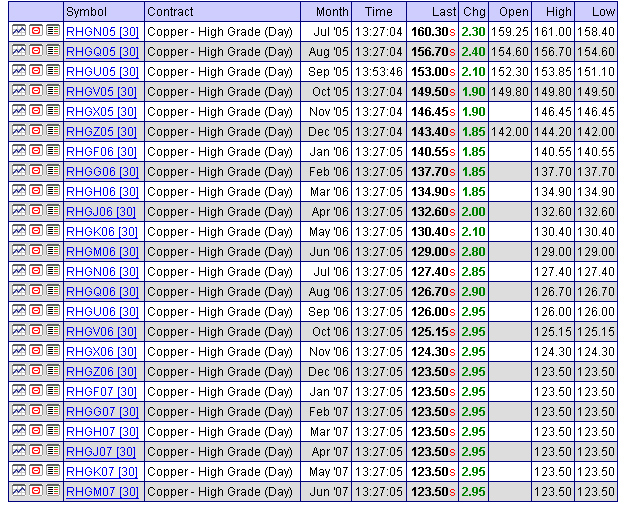
Given the backwardation, option players would be fighting not only time but backwardation as well. At a minimum, taking profits off here, if one has been long for quite some time sure seems like the right move to me.
I believe that wedge breaks will break down hard with first support near 140. I do not think 140 will hold except for a short bounce. Ultimately I think copper corrects back to the 110-120 area that I highlighted on the chart. Perhaps the nature and length of the decline will indicate the next move.
Mike Shedlock / Mish
http://globaleconomicanalysis.blogspot.com/
Tuesday, 5 July 2005
Urgent Needs
The BBC is reporting Further gloom for UK High Street as like-for-like high street sales for April to June were down 2.4% on a year previously.
According to Kevin Hawkins, British Retail Consortium director general, "There is an urgent need for an early cut in interest rates to prevent a continued decline" of consumer spending in the UK. In a shocking statement he went on to say "Retailers cannot rely on good weather to bring in customers".
Oh no! All weather is bad weather. Gee, how unfortunate.
I disagree of course. The real urgent need is for people to understand what is happening and why. More importantly there is a genuine urgent need for everyone to stop depending on the Bank of England and the FED to bail out everyone with repeated interest rates cuts every time there is a problem.
Someone tell me please why there is a desperate need for consumers to spend more with savings rates so pathetic and debt levels so high. That said, I fully expect the BOE to fight the upcoming deflation tooth and nail. The FED will follow their path. By the way, I have news for the British Retail Consortium, the BOE, and the FED: When housing busts you will have lost the last little bit of control over the economy you once had. There is no where left to hide.
Perhaps at the end of the upcoming deflationary collapse, someone will have sense enough to abolish the FED and/or reinstate the gold standard. Don't hold your breath waiting for it. If Japan is any indication, this is going to take a long, long time to play out. Let's see who is next on the global race to ZIRP (zero interest rate policy). My bet is on the EU, in spite of any denial by the ECB.
Mike Shedlock /Mish
http://globaleconomicanalysis.blogspot.com/
According to Kevin Hawkins, British Retail Consortium director general, "There is an urgent need for an early cut in interest rates to prevent a continued decline" of consumer spending in the UK. In a shocking statement he went on to say "Retailers cannot rely on good weather to bring in customers".
Oh no! All weather is bad weather. Gee, how unfortunate.
I disagree of course. The real urgent need is for people to understand what is happening and why. More importantly there is a genuine urgent need for everyone to stop depending on the Bank of England and the FED to bail out everyone with repeated interest rates cuts every time there is a problem.
Someone tell me please why there is a desperate need for consumers to spend more with savings rates so pathetic and debt levels so high. That said, I fully expect the BOE to fight the upcoming deflation tooth and nail. The FED will follow their path. By the way, I have news for the British Retail Consortium, the BOE, and the FED: When housing busts you will have lost the last little bit of control over the economy you once had. There is no where left to hide.
Perhaps at the end of the upcoming deflationary collapse, someone will have sense enough to abolish the FED and/or reinstate the gold standard. Don't hold your breath waiting for it. If Japan is any indication, this is going to take a long, long time to play out. Let's see who is next on the global race to ZIRP (zero interest rate policy). My bet is on the EU, in spite of any denial by the ECB.
Mike Shedlock /Mish
http://globaleconomicanalysis.blogspot.com/
Trade War Tensions Flare Over Oil
The possibility of a trade war with China over oil took another turn to the worse with Congress urging Bush to block the sale of Unocal to a Chinese firm.
"We cannot, in my opinion, afford to have a major U.S. energy supplier controlled by the Communist Chinese," said Rep. William J. Jefferson, a Louisiana Democrat.
China responded with harsh language of its own: "We demand that the U.S. Congress correct its mistaken ways of politicizing economic and trade issues and stop interfering in the normal commercial exchanges between enterprises of the two countries," the Foreign Ministry said in a written statement. "CNOOC's bid to take over the U.S. Unocal company is a normal commercial activity between enterprises and should not fall victim to political interference. The development of economic and trade cooperation between China and the United States conforms to the interests of both sides."
US Congress was already fuming over China's huge $160 billion trade surplus with the United States. Some congressmen have accused China of manipulating the RMB by pegging it to the US dollar which in their minds keeps the RMB artificially low, making Chinese goods unfairly cheap on world markets. The Bush administration and various leaders from Europe have all pressured China to let RMB float freely.
The idea that currency movements along can solve the trade deficit is preposterous of course, given the 20-1 wage differentials between the US and China. That does not stop US trade groups from asking for tariffs, and Congress has indeed threatened to label China a "currency manipulator" and impose 27.5% tariffs in retaliation. Of course this will solve nothing but drive up the price of goods 27.5%, saving a sum total of zero jobs in the process. On second thought, it would cost US jobs as demand for goods would plummet. China believes it is being made a scapegoat for the decline of U.S. manufacturing and I would agree.
Because of China’s trade surplus with the US, it happens to be sitting on a pile of cash, perhaps to the tune of about $650 Billion as the Washington Post article stipulates. It's smart on the part of China to attempt to buy hard assets such as oil with some of that money.
Congress sees this as a threat to the US. It is no such thing.
1) Most of Unocal's reserves are in Asia anyway, not the US
2) Oil is Fungible
Whatever demand China has for oil, its bid for Unocal is not going to change that demand. Oil prices will go wherever they are headed whether Unocal gets sold to China, France, or some other interest in the US.
BTW, I do not want to be misunderstood here. China indeed is a threat to the US but that threat had nothing to do with the fact that China is a Communist country, nor does it have anything to do with this deal in particular. The threat comes because the US is living well beyond its means at a time of increasing prosperity in China and India as well as increasing demand for resources from both of those countries. Blocking the deal will not address the issue of China's increasing demand for resources nor would it address the issue of the US living beyond its means.
Mike Shedlock / Mish
http://globaleconomicanalysis.blogspot.com/
"We cannot, in my opinion, afford to have a major U.S. energy supplier controlled by the Communist Chinese," said Rep. William J. Jefferson, a Louisiana Democrat.
China responded with harsh language of its own: "We demand that the U.S. Congress correct its mistaken ways of politicizing economic and trade issues and stop interfering in the normal commercial exchanges between enterprises of the two countries," the Foreign Ministry said in a written statement. "CNOOC's bid to take over the U.S. Unocal company is a normal commercial activity between enterprises and should not fall victim to political interference. The development of economic and trade cooperation between China and the United States conforms to the interests of both sides."
US Congress was already fuming over China's huge $160 billion trade surplus with the United States. Some congressmen have accused China of manipulating the RMB by pegging it to the US dollar which in their minds keeps the RMB artificially low, making Chinese goods unfairly cheap on world markets. The Bush administration and various leaders from Europe have all pressured China to let RMB float freely.
The idea that currency movements along can solve the trade deficit is preposterous of course, given the 20-1 wage differentials between the US and China. That does not stop US trade groups from asking for tariffs, and Congress has indeed threatened to label China a "currency manipulator" and impose 27.5% tariffs in retaliation. Of course this will solve nothing but drive up the price of goods 27.5%, saving a sum total of zero jobs in the process. On second thought, it would cost US jobs as demand for goods would plummet. China believes it is being made a scapegoat for the decline of U.S. manufacturing and I would agree.
Because of China’s trade surplus with the US, it happens to be sitting on a pile of cash, perhaps to the tune of about $650 Billion as the Washington Post article stipulates. It's smart on the part of China to attempt to buy hard assets such as oil with some of that money.
Congress sees this as a threat to the US. It is no such thing.
1) Most of Unocal's reserves are in Asia anyway, not the US
2) Oil is Fungible
Whatever demand China has for oil, its bid for Unocal is not going to change that demand. Oil prices will go wherever they are headed whether Unocal gets sold to China, France, or some other interest in the US.
BTW, I do not want to be misunderstood here. China indeed is a threat to the US but that threat had nothing to do with the fact that China is a Communist country, nor does it have anything to do with this deal in particular. The threat comes because the US is living well beyond its means at a time of increasing prosperity in China and India as well as increasing demand for resources from both of those countries. Blocking the deal will not address the issue of China's increasing demand for resources nor would it address the issue of the US living beyond its means.
Mike Shedlock / Mish
http://globaleconomicanalysis.blogspot.com/
Subscribe to:
Posts (Atom)


