Tuesday, 13 September 2005

A just in the nick of time downgrade

I would like to thank the analysts at JP Morgan today for coming up with a very timely downgrade of Delta Airlines today. I fail to see how that downgrade could possibly have been more timely.

Here is the downgrade on September 13 at 9:04 AM.

Here is a more complete report.

JP Morgan airline analyst Jamie Baker estimated in a research note that Atlanta-based Delta will reduce capacity by 15 percent from current levels, similar to the shrinkage of the two other major airlines in bankruptcy, United and US Airways.

Baker said the bankruptcy filing would come as no surprise for Delta, which has racked up nearly $10 billion in losses since January 2001. In downgrading his rating on Delta to underweight from overweight, Baker said he believes Delta will continue to retire, sell or swap certain aircraft types as it simplifies its fleet.


Delta shares fell 7 cents, or 8.2 percent, to close at 78 cents in trading Tuesday on the New York Stock Exchange. Here is a weekly chart of Delta Air Lines:


By the way I also want to congratulate Moody's for being on the ball as well.

Besides the JP Morgan downgrade, Moody's Investors Service late Monday lowered certain debt ratings that apply to Delta. The bond rating agency cited as a reason the increasing likelihood that Delta will need to reorganize its obligations, either in or out of bankruptcy, because of its difficult operating environment.

Meanwhile, Delta is seeking a new round of concessions from its pilots. The pilots union said in a memo to its members that at a meeting with management Monday, the company presented the union with a "comprehensive, deeply concessionary contract proposal." The memo did not put a dollar amount on the concessions that Delta is seeking. A union spokeswoman said Tuesday that the union's executive committee will discuss the proposal at meetings starting Monday.


Sarcasm aside, let's see if I have my facts straight.
  • JP Morgan airline analyst Jamie Baker said the bankruptcy filing would come as "no surprise" for Delta.
  • Delta's stock has fallen for 9 consecutive weeks, and was as high as $7.50 per share back in January
  • Up until 9:04AM on September 13, Jamie Baker maintained an overweight rating on Delta
  • At the time of Jamie Baker's "timely" downgrade, Delta stock was trading approximately 85 cents.
Jamie Baker could you please answer a few simple questions for me?
  1. If the bankruptcy filing was "no surprise" exactly why did you maintain an "overweight" rating on Delta while it plunged 89% in less than a year?
  2. By any chance does JP Morgan have any kind of business relationship or loans to Delta?
  3. By any chance is JP Morgan involved in credit swaps, derivatives, or any other type of investment that just might want JP Morgan to hold off downgrades and/or desire that a Delta bankruptcy be held off for as long as possible?
  4. Is the word "sell" in your vocabulary?
Mish note: I do not know the answers to above the questions, but if anyone does know something that they can substantiate or if Jamie Baker would care to reply I would be glad to post it.

At any rate, I do have a problem with this whole smelly mess if for no other reason than it just plain looks bad. As I mentioned in Are You Missing the Real Estate Boom? (Part 2), it just does not seem right for Moody's and the big three rating agencies to maintain relationships or have investments in the companies that they rate. Should that apply to banks and brokerage houses as well?

Mike Shedlock / Mish
http://globaleconomicanalysis.blogspot.com/

Monday, 12 September 2005

Are we headed for a "credit derivatives event"?

Here is a recap of the current state of affairs.

In Are you missing the real estate boom? we noted Saxon Capital openly discussing both "credit events" and the "perfect storm" in an investor conference call. This is what Saxon Capital was saying:

  • "At the point in time WHEN the credit event comes, AND IT WILL we will be very well placed to take advantage of what happens next"
  • "I am concerned about the level of capital" of our competitors "to service the bonds as those portfolios age"
  • "Should real estate on the west coast flatten out I would be worried about a credit event"
  • There are people that will buy a 100% Loan to Value (LTV). We do not have that product we do not believe in it. We want the stated income borrower to actually have some skin in the game"
  • We can now offer those products but "We have no intentions of putting those loans in our portfolio... We are going to pass them thru to other investors"
  • Question: and you think that is a good strategy thinking this is The Perfect Storm you are describing?
  • Answer: "As long as the market is willing to provide that credit... they attempt to deliver the customer as much cash as possible with the least amount of investigation or effort...That's what drives our customer... In order to get the customers we want we need to be able to offer those products"
  • Question: "Since I have known you, you have been bearish on the industry ... now you are saying I want to be more like people offering products that are unsustainable. I am struggling with that"
  • Answer: "The only difference is that I do not intend to put those in my portfolio... and the day that I can't sell these (to someone else) is the day that I stop offering them".
We also noted that Fannie Mae's restatement is such a big task, that Fannie expects to hire some 1,500 consultants by year's end to accomplish the mission.

In Derivatives cannot take the pressure Brad DeLong comments on a Financial Times report as follows:
  • "There is now about eight times the number of outstanding futures contracts as bonds eligible and available to fulfill them."
  • "In June, some large holders of the June 10-year Treasury futures contract, including Pimco, demanded settlement -- taking delivery of actual bonds -- instead of, as usual, rolling their positions into the next contract. The scramble to find the necessary notes was made worse by the fact that one account, possibly the hedge fund Citadel, already held the bulk of the cheapest notes to deliver."
  • "The real problem is that the US economy is just too leveraged. Starting with the housing industry, the country is too dependent on derivatives markets to create the illusion that interest rate risk can be conjured away. The technical problems of the 10-year are just another early warning sign of this fundamental weakness."
As a result of that mishap CNN Money reports an Investor charges Pimco with manipulation.
An investor has sued money manager Pacific Investment Management Company, claiming the firm manipulated the price of June 10-year Treasury futures contracts on the Chicago Board of Trade.

The suit filed in the U.S. District Court for Eastern Illinois in Chicago, which claims Pimco violated the Commodity Exchange Act, is seeking class-action status. Chiu is accusing Pimco of creating a manipulative "short squeeze," which causes short-sellers to pay inflated prices to cover their positions because the entity that owns large amounts of a given security withholds the securities from the market.

The shortage of 10-year Treasury notes led to the millions of dollars of investment losses in June, as short sellers scrambling to cover their positions had to buy back the bonds at high prices to fulfill their obligations.

Chiu's complaint charges that, during the period in question, there were only about $10 billion to $13 billion of the "cheapest to deliver" 10-year Treasury notes available to satisfy the June futures contract, while the value of these outstanding contracts was as high as $170 billion. The complaint alleges that this "artificial scarcity" of bonds caused the price of the futures contracts to increase, generating a profit for Pimco.
Let's backtrack for a moment and consider a time When Genius Failed.
When Genius Failed, by Roger Lowenstein, is the detailed history of the rise and tragic fall of Long-Term Capital Management(LTCM). LTCM was a hedge fund that brought the financial world to its knees when it lost $4 billion trading exotic derivatives.

Roger Lowenstein explains how Long-Term became arrogant due to its success and eventually leveraged $4 billion into $100 billion in assets. This $100 billion became collateral for $1.2 trillion in derivatives exposure!

In 1998, Russia defaulted on its bonds- many of which Long-Term owned. This default stirred up the world’s financial markets in a way that caused many additional losing trades for Long-Term.

By the spring of 1998, LTCM was losing several hundred million dollars per day. What did LTCM’s brilliant financial models say about all of this? The models recommended waiting out the storm.

By August 1998, LTCM had burned through almost all of its $4 billion in capital. At this point LTCM tried to exit its trades, but found it impossible, as traders all over the world were trying to exit as well.

With $1.2 trillion dollars at risk, the economy could have been devastated if LTCM’s losses continued to run its course. After much discussion, the Federal Reserve and Wall Street’s largest investment banks decided to rescue Long-Term. The banks ended up losing several hundred million dollars each.
What became of the LTCM founders?
They went on to start another hedge fund.

In Thoughts on Volatility we discussed the explosive use of all kinds of credit derivatives including
  • Credit Default Swaps (CDS)
  • Collateralized Mortgage Obligations (CMO)
  • Collateralized Debt Obligations (CDO)
  • synthetic CDOs
You might wish to review that article for to see just what is being traded and why.
Here is a snip:
Synthetic CDOs have become hugely popular because they offer almost infinite ways for banks, insurers, hedge funds, and many other money managers to speculate on credit spreads-the spreads between different debt markets, between the debt of different issuers, between different classes of debt on a single company's balance sheet, and so on.

Other innovations include swaps on first-to-default and nth-to-default baskets, swaps on credit derivative indexes, and other highly complex swaps that attempt to cover more than just default risks by combining amortization, call, and prepayment provisions into a single package.

Some CDO portfolios are combining credit swaps on bonds and loans, and others are branching into swaps on asset-backed securities backed by anything and everything from commercial and residential mortgages to aircraft leases. Rating agencies have been hard pressed to keep up with all the new wrinkles.

CDOs and synthetic CDOs are among the most complex financial instruments that you can find. They are often cut into custom tailored slices to suit the "needs" of an individual hedge fund. Obviously this complexity makes the CDO market very illiquid. Illiquid CDOs may contain illiquid CDSs as part of the structure. Given the party-to-party illiquidity of both the CDS and CDO markets with one potentially "supporting" another, it is obvious we have an enormous problem should anything go awry.

Given the "obvious benefits" of these "investments", CDOs and synthetic CDOs have sparked a boom in "credit risk transfer" as hedge funds and banks are all trying to measure and capture anomalies in the spreads between various credit instruments. Let's flashback to 1998. Attempts to exploit anomalies in credit spreads is essentially what Long-Term Capital Management (LTCM) was trying to do when it collapsed in 1998 and nearly threw the U.S. financial system into a freefall. Lenders organized by FED, just minutes before an options expirations close, bailed the fund out. The FED has always stood ready to "bail out" the most stupid investments and that of course has led to even more widespread taking of risk such as we are currently witnessing.

Of course CDO activity is far more "sophisticated" today than when LTCM blew up. Whether that is reducing the risks or creating huge new perils is a subject of much debate. Perhaps I mean the subject is debatable until some six sigma event blows it all up. Here is something to ponder in the meantime: Given the literal explosion in the use of CDOs and CDSs what will happen if something causes credit spreads suddenly to widen far more than risk models anticipate or anyone expects? I suggest the answer will not be pretty to say the least. In that regard, I sense a lull before "the big storm" and that big storm will hit in the form of a housing bust, a junk bond blowup led by GM or Ford, trade wars with China, or something completely off everyone's radar including mine. There are indeed numerous potential "tipping points" and any of them could send us over the edge.

Looking back at the Russian crisis in 1998, the default occurred in August but the credit market did not feel the full effects until October. On that basis the true consequences of mark-to-market losses from General Motors and Ford debt downgrades as well as future demand for more corporate junk may take a few months to become apparent.
Perhaps the following picture courtesy of Contrary Investor will help summarize the current situation.


Not to be an alarmist, but we are well beyond LTCM's use of derivatives that almost crushed the worldwide financial economy back in 1998. Also bear in mind that it is going to take 1500 consultants a year to straighten out FNM's derivatives alone.

Enquiring Mish readers just might be wondering about J.P. Morgan (JPM), Citycorp and other large derivative players. This article from 2002 talks about the Derivatives Monster at JPM.

Obviously bears have been talking about JPM for a long time. It has not mattered yet. Or has it? I keep wondering if those absurdly low interest rates of 1% were kept so low so long for the explicit purpose of bailing out banks like JPM and Citycorp from trillions of dollars worth of derivatives, credit instruments, and loans all gone horribly bad. I also wonder that if the FED thinks that banks are bailed out, if it now couldn't care less about cash strapped consumers.

For a more recent problem, look no further than Derivative Problems At Federal Home Loan Banks of Pittsburg.
The Federal Home Loan Bank of Pittsburgh said on Thursday it will restate over four years of financial results, mainly due to derivatives accounting errors, reducing earnings by an expected $21 million.

Half of the 12 FHLB regional member banks are now restating earnings for similar reasons.

FHLB-Pittsburgh will restate results for 2001 through 2004 and the first quarter of 2005. The bank's review of derivatives accounting is ongoing and "could result in a material change" to its estimated earnings drop, the bank said in a statement.
On August 5th Randall Dodd, Director of the Financial Policy Forum wrote an interesting article on the GM debacle entitled Credit Derivatives Trigger Near System Meltdown.
Rumors started circulating two months ago concerning the possible failure of several large hedge funds and massive losses by at least one major global bank. The source of the troubles was a free-fall in prices in the credit derivatives market that was triggered by the downgrading of GM and Ford. The financial system ended up dodging a systemic meltdown, but without proper coverage and analysis of the events there will be no lessons for policy makers to learn.

This Special Policy Brief is an attempt to put these rumors together in order to tell a coherent story. The purpose is to show how the events posed a severe threat to the stability of our financial markets and overall economy. The narrative also should help illustrate the market problems with these non-transparent markets organized around dealers with no commitment to market participants to maintain orderly and liquid markets.
....
....
What is the extent of the fallout? Exact amounts cannot be known with any clarity or certainty. Actual losses at hedge funds and proprietary trading desks are not reported or at least not reported separately. The change in credit derivatives prices can be estimated from the iTraxx index for credit derivatives, however there is no reported information on the volume of trades and value of derivative and cash positions. Thus estimates of gains and losses to individual firms and the market cannot be determined.

Some anecdotal information can be gleaned from announced hedge fund closings. The well-known Marin Capital hedge fund closed doors after big losses in convertible arbitrage and credit arbitrage; and Aman Capital also closed shop at the end of the mid-year. GLG’s Neutral Group, which has credit derivative investments similar to that of Marin Capital, lost $2.5 billion or 17.2% in the first half of the year. Cheyne Capital’s hedge fund lost 4.8% in May alone. The huge hedge fund Bailey Coates Cromwell Fund, after being named Hedge Fund of the Year for 2004, announced in early June that it would close down.
Is LTCM on the FED's mind once again? Given some recent near misses with derivatives, and given that no one has a clue with what might be trillions of dollars worth of derivatives at Fannie Mae, the FED should be concerned. Actually they should have been concerned long ago but typically they wait until there is a big problem and then and only then do they think about addressing it. At any rate, I am sure LTCM and a derivatives blowup is on the FED's mind since the FED issued a Summons to 14 Banks to Discuss Credit-Derivatives Controls.
The Federal Reserve Bank of New York invited 14 of the 'major participants' in the credit-derivatives market to a meeting next month amid concern the $8.4 trillion industry is rife with unconfirmed trades.

The credit-derivatives market more than doubled in the past year, giving companies, investors and governments the ability to bet on or protect against changes in credit quality.

JP Morgan Chase & Co., Deutsche Bank AG, Goldman Sachs Group Inc., Morgan Stanley and Merrill Lynch & Co. dominate the credit- derivatives market as the five most-cited trading partners, according to Fitch Ratings.

The Fed's letter said 'a senior business representative and a senior risk management person,' should attend the meeting.
Of course the FED summons brings to mind some additional questions:
  • Was this an "invite" from the FED or a demand to be there?
  • Why is the industry "rife with unconfirmed trades"?
  • If there are problems and lawsuits over treasuries, the most liquid of all futures, what the heck is going on with CDOs, CMOs, and synthetic CDOs?
  • If it takes 1500 consultants a year to straighten out Fannie Mae's hedge book, how long would a complete audit of JPM's book take?
  • If all JPM's trades had to be unwound tomorrow, would JPM even be solvent?
One thing we do know is the derivatives bubble has become too large for transparency of any kind. No one fully understands exactly what the counterparty risk really is. Everybody has vast positions, most of which are "netted out", but it's also a chain that no one has complete control over or even knowledge about. What if the ultimate guarantor of a slew of contracts is Madame Merriweather's Mud Hut in Indonesia? How would anyone know? After all, Fannie Mae doesn't even know what they themselves have on their books. How could anyone else possibly know? That of course begs the question: Is Fannie Mae "too big to fail" or "too big to bail"?

Let's now return to the original question:
Are we headed for a "credit derivatives event"?
I do not see how we can possibly avoid one, but timing it is the problem since no one knows what event might trigger the cascade.

Mike Shedlock / Mish
http://globaleconomicanalysis.blogspot.com/

Competition is killing subprime margins as risk skyrockets

With consumers being increasingly stressed as evidenced by rising defaults and delinquencies on Primary Mortgage Insurance, one might think that margin spreads on subprime mortgages would be getting wider. Enquiring Mish readers are probably wondering what is actually happening as opposed to what logic might suggest should be happening.

Let's start by taking a look at Gain on Sale (GOS) margins for Countrywide Financial Corporation from there most recent quarterly reporting. Here is a chart of GOS percentages on a quarter to quarter basis as well as a year over year basis:


GOS margins at Countrywide are dropping like a rock. With mortgages being the primary game in town, it seems every player must be fighting like mad to close the deal.

Here is an interesting chart on the trend in subprime spreads.


The above chart is from the article The Nonprime Mortgage Market in the United States By Richard F. DeMong, Ph.D., CFA.
Apologies are offered for not being able to locate a more recent chart.

On April 25, 2005 David Kogut, Senior Economist, Risk Policy, at Fannie Mae had this to say about delinquencies: "In an environment of rising mortgage payments and moderating home price growth, it is likely that delinquencies in this market will rise over the next one to two years."

Let's take a look at what has transpired since that statement was made.

Following is a chart of Primary Mortgage Insurance Defaults:


Note that PMI defaults bottomed in April but have ticked up every month since then. Also note that cures (those that were in delinquent but managed to catch up), topped in February and have been declining ever since.

Since sub-prime mortgages do not necessarily require Primary Mortgage Insurance (the latter being dependent on % down payment), one might possibly argue that I am making an invalid correlation. On the other hand, perhaps the situation is even worse given the huge increase in defaults by stretched homeowners is happening regardless of whether or not they loans were sub-prime. At any rate, rapidly decreasing margins on sub-prime loans in the face of rising delinquencies sure suggests evidence of increasing complacency and excessive risk taking in the mortgage loan industry.

Mish, what percentage of loans will adjust in the next few years, and how much risk is there in that area. Those are good questions so let's see what Anton Haidorfer, Senior Economist at Fannie Mae had this to say back on May 31, 2005.
Anton Haidorfer, Senior Economist in Fannie Mae’s Mortgage Market Analysis group, has looked at mortgage-backed securities (MBS) data on loans originated in the 2002-04 period to try to determine what share would adjust over the next few years (see chart below). He finds that less than 10 percent of the prime conventional conforming (PCC) loans will reset within the next couple of years, rising to around 20 percent in 10 years (reflecting both a high FRM share and, of those who do use ARMs, a high share of fixed-period ARMs with initial rates set for five years or more). On the other hand, nearly 20 percent of Alt-A mortgages will reset within the next two years – rising to more than 40 percent within five years. And, at the extreme, nearly 60 percent of subprime loans will reset within the next couple of years, rising to around 70 percent within three years (reflecting a high share of 2/28 loans in the subprime market – that is, loans that have a fixed interest rate for the initial two years, then adjust annually after that).

Households that use subprime mortgages appear to be especially vulnerable, given the high share that will reset in the near-term. Moreover, this may be the group least likely to experience significant income increases that would make the mortgage payment hikes less burdensome. As an example of the potential payment shock in the subprime market, a typical 2/28 ARM originated in 2004 has an interest rate of 7.14 percent. On a $200,000 mortgage, that would represent a principal and interest payment of almost $1,350 per month. If that rate should rise by a full 200 basis points in 2006, as seems almost certain, the payment would increase to $1,613 – a hike of nearly 20 percent (and it would be even more if the borrower had an interest-only loan where there was no principal repayment in the first two years, and the entire amount would then amortize over the remaining 28 years of the life of the loan).


Here is the source for the above chart.

This is the bottom line:
Lenders are extremely complacent in the face of ever increasing risk. Margins are shrinking as customer quality is dropping, interest rates are rising, and home prices are stalling or even dropping in some areas. A rude awakening is in store for both borrowers and lenders when this credit bubble pops.

Mike Shedlock / Mish
http://globaleconomicanalysis.blogspot.com/

Friday, 9 September 2005

Renminbi Trading Ranges to Widen

China daily is reporting that China's exchange rate will fluctuate more widely in time, so authorities do not plan another one-off revaluation like the one carried out in July. Following are some of the highlights:

Speaking at the World Economic Forum in Beijing, Ma ruled out a repeat of the July 21 revaluation because the yuan was now managed with reference to a basket of currencies.

Assistant central bank governor Ma Delun offered these comments:
  • "The Chinese Central Bank has no plans to revaluate the RMB at a higher rate"
  • "In line with the change in control method, the range of the renminbi's exchange rate fluctuation should expand. So there is no need to rely on administrative adjustments"
  • China had made no changes to the way it managed its foreign currency reserves since the revaluation, and the move had not prompted the country to sell U.S. Treasury bonds. Answering questions after his speech, he referred to worries that China would sell U.S. Treasury bonds, which have helped to finance the United States' current account deficit. "We will not do that" Ma said.
  • The guiding principles of China's foreign exchange management remained unchanged. These were security first, liquidity second and the possibility of making money third.
Finance Minister Jin Renqing offered these comments:
  • "A stable renminbi will be good for China's economy. It is also good for Asia's economy and for the world economy."
  • "Our reform will be carried out in a gradual and controllable way".
Once again ideas about a huge crushing blow to the US$ coming from China massively selling US treasuries or China repegging the RMB much higher or even huge trading ranges for the RMB seem misplaced. China will slowly widen the trading bands over time and sudden windfalls seem quite unlikely. Since July's 2.1 percent revaluation set the exchange rate at 8.11 to the dollar, the yuan has strengthened to 8.097. Minute moves like these are simply not going to provide a huge source of profit or excitement for currency traders given that one year US treasuries are offering close to 4% yield.

With the US Congress now more focused on Katrina rather that textile imports or the RMB, timing of this news by China could hardly be better. It remains to be seen if this will force out some of that "hot money" sitting in China hoping for that windfall, or if this widening band finally puts an end to nonsense talk from the US Congress branding China a "currency manipulator".

Mike Shedlock / Mish
http://globaleconomicanalysis.blogspot.com/

Tuesday, 6 September 2005

The Train They Call the City of New Orleans (Part 2)

Previously, we discussed the good and the stupid aspects of Hurricane Katrina and the City of New Orleans. A very quick synopsis is that there is nothing good at all about it, but plenty of stupidity could easily be found. More important however, is how this impacts us now looking ahead. Before we address that critical idea, let’s first discuss the bad and the ugly.

Note: Part 1 and part 2 were written last Wednesday and Thursday. They originally appeared in Whiskey and Gundpowder. I am sure there is a lot more ugly to add but save for a small addendum at the end, I am going to go with what I originally wrote. Here goes....

Let's now turn our focus to the ugly.

Conditions deteriorated inside flooded New Orleans, with perhaps as many as 100,000 people left. The Federal Emergency Management Agency suspended boat rescue operations because the city had grown too violent.

Yahoo is reporting that the Unrest Intensifies at Superdome Shelter.
Fights and trash fires broke out at the hot and stinking Superdome and anger and unrest mounted across New Orleans on Thursday, as National Guardsmen in armored vehicles poured in to help restore order across the increasingly lawless and desperate city.

"We are out here like pure animals. We don't have help," the Rev. Issac Clark, 68, said outside the New Orleans Convention Center, where corpses lay in the open and evacuees complained that they were dropped off and given nothing.

Outside the Convention Center, the sidewalks were packed with people without food, water or medical care, and with no sign of law enforcement. Thousands of storm refugees had been assembling outside for days, waiting for buses that did not come.

At least seven bodies were scattered outside, and hungry, desperate people who were tired of waiting broke through the steel doors to a food service entrance and began pushing out pallets of water and juice and whatever else they could find.

An old man in a chaise lounge lay dead in a grassy median as hungry babies wailed around him. Around the corner, an elderly woman lay dead in her wheelchair, covered up by a blanket, and another body lay beside her wrapped in a sheet.

"I don't treat my dog like that," 47-year-old Daniel Edwards said as he pointed at the woman in the wheelchair. "I buried my dog." He added: "You can do everything for other countries but you can't do nothing for your own people. You can go overseas with the military but you can't get them down here."
The US Post Office suspends mail service

Effective immediately, the Postal Service is not accepting any Standard A Mail (Letters and Flats) or Periodicals Mail — from any source — addressed for delivery within the following three-digit ZIP Code ranges: 369, 393, 394, 395, 396, 700, 701 and 704.

This emergency action has been taken as a result of severe facility damage, evacuations and other issues resulting from Hurricane Katrina.

We are now formulating plans to address the handling of Standard A and Periodicals Mail already in the mailstream and addressed for delivery to these eight ZIP Code areas.

We will update this information as circumstances warrant.


Looting is rampant.
Some officers joined in taking whatever they could, including one New Orleans cop who loaded a shopping cart with a compact computer and a 27-inch flat screen television.
Officers claimed there was nothing they could do to contain the anarchy, saying their radio communications have broken down and they had no direction from commanders.

“We don't have enough cops to stop it,” an officer said. “A mass riot would break out if you tried.”

Inside the store, the scene alternated between celebration and frightening bedlam. A shirtless man straddled a broken jewelry case, yelling, “Free samples, free samples over here.”

Another man rolled a mechanized pallet, stacked six feet high with cases of vodka and whiskey. Perched atop the stack was a bewildered toddler.
Throughout the store and parking lot, looters pushed carts and loaded trucks and vans alongside officers. One man said police directed him to Wal-Mart from Robert's Grocery, where a similar scene was taking place. A crowd in the electronics section said one officer broke the glass DVD case so people wouldn't cut themselves.

“The police got all the best stuff. They're crookeder than us,” one man said.
Mish, what about gas gouging? Hmmm good question. Let's take a look.
According to The Atlanta Journal-Constitution Georgia governor enacts anti-gouging law.

"Lines at Atlanta area gas pumps grew along with prices this afternoon as word spread of possible fuel shortages. By noon today, several metro Atlanta gas stations had posted prices above $3.15 per gallon. Some metro area stations were charging as much as $4.75 a gallon, according to a Web site that keeps track of such things, www.atlantagasprices.com. Prices were rising so fast in some areas that signs at gas stations no longer matched what was being charged at the pumps. Declaring that there's 'credible evidence' of price-gouging at the gas pumps, Gov. Sonny Perdue late Wednesday signed an executive order threatening to impose heavy fines on gasoline retailers who overcharge Georgia drivers."

That seems pretty ugly doesn't it? Well what about the bad?
I am afraid I do not have time to report about everything that is bad. It would be an endless task. It's everywhere you look: homeless, dead, people out of work, property destroyed, rising gas prices, power outages, fuel shortages, lack of food, lack of drinking water, overabundance of every other kind of water, etc etc etc. Here are a few lowlights for those that insist.

Utilities see wide damage to systems
Utility systems torn apart by Hurricane Katrina continued to assess damage to power lines in the Gulf region on Wednesday and warned of extensive damage.

Some utilities have begun to make progress returning power to customers but said the hardest hit areas are still likely to face weeks without electricity and predicted vast repair effort.

Estimates of outages calculated from reports by major power companies in the region were still near 2 million on Wednesday and officials indicated these figures remain fluid.
Gas shortages in North Carolina
North Carolina suppliers usually have a five-to-seven-day supply of gasoline on hand, but they haven't been resupplied since Sunday, Easley said. Some off-brand gas stations already have reported shortages, he said.

Gas supplies in Florida
At least four of 17 suppliers in Florida told local stations to expect less-frequent deliveries of fuel.

Florida ports have about 159 million gallons of fuel on hand -- enough to last about seven days under normal circumstances, said Cragin Mosteller, spokeswoman for the state Department of Environmental Protection.


Let's now get to the heart of the matter.
According to the US Coast Guard 20 oil rigs missing in Gulf of Mexico.
"We have confirmed at least 20 rigs or platforms missing, either sunk or adrift, and one confirmed fire where a rig was," Petty Officer Robert Reed of the Louisiana Coast Guard told AFP.

According to the latest tally Wednesday from the federal Minerals Management Service, a total of 561 platforms and rigs have been evacuated in the Gulf of Mexico, which accounts for a quarter of US oil production.

Over 91 percent of normal daily crude oil production in the Gulf -- 1.5 million barrels -- is now shut down, and more than 83 percent of natural gas production, the MMS said.

Among the firms reporting missing rigs was Newfield Exploration Company, which said an aerial survey of its operations in the eastern Gulf showed that one of its platforms at Main Pass 138 "appears to have been lost in the storm".

"As of this morning, boats and helicopters are mobilizing to better access damages, identify any environmental impacts and begin the repair process," Newfield said in a statement.
Here are some Dow Jones Newswire headlines:
*DJ Mississippi R Traffic To Be Halted 'Many,Many Days' -USCG
*DJ Katrina 'Cataclysmic Event' For Energy Facilities -Industry
*DJ At Least 2 Refineries Inaccessible Due To Floods -Industry
*DJ Power Outages A Major Obstacle To Refinery Restarts -Industry
*DJ Katrina 'Cataclysmic Event' For Energy Facilities - Indus

According to the New York Times Carriers Are Stricken by Cancellations and Lack of Fuel
"The airline industry felt the brunt of Hurricane Katrina yesterday, with some airports running low on jet fuel and carriers canceling hundreds of flights. Meanwhile, Wall Street feared that the financial problems of the sickest airlines could grow worse.

And with gasoline selling for upward of $3 a gallon in some parts of the country, versus $1.88 for jet fuel, airlines were worried that refineries might choose to produce gasoline rather than jet fuel, which would be less in demand."


As of August 31st here is a status of key energy facilities.

On the human side of things the Guardian is reporting Katrina Refugees Will Go to Astrodome.
A slow exodus from the smelly and sweltering Superdome began Wednesday as bedraggled refugees boarded giant trucks and then buses for a trip to more comfortable surroundings in the Houston Astrodome.

The evacuation was kept almost secret to avoid a stampede. People were taken a few at a time through a garage, then to trucks that plowed through 4 feet of water and delivered them to the buses.

With no air conditioning and little electricity, the heat and stench inside the Superdome were unbearable for the nearly 25,000 refugees housed there. As the water pressure dropped lower and lower, toilets backed up. The stink was so bad that many medical workers wore masks as they walked around.

"These conditions are atrocious," he said. "We'll take trucks, planes, boats, anything else, I have to get these people out of here."

By midafternoon, medics were hauling people off one after another because of heat-related problems. Even as the evacuation was going on, people walked through waist-deep water to get to the Superdome.

Tempers flared in the crowd. One woman yelled: "You're just lying to us! You had us standing all day in this heat, and you're lying to us. You're not taking us anywhere!"

The oficer yelled back, "Look, ma'am, do you think I'm in charge? Do you think I'm making decisions? I told you what they told me."
I could go on and on and on.
Unfortunately I do not know where to stop. Heck, I do not know where to begin. Should I begin or end with the human tragedy or the destruction of refining capacity and infrastructure? At any rate, and for the time being, the US can release all the petroleum it wants from strategic reserves but point blank there does not seem to be refining capacity to produce gasoline. Many refineries have been damage by this storm as noted in the link above. It could take weeks or longer to be back up to full capacity. Extra supplies of crude do us no good unless we can refine it.

OK Mish where to from here?
Wall Street is salivating over this disaster. Interest rates are falling and billions of dollars in handouts are awaiting the right companies. Interest rate futures plunged and the US dollar fell. This was great news for US multinational corporations but bad news for US consumers and US taxpayers. Who cares about them anyway?

Bernie Schaeffer had this to say in Schaeffer's addendum on Wednesday August 31, after a huge stock market rally in the face of this disaster:

"Now I get it. The markets have become invulnerable to 'nonrecurring events.' Presumably, such events would also include a hedge fund blow up that leads to a derivatives meltdown, a major terrorist attack on a large U.S. city, or an event that takes down a large portion of worldwide oil production capacity. An old adage on Wall Street was 'Never confuse brains with a bull market.' These days, it might go something like this: 'Never confuse a market that is structurally supported by complacent derivatives players and by abnormally high liquidity that is threatened by a tightening Fed and an inverting yield curve with a market that is invulnerable to external shocks.'"

Thanks Bernie, I could not have put it better myself!

In the meantime, 1,000,000 people or so are displaced, without a home, without a job, without any money or clothes and in many cases without any hope. In the face of that, homebuilder stocks stages a big rally today as if any of those people will be buying a home any time soon. Who cares? After all lower interest rates might prolong the housing party for a few more months.

Unfortunately for those from displaced by Katrina, it is going to take months if not much much longer for things to get back to normal. We've no got a million new homeless and currently jobless from New Orleans. There are another million without power, bankrupt airlines unable to buy jet fuel, a lack of refining capacity, and looting by police in a major city.

We were headed for a recession anyway, but rest assured it will all be blamed on Katrina or rising oil prices or both. Wall Street has its "out" now and that is all that matters. Any excuse is good enough for Wall Street but this upcoming lie is perfect simply because it will be so believable to so many. No one will blame the real cause: rampant credit growth and speculation with falling loan standards on top of it, all supported by a bubble blowing FED.

It will be interesting to see exactly how the BEA handles the upcoming jobless numbers. The job loses should be staggering. That said, it gives "someone" a very very easy out. All the government has to do is over report the job losses to make the reports that follow look good. I expect huge "one time" over reporting of job losses, conveniently blamed on Katrina. Rest assured, anything that can be blamed on Katrina will be and then some.

No doubt there are those that think this is inflationary. Rest assured it is not. One million people suddenly put out of work, with no income and destroyed houses is simply NOT inflationary. Rising gasoline prices without rising incomes is not inflationary either regardless of what anyone tells you. This is going to cut into consumer discretionary spending big time, and unlike 911 there is NOT going to be a big housing boom to bail us out.

September 6th Addendum:
It seems President Bush wants to personally lead a task force to shift the blame away from himself and his admistration. Let's take a look at what Bush is saying as well as a translation of what he is saying.

What Bush actually said: "What I intend to do is lead an investigation to find out what went right and what went wrong. We still live in an unsettled world. We want to make sure we can respond properly if there is a WMD (weapons of mass destruction) attack or another major storm."

Bush translation thanks to tenworlds on the Motley Fool: "What I intend to do is lead an investigation to take credit for what went right and to blame others for what went wrong. We still live in an unsettled world, and I intend to keep it that way. We want to make sure we can avoid responsibility again if there is a WMD (weapons of mass destruction) attack or another major storm."

The Intellectual Activist penned an interesting piece on the welfare state in New Orleans. An Unnatural Disaster: A Hurricane Exposes the Man-Made Disaster of the Welfare State.
The man-made disaster we are now witnessing in New Orleans did not happen over four days last week. It happened over the past four decades. Hurricane Katrina merely exposed it to public view. The man-made disaster is the welfare state.

To give you an idea of the magnitude of what is going on, here is a description from a Washington Times story:

"Storm victims are raped and beaten; fights erupt with flying fists, knives and guns; fires are breaking out; corpses litter the streets; and police and rescue helicopters are repeatedly fired on.

"The plea from Mayor C. Ray Nagin came even as National Guardsmen poured in to restore order and stop the looting, carjackings and gunfire....

"Last night, Gov. Kathleen Babineaux Blanco said 300 Iraq-hardened Arkansas National Guard members were inside New Orleans with shoot-to-kill orders.

" 'These troops are...under my orders to restore order in the streets,' she said. 'They have M-16s, and they are locked and loaded. These troops know how to shoot and kill and they are more than willing to do so if necessary and I expect they will.' "

So what explains the chaos in New Orleans?

All of this is related, incidentally, to the incompetence of the city government, which failed to plan for a total evacuation of the city, despite the knowledge that this might be necessary. In a city corrupted by the welfare state, the job of city officials is to ensure the flow of handouts to welfare recipients and patronage to political supporters—not to ensure a lawful, orderly evacuation in case of emergency.

What Hurricane Katrina exposed was the psychological consequences of the welfare state. What we consider "normal" behavior in an emergency is behavior that is normal for people who have values and take the responsibility to pursue and protect them. People with values respond to a disaster by fighting against it and doing whatever it takes to overcome the difficulties they face. They don't sit around and complain that the government hasn't taken care of them. And they don't use the chaos of a disaster as an opportunity to prey on their fellow men.

But what about criminals and welfare parasites? Do they worry about saving their houses and property? They don't, because they don't own anything. Do they worry about what is going to happen to their businesses or how they are going to make a living? They never worried about those things before. Do they worry about crime and looting? But living off of stolen wealth is a way of life for them.

People living in piles of their own trash, while petulantly complaining that other people aren't doing enough to take care of them and then shooting at those who come to rescue them—this is not just a description of the chaos at the Superdome. It is a perfect summary of the 40-year history of the welfare state and its public housing projects.

The welfare state—and the brutish, uncivilized mentality it sustains and encourages—is the man-made disaster that explains the moral ugliness that has swamped New Orleans. And that is the story that no one is reporting.
The Salt Lake Tribune reports Frustrated fire crews to hand out fliers for FEMA
ATLANTA - Not long after some 1,000 firefighters sat down for eight hours of training, the whispering began: "What are we doing here?"

Many of the firefighters, assembled from Utah and throughout the United States by the Federal Emergency Management Agency, thought they were going to be deployed as emergency workers. Instead, they have learned they are going to be community-relations officers for FEMA, shuffled throughout the Gulf Coast region to disseminate fliers and a phone number: 1-800-621-FEMA.

"They've got people here who are search-and-rescue certified, paramedics, haz-mat certified," said a Texas firefighter. "We're sitting in here having a sexual-harassment class while there are still [victims] in Louisiana who haven't been contacted yet."

But as specific orders began arriving to the firefighters in Atlanta, a team of 50 Monday morning quickly was ushered onto a flight headed for Louisiana. The crew's first assignment: to stand beside President Bush as he tours devastated areas.
As if that was not stupid enough FEMA accused of flying evacuees to wrong Charleston.

"A South Carolina health official said his colleagues scrambled Tuesday when FEMA gave only a half-hour notice to prepare for the arrival of a plane carrying as many as 180 evacuees to Charleston.

But the plane, instead, landed in Charleston, West Virginia, 400 miles away.

A call seeking comment from FEMA was not immediately returned."


To cap off this addendum the Washington Post asks Time for a Tough Question: Why Rebuild?
Should we rebuild New Orleans, 10 feet below sea level, just so it can be wiped out again?

Some say we can raise and strengthen the levees to fully protect the city. Here is some unpleasant truth: The higher the defenses, the deeper the floods that will inevitably follow. The current political climate is not conducive to having scientific arguments heard before political decisions are made. But not doing so leads to the kind of chaos we are seeing now.

This is not a natural disaster. It is a social, political, human and -- to a lesser degree -- engineering disaster. To many experts, it is a disaster that was waiting to happen. In fact, Katrina is not even the worst-case scenario. Had the eye of the storm made landfall just west of the city (instead of to the east, as it did) the wind speeds and its associated coastal storm surge would have been higher in New Orleans (and lower in Gulfport, Miss.). The city would have flooded faster, and the loss of life would have been greater.

What scientific facts do we need before making fateful political, social and economic decisions about New Orleans's future? Here are just two:

First, all river deltas tend to subside as fresh sediment (supplied during floods) compacts and is transformed into rock. The Mississippi River delta is no exception. In the early to mid-20th century, the Army Corps of Engineers was charged with protecting New Orleans from recurring natural floods. At the same time, the Corps kept the river (and some related canals) along defined pathways. These well-intended defensive measures prevented the natural transport of fresh sediments into the geologically subsiding areas. The protected land and the growing city sank, some of it to the point that it is now 10 feet below sea level. Over time, some of the defenses were raised and strengthened to keep up with land subsidence and to protect against river floods and storm surges. But the defenses were never designed to safeguard the city against a direct hit by a Category 5 hurricane (on the Saffir-Simpson scale) or a Category 4 hurricane making landfall just west of the city.

Second, global sea levels have risen less than a foot in the past century, and will rise one to three feet by the end of this century. Yes, there is uncertainty. But there is no doubt in the scientific community that the rise in global sea levels will accelerate.

What does this mean for New Orleans's future? Government officials and academic experts have said for years that in about 100 years, New Orleans may no longer exist. Period.

It is time to face up to some geological realities and start a carefully planned deconstruction of New Orleans, assessing what can or needs to be preserved, or vertically raised and, if affordable, by how much. Some of New Orleans could be transformed into a "floating city" using platforms not unlike the oil platforms offshore, or, over the short term, into a city of boathouses, to allow floods to fill in the 'bowl' with fresh sediment.
The problem with rebuilding is a simple question: at whose risk? If there are government subsidies (AKA taxpayer subsidies) the city will be rebuilt. If someone wants to rebuild it's fine by me, as long as it is on their dollar not the taxpayers's dollar. The problem with government subsidies is they never end and they are never cost effective. Period. A strong case can be made for rebuilding the port and enough of the city to service that port but outside of that, rebuilding should be at private sector expense and private sector risk. If it is done with taxpayer money it will just lead to another boondoggle some time down the road at even greater expense.

End Addendum.

The train they call the city of New Orleans just wrecked.
Let's close with a song.

Nighttime on The City of New Orleans,
Changing cars in Memphis, Tennessee.
Half way home, we'll be there by morning
Through the Mississippi darkness
Rolling down to the sea.
And all the towns and people seem
To fade into a bad dream
And the steel rails still ain't heard the news.
The conductor sings his song again,
The passengers will please refrain
This train's got the disappearing railroad blues.

Good night, America, how are you?
Don't you know me I'm your native son,
I'm the train they call The City of New Orleans,
I'll be gone five hundred miles when the day is done.

Mike Shedlock / Mish
http://globaleconomicanalysis.blogspot.com/

Friday, 2 September 2005

The "recovery" in pictures

Following are just a few pictures of our "recovery".
Note: Click on any picture for enhanced resolution.


The only "strong" chart was vehicle sales but then again GM lost over a thousand on every car they sold. Nonetheless, some have suggested that the Chicago PMI is just slowing down because of those sales and inventory will have to be built back up again.

I disagree. Take a good hard look at those sales. I think we had a blowoff top, that GM is producing vehicles that no one will want, especially with rising gas prices. More to the point, pure exhaustion will likely set in. If you disagree with that latter statement, please take a look at that chart and tell me what possible pent up demand for autos there can possibly be, except perhaps to dump SUVs for something more gas efficient. Unfortunately, GM is gearing up to produce more SUVs.

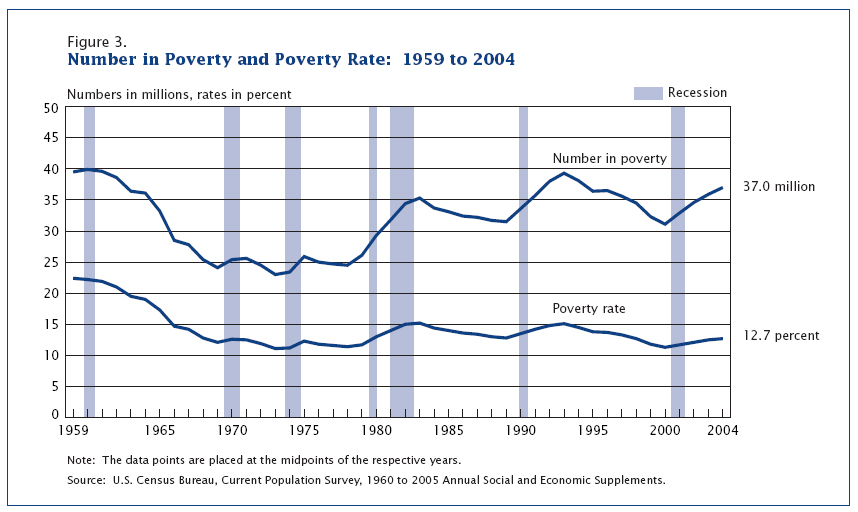
Obviously income never ticked up but somehow poverty did. The official poverty rate in 2004 was 12.7 percent, up from 12.5 percent in 2003. In 2004, 37.0 million people were in poverty, up 1.1 million from 2003. From the most recent low in 2000, both the number and rate have risen for four consecutive years, from 31.6 million and 11.3 percent in 2000 to 37.0 million and 12.7 percent in 2004, respectively.

In 2004, 45.8 million people were without health insurance coverage, up from 45.0 million people in 2003.

Was this really a recovery? If so for who? If this was supposed to "trickle down" I think somehow it "trickled up" instead.

Health insurance costs have skyrocketed, but fewer are insured. Is that supposed to happen in a recovery?

That final chart should be the clincher. Housing defaults have risen for four straight months and "cures" (those that were delinquent but have now caught up) have declined for six straight months.

Sad to say, but as pathetic as this recovery was (and it was pretty pathetic), it is now over. Housing has likely peaked and one million out of work people in New Orleans and skyrocketing gasoline prices likely just tolled the final bell for this trainwreck. The only open questions are: Will the New Orleans trainwreck cause the FED to pause sooner than it would have, and if so will that delay the recession until 2007. I think the first is likely but the second is not.

Mike Shedlock / Mish
http://globaleconomicanalysis.blogspot.com/

Thursday, 1 September 2005

The Train They Call The City of New Orleans (Part 1)

It's time to discuss the good, bad, ugly, and the just plain stupid about what happened in New Orleans. We also need to look ahead at how this will impact our economy looking forward.

Before attempting to undertake that task, let me first send out some heartfelt condolences to anyone that has been touched by the tragedy we calmly name Katrina. Many people have lost their homes, businesses, livelihood, and even their lives in this tragedy. Anything that anyone can do to help out will be appreciated, probably in more ways than anyone of us not affected can imagine.

Let's first dispense with the good. This is easy because quite frankly there isn't any. Oh sure, some material supply company or some refiner stock you own might rise in price but at best that will be a temporary gain. Point blank, no matter what economic cheerleader clowns such as Joe Battaglia on CNBC are saying, there simply is no good that comes out of these disasters. If there was a net positive affect, we should all be wishing for more hurricanes.

If you want serious economic commentary I suggest following Paul Kasriel at the Northern Trust. This is what Kasriel had to say in Hurricane Katrina Had No Silver Lining!
Inevitably, some perky economic analyst is going to say that despite the death and destruction Hurricane Katrina visited on the poor souls who populate Gulf coasts of Alabama, Mississippi and Louisiana, it had a “silver lining” as it will stimulate economic activity via new building, clean-up, etc. Balderdash! Katrina contained no silver lining. Firstly, there is never any silver lining to the death and injury of human beings. Secondly, although there will be expenditures made to clean up the mess and rebuild damaged/destroyed structures, there will be other expenditures not made that otherwise would have. I doubt that folks will be going to the movies or on vacation as much now that they have to spend more on rebuilding. There will be a change in the composition of spending, not in its total. Government disaster aid represents a redistribution of income. So, the givers of aid spend less and the receivers spend more – net, net, a wash. Thirdly, there has been a loss of real wealth. Katrina represented accelerated depreciation. Structures and other tangible assets were destroyed. That means that the services or “income” these tangible assets produced – shelter, transportation – have disappeared. The production of capital assets entails the postponement of current consumption. So, some people are going to have to defer current consumption so that finite resources can be used to reproduce capital assets. If hurricanes or other natural disasters contained economic silver linings, we wouldn’t have to wait for Mother Nature’s serendipities. We could create man-made ones. Short of wars, which destroy not only physical capital but human capital, too, we could blow-up neighborhoods after giving residents a “heads up” to gather their mementos and vacate their homes. Wow! Think of all the economic activity we could generate. This concept of man-made disasters as good for the economy sounds silly, doesn’t it? No sillier than the analysts who will declare that there is an economic silver lining in Hurricane Katrina.
I doubt Paul Kasriel even had time to finish that piece before stupidity from Joe Battaglia and others was gushing from every orifice. Speaking of stupidity, let's now skip to the "Just Plain Stupid" section of tonight's commentary.

$Ben "Helicopter Drop" Bernanke, chairman of the Council of Economic Advisers and perhaps next in line to replace Greenspan as FED chairman had this to say:

"Even the worst-affected states like Louisiana and Mississippi should see some benefits in time". "Reconstruction will add jobs and growth to the economy".

Does anyone want "benefits in time"? Should we all be praying for such benefits? Bernanke is quite frankly clueless. What that means is that unless someone even more clueless can be found, he will most likely become our next FED chairman. Of course there could be an accident and someone competent might actually be nominated but I would not count on it.

Speaking on stupidity let's take a look at our priorities: This is what Walter Maestri, emergency management chief for Jefferson Parish, Louisiana; New Orleans Times-Picayune, had to say way back on June 8, 2004.

"It appears that the money has been moved in the president's budget to handle homeland security and the war in Iraq, and I suppose that's the price we pay. Nobody locally is happy that the levees can't be finished, and we are doing everything we can to make the case that this is a security issue for us."

"But the cost of the Iraq war forced the Bush administration to order the New Orleans district office not to begin any new studies, and the 2005 budget no longer includes the needed money".

According to the above link the US Senate was seeking to restore some of the SELA funding cuts for 2006. Lovely. We have wasted $300 billion in Iraq, with no end in sight, with no benefit to anyone but Halliburton and other companies on no-bid government contracts (and the president had to lie to get Senate approval to do it), and in the meantime we cut funds that might have save the City of New Orleans from devastation. Now if that is not the height of stupidity what is?

In 2001, the New Orleans district spent $147 million on construction projects. When fiscal year 2005 wraps up Sept. 30, the Corps expects to have spent $82 million, a 44.2 percent reduction from 2001 expenditures.

In The FEMA Phoenix an article about the Federal Emergency Management Agency (FEMA), the Washington Monthly reports:

Because FEMA had 10 times the proportion of political appointees of most other government agencies, the poorly chosen Bush [Sr.] appointees had a profound effect on the performance of the agency. Sam Jones, the mayor of Franklin, Louisiana, says he was shocked to find that the damage assessors sent to his town a week after Hurricane Andrew had no disaster experience whatsoever. "They were political appointees, members of county Republican parties hired on an as-needed basis....They were terribly inexperienced."...The difficulties of coordination seem to indicate we've returned to the bad old days where the FEMA administrator position is given away on the basis of political favor, rather than hard experience.

Gee it seems we did not have an exit strategy for either Iraq or New Orleans. Then again the FED does not have one for the housing bubble either. We just keep blowing bigger and bigger and bigger bubbles hoping for some kind of miracle down the road. It should be very clear by now that we have a genuine shortage of "exit strategies". I suggest Wall Steet hop on that idea since there is probably billions of dollars that can be made off it. The beauty of it all is that none of them even have to work!

Mish telepathically receives another question: What Hurricane forces were these levees designed to protect against? WOW. That sounds like a good question so let's take a look.

Here is a Q&A to the US Army corp of engineers .

Q.2 Why did the levees fail?
A.2. What failed were actually floodwalls, not levees. This was caused by overtopping which caused scouring, or an eating away of the earthen support, which then basically undermined the wall. These walls and levees were designed to withstand a fast moving category 3 hurricane. Katrina was a strong 4 at landfall, and conditions exceeded the design.

Q.3. Why only Category 3 protection?
A.3. That is what we were authorized to do.

Not doing that levee work makes you wonder what New Orleans might be like today if we'd been spending billions of dollars a month right here in the United States instead of Iraq. One can only wonder what else are we not doing that's going to do here but waste elsewhere that will eventually come back to bite us in the ass.

Bear in mind there is another side to this story so I will present it. Building on a flood plain in a hurricane zone is just plain stupid. New Orleans was a disaster waiting to happen. Now taxpayers are going to bail out another government stupidity and that stupidity is called flood insurance. There should be no government sponsored flood insurance. If people want it they should pay for it at market prices. It's high time we stop allowing the building in flood zones but if anyone insists, then it is high time it is 100% at their sole risk.

This disaster there is a perfect example of the hubris inherent in man trying to control nature. In attempting to control river flooding, we caused the destruction of flood plain marshes and islands that would have helped prevent the hurricane flooding that we saw. As a direct consequence of our attempt to control mother nature, New Orleans actually sinks a fraction of an inch every year. Over time that adds up.

DrStool on the CapitalStool had this to say
As a commercial real estate analyst, I would say for sure that NO will not be rebuilt.

There is nothing there to rebuild. It would be completely infeasible to rebuild tens of thousands of living units that do not pay enough rent to cover the cost of construction.

The Federal government is already broke. It cannot foot the bill for the hundreds of billions, perhaps trillion, that would be required to rebuild the areas that have been destroyed. First of all, they haven't even stopped the basin from filling up. Assuming they can solve that problem, just exactly how are they going to drain a huge lake that's below sea level, when the pumps have all been destroyed.

New Orleans is only part of the problem. There's Biloxi, Pascagoula, Mobile, Gulfport etc., etc. etc. As the magnitude of the problem and the fact of our inability to adequately cope with the idea of a couple million homeless refugees here within our own borders becomes clear, there will be a sober re-evaluation of what the future holds for all of us in the US.

New Orleans is ruin. It may forever remain a monument to man's monumental stupidity.
DrStool is a bit more pessimistic than me but he has a point. Unfortunately it is an unpopular point. Point blank there is no economic justification for rebuilding a city on a flood plain subject to not only river flooding but hurricane flooding. Furthermore, prevention of the former is at the expense of more damage down the road from the latter. The proper solution, that undoubtedly will not be taken since it makes economic as opposed to sentimental sense, is to keep New Orleans a port subject to periodic flooding by the river, remove the levees and let the river return the silt marshes that protect the city from hurricanes at the expense of more periodic river flooding. Only those structures that are safe from periodic flooding should be allowed to stay. Perhaps portions of New Orleans can be saved but anything that was 50% destroyed or more should be abandoned to nature. I say let’s rebuild, but do it somewhere else. Remember this was a category 4 storm when it hit not a category 5 storm. To attempt to rebuild New Orleans when it is sinking every year in such conditions is foolhardy. Like it or not, it’s time to cut our losses and move on.

Mike Shedlock / Mish
http://globaleconomicanalysis.blogspot.com/