Wednesday, 28 September 2005

Credit Card Delinquencies

The Associated press is reporting Overdue Credit Card Bills Hit Record High.
The scapegoat du jour is of course "high gas prices". Let's take a look:
High Gasoline Prices Blamed for Record-High Past-Due Credit Card Payments in Second Quarter

Charge it! That familiar refrain is producing an unwanted response for more Americans: Your bill is overdue! Surging energy prices, low personal savings and the higher cost of borrowing have combined to produce a record level of overdue credit card bills.
The American Bankers Association reported Wednesday that the percentage of credit card accounts 30 or more days past due climbed to an all-time high of 4.81 percent in the April-to-June period. It could grow in the months ahead, experts said.
The previous high of 4.76 percent came during the first three months of the year, in keeping with a generally steady rise over the past several years.

"The last two quarters have not been pretty," said Jim Chessen, the association's chief economist. "The rise in gas prices is really stretching budgets to the breaking point for some people," Chessen said. "Gas prices are taking huge chunks out of wallets, leaving some individuals with little left to meet their financial obligations."
Notice the period in question is from April to June. Without a doubt we are talking pre-Katrina and pre-Rita. When delinquencies from the hurricanes hit in the 4th quarter, it will not be a pretty sight at all.

Right now I am willing to guess that this rise in delinquencies is precursor to a huge impending jump in bankruptcy filings. The new bankruptcy reform act goes into affect in October and those who were sitting on the fence may now have decided to just get it done while they can. Anyone making that decision may as well stop paying all bills right here, right now.

Mish, what about the new minimum payment standards?
That's a good question so let's take a look at that too.

In accordance with a new Fed ruling that requires banks to adjust Minimum Payments to allow loan repayment in a "reasonable" period of time, MBNA (which will be part of Bank of America by the end of the year) is changing their Minimum Payment calculation As of December 1, 2005, from: $15, plus all interest and fees, ---- to 1% of the Balance, plus all interest and fees.

-> With a Balance of $25,000 at 10% interest --- the Minimum Payment rises 342% from $97.19 to $332.19.

-> With a Balance of $25,000 at 20% interest --- the Minimum Payment rises 231% from $179.38 to $414.38.

The new "reasonable" 100 month repayment period based on 1% per month is considerably shorter than the current repayment period that can take something like forever.

Mish tips his hat to Elroy on Silicon Investor for providing the above MNBA examples.

Let's backtrack for a second. Delinquencies are close to 5% which means that people can not even come up with a measly $15 + interest. Not that 1% is any great shakes but it sure seems to be a lot of extra dough for some that are struggling now. What happens when the minimum pay is a more reasonable 4% of the balance, plus interest, plus late fees? The rising numbers do not even include "hurricane stress". What happens after Katrina and after Rita? Millions of people were affected and hundreds of thousands are without jobs.

Rising delinquencies are a "flashing yellow light that we need to watch" said Lynn Reaser, chief economist at Bank of America's Investment Strategies Group.

I have a question for Ms. Reaser: Are you just going to watch them rise or are you going to do anything about it? If so, what?

Mike Shedlock / Mish
http://globaleconomicanalysis.blogspot.com/

Friday, 23 September 2005

Why Has Gold Been Soaring Recently?

The short answer is the yield curve is starting to widen, Congress is going on another spending spree, the market thinks rate hikes are nearly done, and the FED is likely to be printing more money for more government handouts. That combination is more important than a US$ that has somehow held together in the face of the above.

Let's take a look at the long version.

On Friday, Sept 16th, Bush rules out tax hikes to pay for Katrina.
President George W. Bush, facing alarm from conservatives over the soaring cost of post-Katrina rebuilding, said on Friday the U.S. budget could handle the expense and he would not raise taxes to pay for it.

"It's going to cost whatever it costs," Bush said at a joint news conference with Russian President Vladimir Putin as estimates circulated in Washington the cost could hit $200 billion, exceeding the cost of the Iraq war.

Responding to concerns among fiscally conservative Republicans, Bush said his administration would work with Congress to make sure the money was wisely spent and that he would look elsewhere in the budget to make offsetting cuts.

"But I'm confident we can handle it, and I'm confident we can handle our other priorities. It's going to mean that we're going to have to cut unnecessary spending," Bush said.

The president made clear raising taxes was not an option to help cover the costs.
"We got to maintain economic growth, and therefore we should not raise taxes," Bush said, noting Americans were already paying "a tax in essence" because of higher gasoline prices. "And we don't need to be taking more money out of their pocket."
I do not know about you but isn't "It's going to cost whatever it costs" just a little too nonchalant for something that might cost up to $200 billion? Given that we are still wasting money like mad in Iraq I doubt it catches the waste over there, but then again underestimating the stupidity of the government is seldom a wise thing to do.

As for "It's going to mean that we're going to have to cut unnecessary spending", gee don't we have a Republican Congress and a Republican president? Given that is the case, why is it we have "unnecessary spending" in the first place? Could that be because Bush has signed every appropriations bill ever sent to him? Where is this party of reduced government spending, smaller government proponents etc? Perhaps the simple explanation is that for all practical purposes we do not have either a Republican Congress or a Republican President.

The only person being honest was White House economic adviser Allan Hubbard who offered this comment: "There's no question that the recovery will be paid for by the federal taxpayer and it will add to the deficit".

Perhaps President Bush should get together with Tom Delay when it comes to "unnecessary spending". After all, on September 14, the Washington Times reports DeLay declares 'victory' in war on budget fat.
House Majority Leader Tom DeLay said yesterday that Republicans have done so well in cutting spending that he declared an "ongoing victory," and said there is simply no fat left to cut in the federal budget.

Mr. DeLay was defending Republicans' choice to borrow money and add to this year's expected $331 billion deficit to pay for Hurricane Katrina relief. Some Republicans have said Congress should make cuts in other areas, but Mr. DeLay said that doesn't seem possible.
At this point Mish has two questions:
  1. Mr. President is Tom Delay off his ever loving rocker or are you?
  2. Tom Delay is President Bush off his ever loving rocker or are you?
Clearly one of you is clueless. Which is it?
Given that the budget deficit before Katrina was over $330 billion, and given that president Bush has yet to veto an appropriations bill (or any bill for that matter), I vote that both Bush and Delay are clueless.

The Washington Time continues....
"This is hardly a well-oiled machine," said Rep. Jeff Flake, Arizona Republican. "There's a lot of fat to trim. ... I wonder if we've been serving in the same Congress."

American Conservative Union Chairman David A. Keene said federal spending already was "spiraling out of control" before Katrina, and conservatives are "increasingly losing faith in the president and the Republican leadership in Congress."

"Excluding military and homeland security, American taxpayers have witnessed the largest spending increase under any preceding president and Congress since the Great Depression," he said.
Meanwhile breitbart.com is reporting
Katrina Ushers in Return of Big Government
.
The era of big government is back. President Bush is presiding over what is sure to be the most expensive government relief and reconstruction operation in U.S. history.

With estimates of the federal tab ranging up to $200 billion for rebuilding New Orleans and other storm-ravaged Gulf Coast cities, Bush and his Republican allies in Congress are casting aside budget discipline.

Hurricane Katrina also opened the floodgates to proposals in Congress building on a host of long-cherished Republican themes. These include proposals for school vouchers for storm-displaced children, more federal support for "faith-based" organizations engaged in hurricane relief, as well as business-friendly "enterprise zone" tax credits for enterprises that rebuild in stricken areas and eased environmental and labor-protection requirements.

"The fact of the matter is when our nation faces these type of emergencies, it unfortunately requires us to deficit spend. It's nothing that anybody in Washington, or anywhere for that matter, likes to do but it's necessary," White House counselor Dan Bartlett said ahead of Bush's Thursday night speech to the nation.

Some fiscal conservatives are expressing alarm.

"It is inexcusable for the White House and Congress to not even make the effort to find at least some offsets to this new spending," said Sen. Tom Coburn, R-Okla. "No one in America believes the federal government is operating at peak efficiency and can't tighten its belt."

Government failures at the federal, state and local levels are being widely blamed for the anarchy and loss of life in the early days after Katrina slammed into the Gulf Coast on Aug. 29.

"Yet now everybody says government is the answer. It's baffling," said Ronald D. Utt, who studies federal public works spending for the conservative Heritage Foundation.
Mish apologizes for having more questions but here they are:
  1. Given that the era of Big Government is back, just when did it go away?
  2. Why should "faith based" organizations get any federal money?
  3. Why does it take a disaster to tighten one belt?
  4. Why not tighten ahead of time so money is there in case of a disaster?
  5. Government has proven without a doubt that it is the problem and not the answer so why is there more clamoring for more government now?
Briebart continues:
Sen. Edward M. Kennedy, D-Mass., proposed that Congress create a Gulf Coast Redevelopment Authority, modeled after the Tennessee Valley Authority, to oversee the reconstruction. TVA, created during the Depression as an independent federal agency, is widely credited with the revitalization of the seven-state Tennessee Valley region.

Other lawmakers have called for a domestic version of the Marshall Plan that helped revive Europe after World War II, or something akin to President Franklin D. Roosevelt's Work Projects Administration, which put millions of unemployed people to work mainly on road, bridge and dam projects during the Great Depression of the 1930s.
Obviously there is nothing like a disaster to get idiots chirping on both sides of the aisle. These people want to help. At least I think they do. But barring an unexpected and extremely unlikely mass rush of Congressional sanity, the best thing they can do is nothing.

On that note we should all be praying that Congress does nothing since Barrons is now asking Will Congress Bail Out Gulf Coast Bondholders?
House Speaker Dennis Hastert, the Illinois Republican, says that Congress is seriously considering a federal bailout of municipal bondholders affected by the vicious storm. Many cities and authorities that were in the path of Katrina may be unable to meet interest payments come Oct. 1, because they can't collect the taxes needed to meet these obligations. The federal government is mulling some kind of guarantee, valid through the end of 2006, that would keep the issuers from defaulting.

The bailout idea appears to have originated with the National Association of Bond Lawyers in its Sept. 7 letter to both the Department of the Treasury and the Internal Revenue Service (Re: Hurricane Katrina Relief and Rebuilding-Municipal Market Needs).

Bond lawyers quickly found allies in Louisiana Republican Rep. Jim McCrery and Mississippi Republican Sen. Trent Lott. McCrery says bondholders never anticipated Katrina and should get federal help.

Kotok has some problems with McCrery's logic. If Congress were to follow through, then it might create an implied federal guarantee for bonds issued by other high-risk communities, he says.

The perception that Uncle Sam would protect bond holders from Mother Nature would distort the market's risk-reward pricing mechanisms. In effect, all bonds in communities along the San Andreas fault or in Tornado Alley would trade as if fully protected against natural catastrophes. This would pave the way for projects that otherwise wouldn't be built.
Nothing like a bunch of bond lawyers asking for a Federal bailout because their clients underestimated the risks of a bunch of municipal bonds, is there? No doubt such a relief package will be stated to benefit Aunt Martha who has just one muni in her portfolio while the real beneficiary is some large bank holding thousands of those municipal bonds.

The worst problem is the moral hazard this would create for all municipal bonds. If the government is going to bail out every disaster and every bankruptcy then bonds have no implied risk and everyone will be jumping into to them.

NO! The very best thing Congress can do on this issue is nothing. Don't get your hopes up. When it comes to spending and big government this Congress and this President have no bounds.

Of course no story could be complete without the likely next FED chairman chiming in with a bunch of nonsense. Let's take a look at what $Ben "Helicopter drop" Bernanke has to say in this piece entitled Katrina's economic hit palpable.
Hurricane Katrina will hurt the U.S. economy in the short run but bright long-term prospects mean the Bush administration can push ahead with its reform agenda, a top White House economic adviser said on Thursday.

"In the shorter term, the devastation wrought by Hurricane Katrina will have a palpable effect on the national economy," White House economic adviser Ben Bernanke said in prepared remarks for delivery at the National Press Club. But he said private-sector forecasts were for healthy long-run growth.

Bernanke said the White House intends to continue pursuing policies that have make the economy able to withstand shocks and that will keep growth on track.

"These policies include making tax relief permanent, reducing the budget deficit by limiting spending, strengthening retirement and health security through efforts like
Social Security reform ... and enhancing energy security," Bernanke said.
Yep, nothing can stimulate gold more than cutting taxes while dramatically increasing spending. Those holding major positions in gold thank you Mr. Bernanke, President Bush, and Congress for a nice 1-2-3 punch.

If none of that has sacred you into gold yet, perhaps this will. In a nationally televised address, President George W. Bush said "As long as I sit in this chair, all future catastrophes will be planned by me."

Mike Shedlock / Mish
http://globaleconomicanalysis.blogspot.com/

Tuesday, 20 September 2005

Focus on the UK Consumer

According to the UK Guardian Remortgaging pushes lending figures to new high.
A boom in remortgaging boosted August's mortgage lending figures to the highest level since July 2004, and one of the highest on record, lenders said today.

The Council of Mortgage Lenders (CML) said total mortgage lending for the month had reached £27.5bn, an increase of 9% over the month and 4% more than in August 2004.

"The doom-mongers' prophecies look to have been wrong, as lending has continued to strengthen over the summer," said Michael Coogan, the CML's director general. "Although the market remains far from spectacular in terms of transaction numbers and house prices, the prospects of a significant market correction are receding.
The doom-mongers prophecies are wrong huh? Wrong about what? With fixed rate mortgages now averaging 5.23% and variable rate mortgages averaging 5.61% why wouldn't one expect to see a lot of refis? This is probably a good thing for mortgage loan originators and consumers but is this a good thing for bank profit margins? Does it mean that those proclaiming a collapse in spending were wrong? Hardly. What the doom-mongers have been prophesizing was that spending in the UK and the US was simply unsustainable. Now as housing prices in the UK are no longer supportive of consumption, we are finally starting to see some consumer pain.

According to ThisIsMoney.co.uk Credit card lending plummets with Consumers' enthusiasm for credit cards and loans waning as debt fears continue to quell their spending.
Spending on credit cards dropped by a record £146m in August according to the UK's banking industry.

It was the second time consumers paid off more on their cards than they spent this year following a £40m drop in net lending in April. Prior to that, the last fall in net card lending was 12 years ago, said the British Bankers' Association.

Demand for personal loans is also drying up, with figures from the Nationwide Building Society showing lending in the three months to the end of July was 8.2% lower than the same period last year.

The slowdown reflects the fact that banks have scaled back on the launch of cards offering 0% interest on balance transfers. Borrowers now usually have to pay a fee of up to £50 to switch balances to a new card.

Consumers are also becoming more concerned about their level of indebtedness as the UK debt mountain tops £1 trillion and the future of the economy remains clouded.

Although interest rates recently fell, there are persistent fears that Gordon Brown will have to raise taxes to fund his spending plans and this could impact on consumers' disposable income.

Nationwide said the demand for personal loans was led by a desire to consolidate existing debts and credit cards, with demand for straightforward purchase loans slowing down.
The Guardian is also reporting 34% of Britons are running out of money five days before payday.
A third of Britons are unable to make their wages last an entire month, with 34% running out of money five days before payday, research revealed today. As a consequence, the research claims, the average Briton spends 23 days every year living in the red.

The survey, carried out for the internet bank Egg, showed that of those who said they ran out of money before payday, 18- to 29-year-olds fared the worst, with cashflow drying up a full week before the wages hit their bank accounts. This adds up to 74 days a year, compared with 66 days a year for 30- to 50-year olds.
Those in Scotland who said they ran out of cash each month were the quickest to do so, spending an average of six days a month, or 73 days a year, with no money in the bank.

"A staggering 16 million Britons run out of cash each month and often resort to expensive overdrafts to make it through to payday," said Andy Deller, Egg's chief marketing officer. "Consumers can easily slip into the red each month if they don't have a clear figure of what they can afford to spend."

The bank said that this poor budgeting is proving expensive for consumers, who often borrow at an average overdraft rate of 12.6% and unauthorized rate of 24.3%. Almost a third of consumers paid an average £27 in penalty charges over the year.
This is not a "soft patch". This is a serious problem as people in the UK bought more house than they could possibly afford and consumption was supported only by rising home prices. The party is over in the UK and the party seems to be coming to a rapid close in the US as well. Meanwhile the FED is still hiking interest rates trying desperately to take away the punch bowl before it's too late. Unfortunately for the FED, it's too little too late to do any good. The punch bowl is already empty, and consumers are tapped out here too. The FED likes to deal with aftermaths rather than preventing bubbles in the first place. They will soon get a second chance.

Mike Shedlock / Mish
http://globaleconomicanalysis.blogspot.com/

Monday, 19 September 2005

Improprieties with Hoku Scientific?

Market Pulse:
Hoku Scientific shares soar on two upbeat broker notes

Shares of Hoku Scientific Inc. soared $1.51, or 24.7% to $7.63 in afternoon trading Thursday after two brokers started coverage on the company with an outperform rating. Piper Jaffray analyst Jesse Pichel said Hoku is one of the best-positioned component suppliers to the emerging fuel cell industry. Pichel said its proprietary technology has the potential to enable lower cost and better performing fuel cells, thus improving commercial viability. The analyst estimates Hoku is working in a stationary and automotive fuel cell market worth around $150 million in 2005, rising to around $2.6 billion by 2012. Over at Thomas Weisel Partners, analyst Kevin Monroe said the company will benefit from increased investment in alternative energy such as fuel cells because of high oil prices, political instability in oil-producing regions and increased efforts to reduce reliance on fossil fuels. Both brokers noted the company is benefiting from key funding development from companies such as Nissan or Sanyo, that are interested in Hoku's technology. As a result, the company is in a stable financial situation.

Two completely out of the blue coverages for little known Hoku Scientific?
On the same day?
Didn't this company Just IPO in July?
Yes I see that it did.
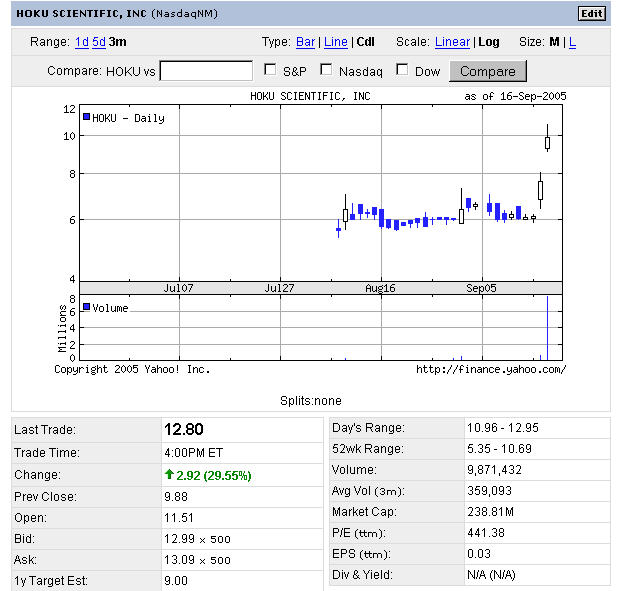
Here is the chart:


Normally I do not follow stocks like these and in fact I seldom even know about them. So why am I bothering writing about this? A quick look at who was involved in the IPO might answer that question (with thanks to BC on Silicon Investor for pointing it out to me). Let's take a look:

PROSPECTUS

Until _____ , 2005, all dealers that effect transactions in these securities, whether or not participating in the offering, may be required to deliver a prospectus. This is in addition to the dealers’ obligation to deliver a prospectus when acting as underwriters and with respect to their unsold allotments or subscriptions.

The underwriters named below have agreed to buy, subject to the terms of the purchase agreement, the number of shares listed opposite their names below. Piper Jaffray & Co. is acting as book-running manager for the offering and, together with SG Cowen & Co., LLC and Thomas Weisel Partners LLC, is acting as representative of the underwriters. The underwriters are committed to purchase and pay for all of the shares if any are purchased, other than those shares covered by the over-allotment option described below.

Piper Jaffray
SG Cowen & Co.
Thomas Weisel Partners LLC


Gee, Who coulda possibly thunk that?
That chart is rather interesting too.
Look at the volume.

As usual Mish has some questions:
  1. How many shares of Hoku Scientific do Piper Jaffray, and Thomas Weisel Partners LLC each have?
  2. Gaps up three days in a row. Who knew that coverage would be initiated at "outperform"?
  3. With a volume of over 7.5 million shares on each of the last two days someone had to know in advance that this was coming didn't they?
  4. Who told who what?
  5. How many shares did Piper Jaffray and Thomas Weisel Partners LLC buy in the last week or so?
  6. How many shares did Piper Jaffray and Thomas Weisel Partners LLC sell into this spike?
  7. What are the odds of two random upgrades on the same day on an obscure stock like Hoku?
  8. When is the SEC going to look into this kind of activity?
  9. Better yet, when is the SEC going to stop any possible improprieties from occurring simply by not allowing firms to have a vested interest in the companies they rate? Note: I asked nearly the same question about Moody's and Fitch here.
Seriously, when is the SEC going to put an end to this kind of nonsense?

Mike Shedlock / Mish
http://globaleconomicanalysis.blogspot.com/

Thursday, 15 September 2005

Thoughts on Savings (part 2 of 2)

Following is part two in a two part discussion about savings. This part will take a look at Ben Bernanke's viewpoint that there is a glut of savings and the problem is not that the US is spending too little but the rest of the world is not consuming enough. This part will also take a look at the growing national debt, the impact of Katrina, and offer some final comments of the cash flow of consumers. Here goes:

Is the problem that the US is spending too much or is the problem that the rest of the world is saving too much? Let's briefly consider the latter viewpoint. Ben "Helicopter Drop" Bernanke (affectionately known as $Ben for the rest of this article) suggests the problem with the US current account balance and growing indebtedness is a Global Saving Glut.

$Ben asks "Why is the United States, with the world's largest economy, borrowing heavily on international capital markets--rather than lending, as would seem more natural?"

In a self serving answer $Ben proposes:

"My answers will be somewhat unconventional in that I will take issue with the common view that the recent deterioration in the U.S. current account primarily reflects economic policies and other economic developments within the United States itself. To be more specific, I will argue that over the past decade a combination of diverse forces has created a significant increase in the global supply of saving--a global saving glut--which helps to explain both the increase in the U.S. current account deficit and the relatively low level of long-term real interest rates in the world today."

"One well-understood source of the saving glut is the strong saving motive of rich countries with aging populations, which must make provision for an impending sharp increase in the number of retirees relative to the number of workers. With slowly growing or declining workforces, as well as high capital-labor ratios, many advanced economies outside the United States also face an apparent dearth of domestic investment opportunities. As a consequence of high desired saving and the low prospective returns to domestic investment, the mature industrial economies as a group seek to run current account surpluses and thus to lend abroad."

$Ben proposes this solution:

"Some of the key reasons for the large U.S. current account deficit are external to the United States, implying that purely inward-looking policies are unlikely to resolve this issue. Thus a more direct approach is to help and encourage developing countries to re-enter international capital markets in their more natural role as borrowers, rather than as lenders."

$Ben concludes with:

"We probably have little choice except to be patient as we work to create the conditions in which a greater share of global saving can be redirected away from the United States and toward the rest of the world--particularly the developing nations."

Gee.
The answer to our dilemma is not for the US which has negative savings rate, consumes 25% of the world's oil supply, and goes deeper in hock every day to start consuming less, but for the rest of the world to start consuming more.

If deficit spending was the answer I am sure that many countries in Africa should by now be the most prosperous nations on earth. Besides, someone please tell me exactly what the US makes that anyone wants to buy. About the only thing I can figure out that we make that anyone wants is weapons. Yep, we make the worlds best. Unfortunately (or fortunately depending on your point of view), we will not sell those to China or many other countries in fact. Instead, China will end up buying weapons from France or Russia. Our agricultural exports depend on subsidies, and GM and Ford cars are a joke compared to cars from Japan and now South Korea. Besides, most of the parts and components in autos are not "made" in the US anyway. For the most part, all we do is assemble stuff here. If I am not mistaken, weapons really are made here.

No, $Ben the problem is NOT a global savings glut but a hollowed out US manufacturing base, bloated auto industries, refusal to sell the only really good products we make (weapons), and consumers willing to buy million dollar homes at zero % down ultimately financed by someone from Japan or China.

The prevailing line of thinking in this mess is that we are being financed by the "kindness of foreigners". Is that line of thinking correct? Perhaps we are being financed by the "cleverness of foreigners" who are willing to save while we spend ourselves into oblivion. I liken this to the fable of The ant the grasshopper.

In a field one summer's day a Grasshopper was hopping about, chirping and singing to its heart's content. An Ant passed by, bearing along with great toil an ear of corn he was taking to the nest.

"Why not come and chat with me," said the Grasshopper, "instead of working so hard?"

"I am helping to lay up food for the winter," said the Ant, "and recommend you to do the same."

"Why bother about winter?" said the Grasshopper; "we have plenty of food right now."

But the Ant went on its way and continued its work.

When the winter came the Grasshopper had no food and found itself dying of hunger, while it saw the ants distributing, every day, corn from the stores they had collected in the summer.

Then the Grasshopper knew:
It is best to prepare for the days of necessity.

Fables aside, let's now take a look at the reality of US government spending.
Following is the growth rate of the national debt limit:

In 2002 it was $450 billion.
In 2003 it was $984 billion.
In 2004 it was $800 billion.
In 2005 the House has passed an increase of another $781 billion, on which the Senate has yet to act.

Total that up and you get a stunning $3015 billion ($3.015 trillion) in additional debt in just four years. Not only do we have a negative person savings rate, but we also have Republicans spending like drunken fools, over $3 trillion was added to the national debt in a mere four years, a sitting president has not vetoed any spending bill (or any other bill for that matter during his entire term), and $Ben Bernanke suggests the problem is not with the US but rather the rest of the world is saving to much! That brilliant thinking is coming from the man who is the leading candidate to replace Greenspan as our next FED Chairman.

David S. Broder discusses the growing national debt and more in a Washington Post article entitled A Price To Be Paid For Folly. Here is a snip:

In August, when the Congressional Budget Office lowered the deficit forecast to $331 billion, Republican Rep. Jim Nussle of Iowa, the chairman of the House Budget Committee, said, "We're clearly on the right track.

These judgments were faulty at the time. They made no provision for the continuing costs of the war in Iraq, or for the Republican plan to end the estate tax and make all the previous Bush tax cuts permanent. And, most of all, they did not realistically calculate the costs of the new Medicare prescription drug benefit and the looming obligations to the millions of baby boomers who are nearing retirement age.

Now those pre-Katrina estimates have been rendered even more ridiculous. In the first 10 days since the storm hit, the president asked Congress for emergency appropriations of $62 billion -- and the bills are just starting to come in.

Treasury Secretary John Snow reportedly told congressional Republicans in a closed meeting that Katrina strengthens the case for making the Bush tax cuts permanent.

The warning signs of impending economic calamity are every bit as evident as the forecasts of ruin for New Orleans when a major hurricane hit.

The runaway budget deficits are compounded by the persistent and growing imbalance in our trade accounts -- jeopardizing the inflow of foreign funds we have used to finance our debt.

At a private dinner the other evening where many of the men and women who have steered economic and fiscal policy during the past two decades were expressing their alarm about this situation, one speaker summarized the feelings of the group:

"I think it's 1925," he said, "and we're headed for 1929."

Apparently Snowjob thinks the more money the Government gives away the more taxes should be reduced. Other than Ron Paul, is there a fiscal conservative left to be found anywhere?

There is one good thing that just might come from Katrina. My hopes are not all that high actually given the total recklessness of this Congress and this administration, but perhaps Katrina may force someone to decide whether or not to keep wasting money in that bottomless pit known as Iraq vs. wasting money in the US with insurance handouts to companies that neither need handouts or deserve them. At least in the latter case it is robbing Peter to pay Paul. The former is just blatantly throwing money into an external sink hole.

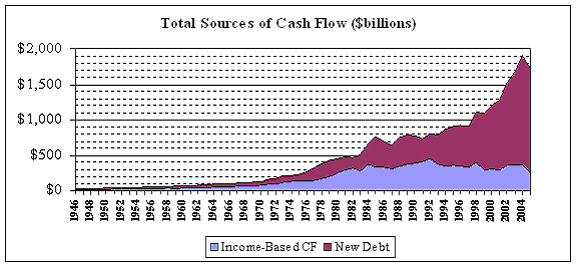
On that note, let's return for a final look at the consumer side of the savings problem. Following is a nice graph of consumer cash flows by Stephen Church as presented Prudent Bear. Let's take a look and see what Stephen Church has to say as well.


Church writes:
The analysis of the sources and uses of consumer cash flow shows that new household debt has become the main source of new cash for financing consumer uses of cash.

Cash flow generated by consumer income producing activities is not sufficient to cover required debt repayments. Consumers must borrow new funds, in aggregate, in order to meet debt repayments and to make personal and residential investments.

An analysis of the uses of cash flow indicates that even the most minimal investment, residential construction, debt repayment and consumer liquidity requirements will lead to new borrowings totaling about 11% to 12% of GDP.

A scenario analysis of these financing requirements did not indicate any obvious short-term way to reduce this level of debt financing without effecting economic activity. The scenario analyses indicate that reductions in consumer liquidity would be the only reasonable path by which the economy could begin adjusting these financing needs.

It is not clear that even reducing consumer liquidity would be sufficient to support the process of slowing debt accumulation. It appears more likely that any attempt to reduce the growth of debt could result in an underperforming economy.

The scenario analysis left open a tantalizing opportunity to manage the transition to a stable economy with lower annual debt financing. The rate of growth of personal consumption expenditures would need to decline significantly while the rate of growth of personal income stayed near its current level.

The only way that we can envision this would be a managed deflation transferring corporate profits to households through price reductions on goods and services. Though this would lower profits appreciably, it would also enable the economy to cut household debt financing needs to reasonable levels.

Other than our tantalizing possibility, we were unable to identify any reasonable path of reducing the growth of household debt. The sources and uses of cash flow indicate that households are completely dependent on access to new debt.
Thanks Stephen for an excellent chart and commentary. Given that one can not perpetually refinance one's house to support consumption something clearly has to give. What has to give actually is the US standard of living. Regardless of what anyone might think, we simply can not sustain ourselves by borrowing to support consumption based on the concept of ever rising home prices. Somehow Wall Street has not caught on to this simple concept or if it has it just wants one hell of a last party before things crash.

The transition that Church envisions (a transfer of wealth via declining prices on goods and services) sure will not be a smooth or an easy one. It will also be resisted. There certainly will not be a voluntary redistribution of wealth from creditors to debtors. Given that resistance, a slow deflationary torture like Japan endured would appear to be a more likely possibility than a sudden massive purge of debts via bankruptcies. The new bankruptcy reform act (designed to make people debt slaves forever) reinforces that concept. Given that hyperinflation would "end the game" I do not believe that is a realistic possibility.

Regardless of the actual endgame or the timing of it, what we do know is that negative or even 0% savings are not sustainable, nor is the balance of trade, and nor is US government spending. Something will give. That something is some combination of a lower standard of living, a higher savings rate, a falling US dollar, and lower equity prices. My guess is we see all of those. The timing could hardly be worse as baby boomers face an upcoming retirement in mass. Those that are not prepared for such a brutal combination of possibilities are likely to be in for one rude awakening.

Mike Shedlock / Mish
http://globaleconomicanalysis.blogspot.com/

Wednesday, 14 September 2005

Thoughts on Savings (part 1 of 2)

Following is part one in a two part discussion about savings. This part will take a look at what savings are, some charts and other supporting evidence of the unsustainable nature of a US savings rate that has now gone negative. Part two will take a look at Ben Bernanke's viewpoint that there is a glut of savings and the problem is not that the US is spending too little but the rest of the world is not consuming enough. Note: Ben Bernanke is Chairman of the Council of Economic Advisors and possibly next in line to replace Greenspan. Part two will also take a look at the growing national debt, the impact of Katrina, and offer some final comments of the cash flow of consumers. Be sure and stay tuned. Here goes with part one:

Someone recently told me he was saving by contributing to his 401K.
Another person told me he was saving by paying off his home mortgage quicker.
Both of those may be wise decisions but are they savings?

In the strictest definition, savings are that part of your production that is in excess of your consumption. Money is merely a means of channeling, or storing your saved production. Once you've exchanged your real savings for money and go on to invest, you have replaced your savings with investment, while transferring the claim to your savings to someone else.

Under that definition it is clear that paying down one's house mortgage or paying off credit card debts or investing in the stock market is simply not saving. That does not imply these are bad ideas, it just means they are not savings.

Frank Shostak discusses this concept in Have We Saved Enough? Let's take a look:
If a baker produces ten loaves of bread and consumes one loaf his saving is nine loaves of bread. In other words, saving is the baker’s real income (his production of bread) minus the amount of bread that the baker consumed. The baker’s saving now permits him to secure other goods and services.

For instance, the baker can now exchange his saved bread for a pair of shoes with a shoemaker. Observe that the baker’s saving is his realmeans of payment—he pays for the shoes with the saved bread. Likewise, the shoemaker pays for the nine loaves of bread with the shoes that are his real saving.

The introduction of money doesn’t alter what we have so far said. When a baker sells his bread for money to a shoemaker, he has supplied the shoemaker with his saved unconsumed bread. The supplied bread sustains the shoemaker and allows him to continue making shoes. Note that the money received by the baker is fully backed up by his unconsumed production of bread.

Money enables the goods of one specialist to be exchanged for the goods of another specialist. In short, by means of money people can channel real savings, which in turn permits the widening of the process of real wealth generation.

Now what about the case where money is used to buy unprocessed material—is the unprocessed material real saving? The answer is no. The raw material must be processed and then converted into a piece of equipment, which in turn can be employed in the production of final goods and services that are ready for human consumption. In this sense the buyer of unprocessed material transfers his claims on real savings to the seller of material in return for the prospect that the transformed material some time in the future will generate benefits far in excess the cost incurred.
If I quoted everything of merit in that article I would be reproducing it in its entirety. The concept is important so I suggest it is a worthwhile read. Before continuing on, let's quickly point out that expansion of money supply, whether or not that money ends up in "savings accounts" is not savings either. That concept can easily be proven by adding a extra zero to everyone's paycheck and of course to the cost of goods as well. Savings have not increased, only the denomination on money has. When it comes to home prices, what good does it do you if your home has doubled in price when a replacement home will have doubled in price as well? Of course this does not even delve into the very real possibility that asset prices just might drop.

Stephen Roach discussed savings on September 9th in an article entitled The Shoestring Economy . This is one of his better articles as of late and following are the highlights:
Never in modern history has the world’s leading economic power tried to do so much with so little. A saving-short US economy has long pushed the envelope in drawing on foreign capital to subsidize excess consumption. But now Washington is upping the ante as it opens the fiscal spigot to cope with post-Katrina reconstruction at the same time it is funding the ongoing war in Iraq. Could this be a tipping point for America’s shoestring economy?

For any economy, saving is emblematic of the willingness to defer current consumption in order to invest in the future. America’s problem is that it no longer saves. Its net national saving rate -- the combined saving of individuals, businesses, and the government sector (all adjusted for depreciation) -- has fallen to a record low of only 1.5% of GNP since early 2002. By contrast, this same national saving rate averaged 7.5% over the 40-year period, 1960 to 2000. Unwilling to cut back on investment, a saving-short US economy has become increasingly dependent on surplus foreign saving in order to grow.

Asset-dependent consumers were running a negative personal saving rate to the tune of -0.6% of disposable personal income in July 2005. Not since the Great Depression of the early 1930s have US households been stretched that far. Yet, today, few seem worried about this development. Conventional wisdom has it that “rational” consumers have uncovered new and permanent sources of saving in the form of rapid asset appreciation -- first equities and now homes. .... The American consumer is on the leading edge of the shoestring economy.

The government sector is in a similar position. So far, the Bush Administration has hit Congress with $62 billion in supplemental spending requests in the immediate aftermath of Katrina. The risk is that these disaster-relief appropriations are only a down-payment on the final tab, which eventually will span the gamut -- from infrastructure repair and reconstruction of housing and commercial areas to massive environmental clean-up efforts. In the politically-charged post-Katrina environment, any semblance of fiscal discipline has vanished into thin air. Next year’s federal budget deficit is currently projected at -2.4% of GDP; a conservative estimate of a post-Katrina budget could easily push that figure into the -3.25% to -3.5% range -- virtually identical to peak cyclical shortfalls hit in 2003-04.

One of two things has to happen -- either the US attempts to maintain its current lifestyle and places a greater claim on surplus saving elsewhere in the world or there is a consolidation of discretionary spending by American households and businesses, alike.

The macro conclusions are inescapable: A saving-short US economy that runs a massive current account deficit is effectively living beyond its means. It not only relies on foreign saving to fund domestic growth, but it also lacks the capacity to invest in public goods that may be needed to safeguard its future. Lacking in domestic saving, the shoestring economy is also biased toward chronic under-investment in infrastructure -- leaving itself vulnerable to “breakage.” Whether that breakage comes from within (i.e., Katrina) or from the outside (i.e., terrorism), the shoestring economy runs the risk of being unprepared to ward off such blows in a fragile and dangerous world. An energy shock exacerbates the imbalances that produce such vulnerability. This draws into serious question the resilience that financial markets now seem to be banking on.
According to the US bureau of economic analysis for the month of July, personal income increased $29.3 billion, or 0.3 percent, and disposable personal income (DPI) increased $27.2 billion, or 0.3 percent. Personal consumption expenditures (PCE) increased $85.7 billion, or 1.0 percent. In June, personal income increased $54.7 billion, or 0.5 percent, DPI increased $45.9 billion, or 0.5 percent, and PCE increased $88.0 billion, or 1.0 percent, based on revised estimates.

In plain English, disposable income went up $27.2 billion (.3%) but spending went up $88 billion (1%). Here it is in chart form:


Here are the interesting highlights
  • Private wage and salary disbursements increased $29.4 billion in July, compared with an increase of $17.9 billion in June.
  • Personal outlays -- PCE, personal interest payments, and personal current transfer payments increased $86.8 billion in July, compared with an increase of $92.8 billion in June. PCE increased $85.7 billion, compared with an increase of $88.0 billion.
  • Proprietors' income decreased $3.5 billion in July, in contrast to an increase of $14.7 billion in June.
  • Farm proprietors' income decreased $0.5 billion, compared with a decrease of $0.8 billion.
  • Nonfarm proprietors' income decreased $3.0 billion, in contrast to an increase of $15.5 billion.
  • Rental income of persons decreased $3.3 billion in July, compared with a decrease of $4.3 billion in June.
  • Personal income receipts on assets (personal interest income plus personal dividend
  • income) increased $7.8 billion, compared with an increase of $18.0 billion. Personal current transfer receipts decreased $4.2 billion, in contrast to an increase of $5.6 billion.
  • Contributions for government social insurance -- a subtraction in calculating personal income increased $3.6 billion in July, compared with an increase of $2.1 billion in June.
This is the bottom line:

Personal saving , disposable personal income less personal outlays was a negative $58.8 billion in July, in contrast to a positive $0.9 billion in June. Personal saving as a percentage of disposable personal income was a negative 0.6 percent in July, compared with 0 percent in June.

Negative personal saving reflects personal outlays that exceed disposable personal income. Saving from current income may be near zero or negative when outlays are financed by borrowing (including borrowing financed through credit cards or home equity loans), by selling investments or other assets, or by using
savings from previous periods.

Not only are we not saving, we are now borrowing simply to support consumption.
On that note Mish is taking telepathic questions. Hmmm questions just came pouring in. Let's address them while the telepathic lines are still open.

Q1) Mish has the US always been a nation of spending fools?
A1) No, as hard as it might be for some to remember, as recently as 1992 the savings rate is the US was as high a 10%. Here is a chart to prove it.


Q2) Mish what does retail spending look like now as compared to historical growth?
A2) It seems as if we are now treating our houses as ATMs since wage growth is not keeping up. I offer this chart as evidence.


Q3) Mish is there any evidence of consumer stress as a result of all this spending?
A3) Yes indeed there is. We are finally starting to see a big uptick in mortgage defaults and delinquencies. As long as home prices allowed equity extraction everyone was OK. Unfortunately it now seems that appreciation has not kept up with expenditures. I offer the following chart as proof.


Note that PMI defaults bottomed in April but have ticked up every month since then. Also note that cures (those that were in delinquent but managed to catch up), topped in February and have been declining ever since. This is a clear sign that rising home prices are no longer sustaining consumption at least in some areas. Watch what happens when housing prices take a serious hit in California or Florida. It will not be pretty.

Mike Shedlock / Mish
http://globaleconomicanalysis.blogspot.com/

Tuesday, 13 September 2005

New Orleans is Broke

Amist grim reporting that owners of a nursing home were charged in the deaths of dozens of patients comes the official news that New Orleans is broke.

Mayor C. Ray Nagin warned that the city is broke, unable to make its next payroll. The mayor also said the city was working "feverishly" with banking and federal officials to secure lines of credit through the end of the year.

Mike Shedlock / Mish