Thursday, 6 October 2005

The Wisdom of Richard Fisher

Back on June 13 in Stupid Comments by the FED, we took a look at (and blasted) some comments made by Richard Fisher, president and CEO of the Federal Reserve Bank of Dallas, and a new member of the FOMC.

Here is a short recap:
  • Where would the world be if Americans did not live out their proclivity to consume everything that looks good, feels good, sounds good, tastes good?
  • We provide a service for the rest of the world. If we were running a current account surplus or trade surplus, what would happen to economic growth worldwide and what would be the economic consequences? So I think we are doing our duty there.
Those quotes will likely go down in history as some of the dumbest things a FED governor have ever said. This guy is really quite amazing, and he is seriously challenging $Ben "Helicopter Drop" Bernanke for all time stupid FED comments.

Back in June Fisher was talking Baseball when he made these comments:

"I think we've room to tighten a little bit further but the U.S. central bank is in the eighth inning of its tightening cycle and entering the ninth, and usually final, inning this month."

Fisher was yapping again today, October 4th, and given that the baseball playoffs recently started I was hoping for some hot baseball tips. Specifically I wanted to know his opinion on the Chicago White Sox vs. the St. Louis Cardinals. From what I have seen, his opinions on baseball can not possibly be any worse than his economic thoughts as a FED governor.

Given that we were in the 8th inning in June and have had two more rate hikes since then, it seems clear to me we are now in "extra innings". Surely something exciting as extra innings should deserve some kind of comment but alas none came. I was distraught when Fisher could not muster up a single comment about what inning we are in.

Instead of baseball, Fisher was yapping about football. "I traveled to College Station this weekend to watch the Aggies eke out an overtime victory against the Baylor Bears. Before watching those two teams from storied Texas universities go at it hammer and tongs, I spent a couple of hours with the Aggie Corps of Cadets. After the game, I heard that the Texas Longhorns had walloped Missouri.".

Those comments came when Fisher spoke before The Greater Dallas Chamber Economic Forum. He also offered A Perspective on the Economic Outlook. Let's tune in to his economic outlook:
From an economic standpoint, Katrina and Rita have left their marks on Texas. Some state firms lost inventories. Others lost customers that were in the supply chain for the impacted area. The state budget has also taken a hit. A total of 265,000 evacuees fled to Texas, and many have no home to return to. More than 45,000 evacuee students have enrolled in Texas public schools—about 1 percent of total Texas enrollment. Another 10,000 to 15,000 students may be in the pipeline. The fiscal burden for evacuees in public schools could be $335 million to $432 million, assuming the evacuees remain in Texas for the entire school year.

Other negatives for Texans include increases in the costs of doing business. Rebuilding efforts will push up prices for construction materials. Many industries are likely to encounter higher fuel, freight, utility and transport costs—a heavy burden for those sectors, like airlines, already facing hardships. Consumers will have to pay more for winter heating bills and possibly gas at the pump, so they may have less to spend at retail stores and restaurants.

Yet, even with these drags on the economy, it appears that the hurricanes’ net effect will be slightly positive for Texas.
Obviously Fisher is yet another proponent of the "Broken Window Fallacy". If two hurricanes were good for Texas, three must be better. Right? Perhaps Fisher believes the real problem with Rita was that it did not break enough windows. For those not familiar with the concept, I highly recommend reading the Parable of the broken window.

At this point I must issue a staunch warning to my friend and fellow Daily Reckoning writer, the Mogambo Guru. Mogambo, if per chance you are tuned in I have a duty to tell you to have a stiff drink (or three) before reading any further. I would hate to be responsible for causing some kind of Mogambo Consternation.

With that warning, Fisher went on to say:
  • The Federal Reserve has staunchly resisted monetizing deficits for more than a quarter century, and I feel strongly that it can ill afford to monetize them today.
  • I will never vote to monetize fiscal profligacy. And while I never speak for my colleagues, it is my distinct impression that none of them will do so either.
  • When it comes to accommodating inflation, central bankers everywhere have become, to quote my late, great father-in-law, Jim Collins, "tighter than a new pair of shoes".
The FED has staunchly resisted monetizing deficits for more than a quarter century?! The FED has been "tighter than a new pair of shoes"?! Is that tightness what brought about a parabolic increase in money supply and 1% interest rates? Is this clown serious?

Fisher did make two comments that are totally 100% believable:
  • Five years ago, Chairman Greenspan told his colleagues at the FOMC that Information Age technology had begun rewriting the operations manual for the economy. "We really do not know how this systems works," he said. "It’s clearly new. The old models just are not working."
  • I believe the same can be said of globalization today: We really do not understand how globalization works.
Finally, I leave you with these Fisher comments:
  • No government anywhere in the world can go on taxing and spending as if it is still operating in yesterday’s economy. If the United States is to remain an economic colossus, its fiscal authorities, like its central bankers, will have to become paragons of prudence and restraint, implementing policies that will put the nation in a position to bolster, not hamper, its competitive edge.
  • The FOMC has taken note of the fiscal situation, as shown by this pre-Katrina passage from the released minutes of the Aug. 9 meeting: “Few signs were evident that greater fiscal discipline in the budget process would emerge any time soon.”
  • Business is risky enough without the additional uncertainty created when a nation’s unit of account—in plain language, its money is undermined.
Truer words were never spoken but unfortunately the evidence is clear that Fisher has no idea what he even said. Our money right now is undetermined, backed by nothing and printed at will. Congressional spending is running amok and the purchasing power of the US dollar is based only on the faith of those willing to accept it.

It is clear to me that Fisher was arguing for a return to the gold standard.
Unfortunately he doesn't have the slightest clue about what he was really saying.

Mike Shedlock / Mish
http://globaleconomicanalysis.blogspot.com/

Tuesday, 4 October 2005

Will the Housing Bubble Fizzle or Pop?

The S&P reports Regional Housing Bubbles Vulnerable, then asks the follow up question: Will they fizzle or pop? Let's have a look.
With housing prices continuing to outpace both income and inflation from coast-to-coast, it is hard not to see a housing bubble, according to a comprehensive report published today in Standard & Poor's CreditWeek. The report looks at the implications of the bubble for builders, bankers and owners in the US and abroad, as well as in the structured finance and REITs markets, from both the credit and equity perspectives.

"If the past is a guide," says S&P Chief Economist David Wyss, "home prices in the U.S. are less likely to crash nationwide than to stop accelerating and then stabilize until incomes catch up with unsustainably high mortgage debt. This happened after home price spikes in the late 1970's, and again in the late 1980s. The coming rebalancing period could last half a decade, because it will take a 20% correction nationally to restore the normal ratio of home prices to income."

Echoing a similar theme abroad, Standard & Poor's senior economist in Europe, Jean-Michel Six, forecasts an orderly slow down in house price inflation in Europe, owing to a combination of demographic, financial, and structural factors, with a soft landing likely in the UK and near-term overheating in Spain.

"While the overall outlook may be reasonably benign," Mr. Wyss continued, "there's a regional danger: the possibility of deeper, more disruptive corrections in the most overvalued markets. In urban areas on both coasts, for instance, housing costs have risen 30% or more above the normal home price-to-income ratio - all the more alarming considering that in these regions this ratio was about twice the U.S. average before prices soared. This could make such places particularly vulnerable to economic shocks or rising interest rates."
The economists at the S&P seem to be parroting the consensus view:
1) The overall outlook is benign
2) There is no national housing bubble
3) There are indeed regional housing bubbles
4) There will be a housing soft landing in both the UK and the US
5) The only real problem is in the most bubbly areas on the coasts

Wyss did attempt to give himself an out by mentioning a "possibility of deeper, more disruptive corrections in the most overvalued markets" but his overall "benign" view seems to me to be the equivalent of the "permanently high plateau" theory. It is based on his interpretation of "prior history" but more importantly on a belief in rising incomes. "If the past is a guide, home prices in the U.S. are less likely to crash nationwide than to stop accelerating and then stabilize until incomes catch up with unsustainably high mortgage debt."

Well judging from the experience in Japan, if past history is any guide, US home prices will sink for the next 18 years. Since there are differences between Japan and the US let's instead focus on the income side of the statement.

Are incomes likely to catch up to "unsustainably high mortgage debt"? I think not.
  • We are losing manufacturing jobs.
  • We are outsourcing technical jobs.
  • We are gaining service jobs at Walmart, Pizza Hut, and retail outlets.
  • Pension plans are going under (United Air, Northwest Airlines to name two), and auto pension plans at Ford and GM are under attack.
  • 50% of the jobs gained in this recover were related to housing expansion. What happens to those incomes if housing so much as slows?
  • Will pay raises at Walmart catch up with mortgage debt? When?
  • What about rising energy costs and peak oil? When will wages catch up to those costs?
  • What about those on ARMs whose mortgage costs will start rising dramatically in 2006 and 2007 from low teaser rates?
  • What about rising property taxes and increased medical expenses, or does the S&P suggest that such items are not a concern?
Mish wonders what the economists at the S&P are smoking when they think that rising wages will catch up to the absurd home prices in the bubble areas in any sort of likely "soft landing". We are three years into a recovery and real wages in general are still declining. Demand for housing as suggested by rising inventories is now slackening at the same time. Demand for gasoline even seems to be recently declining. What about real estate sales commissions if home sales even modestly decline? What about other sales commissions if retail spending slackens? Is Wyss aware that there is an 18-1 or 20-1 wage differential with China that is putting pressure on jobs, wages, and benefits? Under what logical scenario will overall wages finally start rising now, this far into a recovery? The only way I can see wages rising is if the bubble keeps inflating. All that would do would be to postpone the problem and make it bigger in the long run.

Note too, that the S&P also seems to be discounting the affects of Katrina as well as any upcoming recession. Perhaps the economists at the S&P think that the spend and spend policies of this Congress and this administration have forever eliminated the business cycle as well. Who knows? Whatever they are smoking sure is powerful stuff.

I do not buy this "permanently high plateau" nonsense or any talk of a miracle "soft landing" either. Nor do I accept that the business cycle has been defeated and there will be no more recessions. The next consumer led recession is going to be a doozie and along with it will come a severe strain on home prices. The upcoming correction is likely to be dramatic in terms of price action or length of time or both. It may come about as a very long painful slow leak (the Japan scenario), or some sort of faster price crash. I think the latter is the most likely scenario, perhaps in a sloping stairstep fashion. The least likely ending is the widely held fairy tale belief that wages keep rising, jobs will be plentiful, the business cycle is defeated, and "everyone lives happily ever after".

Mike Shedlock / Mish
http://globaleconomicanalysis.blogspot.com/

Monday, 3 October 2005

Strong September ISM?

CBS Marketwatch reports ISM factory index up in September. Hurricane Katrina sparks higher prices and new orders.
Instead of depressing activity, there was a rush of new orders from manufacturers concerned about losing supplies. In addition, prices shot up as those manufacturers appeared willing to pay top dollar for the goods they needed.

The ISM index rose to 59.4% in September from 53.6% in August. Read full survey. This is the highest level since August 2003 and well outside of expectations.

The consensus forecast of estimates collected by MarketWatch called for the index to slip to 52.1 % in the wake of Katrina. See Economic Calendar.

Economists were cheered by the headline, which they said alleviated some concern about the national impact of the two hurricanes that struck the Gulf Coast in the past two months.

"This data supports the Fed's view of Katrina," said Drew Matus, economist at Lehman Brothers.

The Fed said Katrina would only have a near-term impact on growth, and officials have been warning the market that the Fed is committed to hiking rates at a measured pace.
Were those strong ISM numbers for September? The Marketwatch headlines would have you believe so. Mish, is there another explanation? Yes indeed there is and the article mentions it but beats around the bush. I can sum it up in a single word: hoarding. Let's take a look.
But the ISM said some of the surprising strength might be temporary as it represented a scramble of manufacturers to maintain a steady stream of supplies.

Norbert Ore, chairman of the ISM survey committee, said Katrina sparked new orders as manufacturers sought to lock in materials that they feared might become in short supply. In some instances, manufacturers had to place two or three orders to get their regular supply.

The new orders index rose to 63.8% in September from 56.4% in August. The price index soared to 78% from 62.5%.
Fearing a short supply, factories locked in supplies at soaring prices.

The bond market reaction to these numbers may force yet two more rate hikes out of the FED this year. Consumer sentiment is already in the gutter and consumer sales are slowing. SUV sales are anemic. It is unlikely that additional rate hikes are going to lift consumer sentiment any. The question remains whether or not this hoarding is going to prove warranted based on forthcoming demand. I believe it is not.

Mike Shedlock / Mish
http://globaleconomicanalysis.blogspot.com

Sunday, 2 October 2005

Faith Based Financing

Bill Fleckenstein is reporting Empty houses, falling prices, and the end of a boom. For one homebuilder it seems that "Faith Based Financing" has gone to hell. Let's take a look at what Bill Fleckenstein is saying:
You can see how the housing bubble is bursting in places like Columbus, Ohio, where builders and lenders threw common sense away and enticed people to buy homes they couldn't afford.

In June, I suggested that Time magazine's cover story, "Home Sweet Home: Why We're Going Gaga Over Real Estate," might be signaling the peak. It's looking more and more like June was the peak (witness last week's disappointing new-home sales, pre-Katrina), as various problems begin to surface around the country.

Turning to one such place, I am indebted to a reader of my daily column, who forwarded a copy of the Sept. 19 Columbus Dispatch. It ran a thorough article on the plight of a couple in the Galloway Ridge subdivision in suburban Columbus and also shed light on some financing techniques that get folks into trouble. The article, "Suburban Blight," singled out Dominion Homes (DHOM) for enticing people to reach too far. Allow me to share a few quotes:

"Big dreams filled Rick and Christy Alonso when they bought their new house from Dominion Homes. Start a family. Build equity. Move to a larger house. But six months later, their suburban neighborhood on the Far West Side began to deteriorate. New houses suddenly emptied. Thistles and dandelions overran lawns. Neon orange labels appeared in windows, signaling foreclosures."

"Nearly a third of the Franklin County houses and condominiums built since 1998 that have been listed for sheriff's sales involved Dominion buyers." Further, the company is cited for its loan violations: "In 2002 and 2004, HUD randomly selected 42 Dominion loans and found violations in 22 cases, some of which had more than one problem."

Sometimes folks who are on the innocent side wind up getting hammered. (It's not always greed that leads to destruction. Often, just being naive will do it.) Though the Alonsos hadn't planned on spending more than $140,000, a Dominion salesman showed them how they could buy a house for $189,900, of which they financed $187,500. The family was able to shoe-horn into the loan with a creative financial package.

Meanwhile, the Alonsos were given a low estimate for property taxes, and when they got their first payment notice, the tax increase really stung: "'I about croaked,' said Mrs. Alonso." Of course, increasing property taxes hurt their neighbors, too. As of a month ago, 10% of the houses in the Galloway Ridge development, were either in foreclosure or had gone through foreclosure.

The Alonsos now find themselves with a house that cost $189,900 in 2001 and now can't be sold for that price. The real-estate agent has told them that if they really wanted to sell it, they'd have to knock off about $30,000 from the asking price.

"Homebuilders across the country, including Dominion Homes, have found a way around a Federal law barring sellers from giving money directly to buyers for a down payment. They route the money through charities such as the Nehemiah Corp. of America, a faith-based group in California. Nehemiah provides down payments for both existing and new homes, and its relationship with Dominion is the largest of its kind in central Ohio between a builder and charity.

"Nehemiah uses a loophole in federal regulations that allows charities to provide the 3% down payment required to qualify for Federal Housing Administration mortgages. An uncounted number of copycats have followed, leading to an explosion of 'zero-down' loans. Federal authorities do not regulate or track such organizations."
The real question that Fleck does not address is whether or not Dominion Homes purposely overpriced houses then found unwitting buyers by providing minimal down payments. If you jack prices up enough, a "free" down payment is no bargain. To be 100% clear, I am not accusing Dominion of doing that. For all I know Dominion builds the best homes on the market for the prices given. However Dominion (and every other homebuilder for that matter) leaves themselves open to such questions by providing down payment assistance. Is this akin to 30% off sales where prices are raised 30% before the sale? I certainly would like to see an accounting. Losing $30,000 on a house bought in 2001 should raise more than just a few eyebrows.

This is yet another problem with Bush's "Ownership Society". Corruption and greed are rampant, and the very act of trying to get everyone to "own" their home vs. renting has in and of itself jacked up prices to the point that houses are no longer affordable. Affordability of housing in California is 12% or so. This is what happens when laws are passed to favor certain asset classes. It should not be the role of government to persuade people to buy homes whether they really want one or not. Combine stupid government policies with absurdly low 1% interest rates (long gone but the aftermath speculation continues) and you get housing bubbles. We are in one right now but it is breaking.

Let's finish of with a chart of Dominion Homes. Here goes:


Dominion Homes fell from 40 to 15 huh?
The market does not seem too impressed with those overly dependent upon faith based financing and neither am I.

Mike Shedlock / Mish
http://globaleconomicanalysis.blogspot.com/

Thursday, 29 September 2005

Rita

When hurricane Rita hit the Texas coastline at Beaumont/Port Arthur, as a category 3 hurricane, everyone breathed a sigh of relief. In terms of lives lost it certainly would be hard to fare better than we did. However, the Pollyanna viewpoint that there was minimal damage is just plain wrong. At sea Rita blasted her way through the Gulf of Mexico offshore oilfields as a Category 5 tempest doing mammoth damage to numerous rigs that will affect oil and natural gas production for quite some time. In addition some costal refineries were heavily damaged and that comes on top of refineries already crippled by Katrina.

Here are before and after pictures of Chevron's Typhoon platform in the Gulf platform with thanks to Resource Investor.


According to the department of energy, damage to some of the refineries in the Port Arthur TX and Lake Charles LA, and the lack of electrical power supply to others, is preventing their immediate return to service. Combined with the 5 percent of refinery capacity near the New Orleans area that was still out following Hurricane Katrina, as much as 15 percent of U.S. refinery capacity could be out for at least another couple of weeks.

As of Wednesday, September 28th, there are 4 refineries still shut down in the New Orleans area following Hurricane Katrina, 7 shut down in the Port Arthur and Lake Charles areas, and 3 shut down or attempting to restart in the Houston/Texas City/Galveston refining area, amounting to a total of over 3.5 million barrels per day that is currently offline. This accounts for over 1.5 million barrels per day of gasoline, over 800,000 barrels per day of distillate fuel, and over 400,000 barrels per day of jet fuel that is not being produced as long as these refineries remain shutdown.

A daily status report of Hurricane Impacts on the U.S. Oil and Natural Gas Markets can be found here .

The following highlights are from a DOE PDF as of September 28, 2005 (3:00 PM EDT).
  • 945,506 customers are without electric power in Texas, Louisiana, Arkansas, and Mississippi. This includes new customer outages due to Hurricane Rita as well as outages remaining from Hurricane Katrina.
  • As a result of damage from Hurricane Katrina and precautionary actions in advance of Hurricane Rita, shut-in oil production in the Gulf is currently at 1,511,715 barrels of oil per day. Shut-in gas production is at 8.027 billion cubic feet per day.
  • The shut-in gas production is equivalent to 80.27 percent of the normal daily gas production in the Gulf, approximately 10 billion cubic feet per day.
  • Evacuations are equivalent to 72.40 percent of 819 manned platforms and 47.76 percent of 134 rigs currently operating in the Gulf.
  • There are reports that as many as 18 GOM rigs and 40 platforms may be missing, damaged and/or detached from their moorings.
Russ Winter did a nice summary about Rita for The Wall Street Examiner in an article entitled Postscript on the Rita "Dodged Bullet". Following is a list of damage estimates compiled by Mr. Winter.

Citgo, Lake Charles (324,300): three weeks
Total, Port Arthur (233,500): a month
Valero, Port Arthur (255,000): 2-4 weeks
COP, Westlake, (239,400): 2 weeks
Motiva, Pt. Arthur (285,000), wind damage, no power, no date given
Exxons's Beaumont plant (348,500) appeared to have no significant damage, and was awaiting power.


GOM shut-ins account for about 28% of total US oil output and 14% of total US natural gas output.

The Houston Chronicle is reporting a close call on natural gas for winter.
Winter is coming, and most of the natural gas wells in the Gulf of Mexico remain shut in. Industry officials say gas supplies will be adequate to heat Americans' homes through the colder months. But at what cost?

"Based on everything we see right now, coming off of Katrina and Rita, we should be fine this winter," Natural Gas Supply Association Chairman Joseph Blount said Tuesday.

Consumers, however, won't be happy.

Even before Rita pushed natural gas prices to new highs, Guy Caruso, head of the Energy Information Administration, was estimating home heating bills this winter could jump as much as 70 percent in some parts of the Midwest.

Lawmakers on Capitol Hill are hurriedly responding to the latest energy crunch sparked by the hurricane duo by writing a new energy bill. House Energy and Commerce Committee Chairman Joe Barton, R-Ennis, today will push a provision to encourage construction of a natural gas pipeline across Alaska and bring new supplies to the lower 48 states. Resources Committee Chairman Richard Pombo, R-Calif., will sponsor a measure that would allow states to authorize oil and natural gas drilling off their coasts. Neither provision will help consumers this winter.

To date, hurricanes Katrina and Rita have deprived the markets of nearly 5 percent of the annual gas production that would have otherwise come from the Gulf.

Although natural gas is used year-round to generate electricity, demand is greatest in the winter months. To meet that seasonal demand, the industry must build inventories before the severe cold hits.

As of Sept. 16, 2.8 trillion cubic feet of gas was in storage, the Energy Information Administration reported. That's up about 3 percent from the five-year average, although down about 3 percent from the same time last year.

Industrial customers with the ability to switch from use of natural gas to heating oil have largely done so. Residential customers typically don't have the luxury of switching. Their demand depends on the weather.

Forecasters are predicting a warmer-than-normal winter, although cooler than last year. Overall, the natural gas association estimates residential gas demand will be up more than 7 percent from last year.
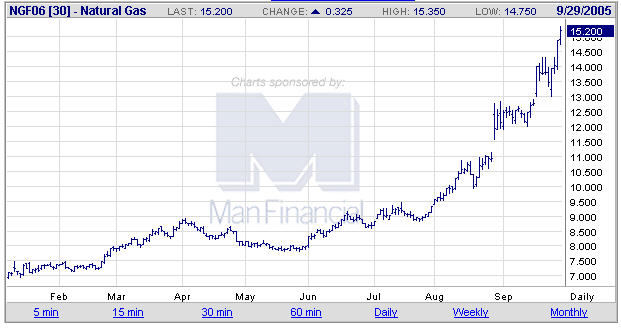
Following is a chart of natural gas prices for the January 2006 Contract, as of September 29th.


To see a more current chart click here.

On Wednesday we looked at rising Credit Card Delinquencies. Here is a small snip:

The American Bankers Association reported Wednesday that the percentage of credit card accounts 30 or more days past due climbed to an all-time high of 4.81 percent in the April-to-June period. It could grow in the months ahead, experts said.

Those figures were pre-Katrina and pre-Rita. Not only do we have continued high prices for gasoline, we have record high prices for natural gas as well. If the experts are correct and Midwest heating bills rise 70% this winter, there is sure going to be a lot more economic stress than we see right now.

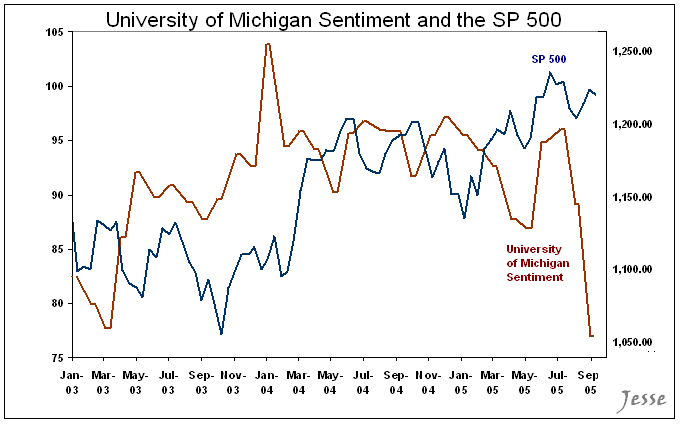
Consumer sentiment is already falling thru the floor and that is before any of those heating bills have hit. Here is a chart of consumer sentiment to ponder, with thanks to Jesse.


Mish, is this a weather related outlier or are consumers finally ready to toss in the towel? Good question but I think that sticky gas prices, rising interest rates (eleven consecutive rate hikes and more threatened), falling real wages, two hurricanes with possibly more to come, rising foreclosures, rising delinquencies, and looking ahead to even 30% hikes in winter heating bills let alone the 70% that is projected is likely to be the brick that broke the consumers' back. The recession of 2006 is coming up.

Mike Shedlock / Mish
http://globaleconomicanalysis.blogspot.com/

Iran Plays Hardball

The daily Times and The Hindu are both reporting that Iran is scrapping a $21b gas deal with India. Following are some snips:
Iran has informed India that the five-million-tonne a year liquefied natural gas (LNG) export deal, with deliveries scheduled to begin in 2009 for a 25-year period, is off. This was conveyed to Indian officials in Vienna soon after the anti-Iran vote cast on Saturday by New Delhi at the International Atomic Energy Agency (IAEA) governing board meeting.

Under a deal signed in June, India planned to import five million tons of liquefied natural gas (LNG) annually for 25 years with deliveries from Iran starting in 2009. Iran’s decision to cancel the deal was conveyed to India’s permanent representative, Sheelkant Sharma, at the IAEA by Iran’s ambassador in Vienna, The Hindu reported.

It followed India’s decision to join the US, Britain, France, Germany and other nations in backing a resolution calling on the agency to consider reporting Iran to the UN Security Council for not complying with the nuclear non-proliferation treaty (NPT). The motion states that Iran is in “non-compliance” with the NPT, mainly for hiding sensitive atomic activities, and is an automatic trigger for taking the matter to the Security Council. Referral would come only after a report by IAEA chief Mohammed El Baradei, expected in November.

Sharma wrote to the Prime Minister’s Office on September 24 that his Iranian counterpart had told him the LNG deal, signed between the two sides in June, was off. The Iranian Ambassador in Vienna came up to Sharma after India’s vote and conveyed a message from Ali Larijani, Iran’s top nuclear negotiator, that Tehran was no longer willing to go ahead with the $21 billion deal, added the report.

With this, India's energy security has suffered a major blow. The agreement was considered a good deal for India; in the variable component of the price formula the Brent price of crude was capped at $31 a barrel.
Perhaps I take some heat for this but I applaud Iran's decision. It's high time countries step up to the plate and do what is best for them rather than what the US thinks is best for everybody. Iran has the same right to nuclear energy as does India, Pakistan, Europe, and the US. Yes there are worries that Iran might not use nuclear facilities for peaceful purposes. Then again, how can anyone possibly blame Iran for wanting to protect itself from unwarranted military aggression from the US? If the US did not invade Iraq and threaten Iran, would Iran feel so threatened? Are threats from Bush driving Iran towards nuclear weapons? I think so. Whether on purpose or not, US policies are hardly a stabilizing factor for either terrorism or preventing nuclear weapons proliferation.

On August 14, The Sunday Times reported Britain keeps distance from talk of strike on Iran.
Foreign secretary Jack Straw sought to distance Britain yesterday from comments by President George W Bush that he would not rule out a military strike against Iran.

Bush raised the temperature by giving an interview to Israeli television from his ranch in Crawford, Texas. Asked if he would consider force, he replied: "All options are on the table." He added: "The use of force is the last option for any president and you know we’ve used force in the recent past to secure our country."

The Foreign Office reacted swiftly. "Our position is clear and has been made very, very clear by the foreign secretary," a spokesman said. "We do not think there are any circumstances where military action would be justified against Iran. It does not form part of British foreign policy."

"Iran has all the cards," said one official close to the talks. "It’s going to be embarrassing for the Brits."

Russia has a civilian nuclear contract with Iran worth £500m while China is increasingly reliant on Iranian oil and gas. Last October Sinopec, the Chinese state oil company, signed a £39 billion deal giving it a 51% stake in Yadavaran, Iran’s largest onshore oilfield.
It does indeed appear that Iran is holding all the cards. The US is bogged down in Iraq, UK tolerance for more military action is non-existent, and US support for stupidity in Iraq is plunging as fast as President Bush is in the polls. On the other hand, one simply can not rule out more insanity from this administration.

With that backdrop, Iran stepped up to the plate and told India where to go. Somehow I have a feeling that China will be the beneficiary of this ball game. In the meantime, that was one hell of a warning that Iran issued to countries regarding its rights to use nuclear energy in a peaceful manner. It will be interesting to watch the fallout over this. I expect to see a United States increasing isolated from world politics as a result.

India just lost a $21 Billion oil and gas project by being stupid. Let's see if anyone else is dumb enough to follow suit.

Mike Shedlock / Mish
http://globaleconomicanalysis.blogspot.com/

Wednesday, 28 September 2005

Thoughts on the Davis Bacon Act

CNN Money is reporting President Bush used Katrina to suspend the Davis Bacon Act.
President signs executive order allowing contractors to pay below prevailing wage in affected areas.

President Bush issued an executive order Thursday allowing federal contractors rebuilding in the aftermath of Hurricane Katrina to pay below the prevailing wage.
In a notice to Congress, Bush said the hurricane had caused "a national emergency" that permits him to take such action under the 1931 Davis-Bacon Act in ravaged areas of Alabama, Florida, Louisiana and Mississippi.

The Davis-Bacon law requires federal contractors to pay workers at least the prevailing wages in the area where the work is conducted. It applies to federally funded construction projects such as highways and bridges. Bush's executive order suspends the requirements of the Davis-Bacon law for designated areas hit by the storm.

Bush's action came as the federal government moved to provide billions of dollars in aid, and drew rebukes from two of organized labor's biggest friends in Congress, Rep. George Miller of California and Sen. Edward Kennedy of Massachusetts, both Democrats.

"The administration is using the devastation of Hurricane Katrina to cut the wages of people desperately trying to rebuild their lives and their communities," Miller said.

"President Bush should immediately realize the colossal mistake he has made in signing this order and rescind it and ensure that America puts its people back to work in the wake of Katrina at wages that will get them and their families back on their feet," Miller said.

"I regret the president's decision," said Kennedy.

"One of the things the American people are very concerned about is shabby work and that certainly is true about the families whose houses are going to be rebuilt and buildings that are going to be restored," Kennedy said.
The International Brotherhood of Electrical Workers AFL-CIO also blasted Bush in this article. Following is a small snip:

"The IBEW will join with our friends, far and wide, to prevent President Bush from reversing this mission in the midst of Katerina's unimaginable human suffering," he added.

The DailyKos Writes

"Bush continues to act outrageously and opportunistically to advance his ideological and political agenda and enrich his political allies in this time of national crisis. He has suspended rules for pollution control, tried to use the crisis to enhance fears about social security, hire Halliburton, etc...now he suspends the prevailing wage rule in the areas that need decent jobs."

That sounds pretty mean doesn't it. But is it? Enquiring minds might want to know if there is another side to this story. Indeed there is.

Let's start with a brief review of the Davis-Bacon Act which was passed in 1931 and amended a couple of times.
The Davis-Bacon Act as amended, requires that each contract over $2,000 to which the United States or the District of Columbia is a party for the construction, alteration, or repair of public buildings or public works shall contain a clause setting forth the minimum wages to be paid to various classes of laborers and mechanics employed under the contract. Under the provisions of the Act, contractors or their subcontractors are to pay workers employed directly upon the site of the work no less than the locally prevailing wages and fringe benefits paid on projects of a similar character. The Davis-Bacon Act directs the Secretary of Labor to determine such local prevailing wage rates.
According to the Institute for Justice here is The History of the Davis-Bacon Act.
The co-author of the Davis-Bacon Act, Rep. Robert Bacon, represented a congressional district in Long Island. Bacon's opinions on issues like immigration demonstrate the extent to which his views were patently racist. For example, in 1927, the same year he introduced the Davis-Bacon Act, he submitted the following statement from 34 university professors concerning a new immigration law into the Congressional Record:

We urge the extension of the quota system to all countries of North and South America from which we have substantial immigration and in which the population is not predominantly of the white race. . . . Only by this method can that large proportion of our population which is descended from the colonists . . . have their proper racial representation. . . . Congress wisely concluded that only by such a system of proportional representa-tion . . . could the racial status quo be maintained.

In 1927, Bacon submitted H.R. 17069, "A Bill to Require Contractors and Subcontractors Engaged on Public Works of the United States to Comply With State Laws Relating to Hours of Labor and Wages of Employees on State Public Works." This action was a response to the building of a Veterans' Bureau Hospital in Bacon's district by a contractor from Alabama, who employed only black laborers.

Over the next four years, Bacon submitted 13 more bills to regulate labor on federal public works contracts. Finally, the bill submitted by Bacon and Senator James Davis was passed in 1931, at the height of the depression, with the support of the American Federation of Labor.

The comments made by various congressmen during the debate over the different bills submitted by Bacon betrayed the racial animus that motivated the passage of the law. Representative John Cochran stated, "I have received numerous complaints in recent months about southern contractors employing low-paid colored mechanics getting work and bringing the employees from the South." Representative Clayton Allgood similarly complained, "That contractor has cheap colored labor that he transports, and he puts them in cabins, and it is labor of that sort that is in competition with white labor throughout the country."

Other derogatory comments were made about the use of "cheap labor," "cheap, imported labor," "transient labor," and "unattached migratory workmen." Thus, while the sponsors and supporters of the Act also intended it to disadvantage immigrant workers of other races, these thinly veiled references make it clear that the Act was primarily intended to discriminate against blacks.

Effects of the Davis-Bacon Act

The Davis-Bacon Act imposes tremendous economic and social costs-at least $1 billion in extra federal construction costs and $100 million in administrative expenses each year. Industry compliance costs total nearly $190 million per year. Repeal of the Act would also create an estimated 31,000 new construction jobs, most of which would go to members of minority groups.

Davis-Bacon's impact on the ability of minorities to find work in the construction industry has been particularly devastating. The Department of Labor's initial set of regulations did not recognize categories of unskilled workers except for union apprentices. As a result, contractors had to pay an unskilled worker who was not part of a union apprenticeship program as much as a skilled laborer, which almost completely excluded blacks from working on Davis-Bacon projects. This effectively foreclosed the only means by which unskilled blacks could learn the necessary skills to become skilled workers.

Ralph C. Thomas, former executive director of the National Association of Minority Contractors, stated that a minority contractor who acquires a Davis-Bacon contract has "no choice but to hire skilled tradesmen, the majority of which are of the majority. " As a result, Thomas said, "Davis-Bacon closes the door in such activity in an industry most capable of employing the largest numbers of minorities."

The paperwork a contractor must fill out pursuant to Davis-Bacon contracts also discriminates against small, minority-owned firms. Many do not have personnel with the necessary expertise to complete the myriad forms and reports required.

As a result of all these factors, the Davis-Bacon Act prevents rural and inner-city laborers and contractors from working on projects in their own communities. Ironically this is one problem Davis-Bacon was intended to prevent.
Unfortunately Mish does not have a time machine to go back and verify some of those racial claims but logic alone would dictate that forcing local contractors to pay some government mandated "prevailing wage" is bound to drive up costs and lower employment if for no other reason than nonsensical bureaucratic compliance.

Here is the official U.S. Department of Labor DAVIS-BACON WAGE DETERMINATION REFERENCE MATERIAL.

Here is a description of the obviously wasteful wage determination practice:

The Davis-Bacon Wage Determinations contained on this web site are wage determinations issued by the U.S. Department of Labor under the Davis-Bacon and related Acts. The Wage and Hour Division of the U.S. Department of Labor determines prevailing wage rates to be paid on federally funded or assisted construction projects. It is the responsibility of the federal agency that funds or financially assists Davis-Bacon covered construction projects to ensure that the proper Davis-Bacon wage determination(s) is/are applied to such construction contracts(s).

Here is a list of 117 determinations that will be modified for the week of 09/16/2005.
Note: That list was at the time of this writing it is subject to change. Some of the items on that list have already been modified as many as 36 times previously.

I am not going to bother to count this next list but there are another 100 or so determinations for the week of 09/09/2005.

Gee I wonder how many bureaucrats it takes to make all those weekly adjustments, just so the government can overpay some sort of nonsensical prevailing wage at taxpayer expense for the benefit of practically no one.

Questions regarding Davis-Bacon Wage Determinations?
Contact Wage and Hour at dbra-faqs@fenix2.dol-esa.gov
How many people does that take?

Look at all the classifications that must be supported:

ASBE = International Association of Heat and Frost Insulators and Asbestos Workers
BOIL = International Brotherhood of Boiler Makers, Iron Shipbuilders, Blacksmiths, Forgers and Helpers
BRXX = International Union of Bricklayers, and Allied Craftsmen
(bricklayers, cement masons, stone masons, tile, marble and terrazzo workers)
CARP = United Brotherhood of Carpenters and Joiners of America
ELEC = International Brotherhood of Electrical Workers
(electricians, communication systems installers, and other low voltage specialty workers)
ELEV = International Union of Elevator Constructors
ENGI = International Union of Operating Engineers
(operators of various types of power equipment)
IRON = International Association of Bridge, Structural and Ornamental Iron Workers
LABO = Laborers' International Union of North America
PAIN = International Brotherhood of Painters and Allied Trades
(painters, drywall finishers, glaziers, soft floor layers)
PLUM = Operative Plasterers' and Cement Masons' International Association of the United States and Canada
PLAS = United Association of Journeymen and Apprentices of the Plumbing and Pipe Fitting Industry of the United States and Canada
ROOF = United Union of Roofers, Waterproofers and Allied Workers
SHEE = Sheet Metal Workers International Association
TEAM = International Brotherhood of Teamsters

Here is the survey program to help make determinations.

Is it easy to prove compliance?
Who knows but perhaps The Boon Group can help.

In 1999 Ron Paul introduced THE DAVIS-BACON REPEAL ACT.
Mr. Speaker, I rise today to introduce the Davis-Bacon Repeal Act of 1999. The Davis-Bacon Act of 1931 forces contractors on all federally-funded contraction projects to pay the `local prevailing wage,' defined as `the wage paid to the majority of the laborers or mechanics in the classification on similar projects in the area.' In practice, this usually means the wages paid by unionized contractors. For more than sixty years, this congressionally-created monstrosity has penalized taxpayers and the most efficient companies while crushing the dreams of the most willing workers. Mr. Speaker, Congress must act now to repeal this 61-year-old relic of an era during which people actually believed Congress could legislate prosperity. Americans pay a huge price in lost jobs, lost opportunities and tax-boosting cost overruns on federal construction projects every day Congress allows Davis-Bacon to remain on the books.

Davis-Bacon artificially inflates construction costs through a series of costly work rules and requirements. For instance, under Davis-Bacon, workers who perform a variety of tasks must be paid at the highest applicable skilled journeyman rate. Thus, a general laborer who hammers a nail must now be classified as a `carpenter,' and paid as much as three times the company's regular rate. As a result of this, unskilled workers can be employed only if the company can afford to pay the government-determined `prevailing wages' and training can be provided only through a highly regulated apprenticeship program. Some experts have estimated the costs of complying with the paperwork imposed on contractors by Davis-Bacon regulations at nearly $200 million a year. Of course, this doesn't measure the costs in lost job opportunities because firms could not afford to hire an inexperienced worker.

Most small construction firms cannot afford to operate under Davis-Bacon's rigid job classifications or hire the staff of lawyers and accountants needed to fill out the extensive paperwork required to bid on a federal contract. Therefore, Davis-Bacon prevents small firms from bidding on federal construction projects, which, unfortunately, constitute 20 percent of all construction projects in the United States.

Because most minority-owned construction firms are small companies, Davis-Bacon keeps minority-owned firms from competing for federal construction contracts. The resulting disparities in employment create a demand for affirmative action, another ill-suited and ill-advised big government program.

The racist effects of Davis-Bacon are no mere coincidence. In fact, many original supporters of Davis-Bacon, such as Representative Clayton Allgood, bragged about supporting Davis-Bacon as a means of keeping `cheap colored labor' out of the construction industry.

In addition to opening up new opportunities in the construction industry for smaller construction firms and their employees, repeal of Davis-Bacon would also return common sense and sound budgeting to federal contracting which is now rife with political favoritism and cronyism. An audit conducted earlier this year by the Labor Department's Office of the Inspector General found that inaccurate data were frequently used in Davis-Bacon wage determination. Although the Inspector General's report found no evidence of deliberate fraud, it did uncover material errors in five states' wage determinations, causing wages or fringe benefits for certain crafts to be overstated by as much as $1.08 per hour!

The most compelling reason to repeal Davis-Bacon is to benefit to the American taxpayer. The Davis-Bacon Act drives up the cost of federal construction costs by as much as 50 percent. In fact, the Congressional Budget Office has reported that repealing Davis-Bacon would save the American taxpayer almost three billion dollars in four years!

Mr. Speaker, it is time to finally end this patently unfair, wildly inefficient and grossly discriminatory system of bidding on federal construction contracts. Repealing the Davis-Bacon Act will save taxpayers billions of dollars on federal construction costs, return common sense and sound budgeting to federal contracting, and open up opportunities in the construction industry to those independent contractors, and their employees, who currently cannot bid on federal projects because they cannot afford the paperwork requirements imposed by this act. I, therefore, urge all my colleagues to join me in supporting the Davis-Bacon Repeal Act of 1999.
Bush should not be criticized for suspending Davis-Bacon, rather he should be criticized for not doing enough in working with Congress to repeal it. Davis-Bacon is a real piece of pork and it's high time this legislation is thrown on the scrap heap of history.

Mike Shedlock / Mish
http://globaleconomicanalysis.blogspot.com/