Tuesday, 28 February 2006

Stunning PMI Numbers

MicaNews is reporting PrivateMI Helps More Families Achieve Homeownership in January. What the headline should read is "The bottom falls out of PMI applications".
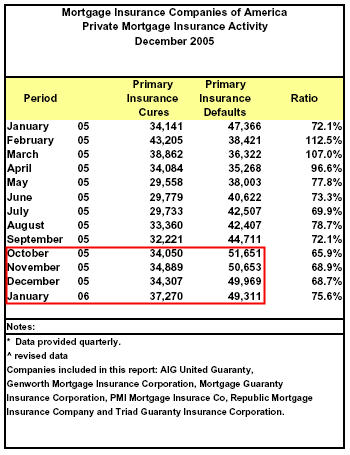
Mortgage Insurance Companies of America (MICA) reports that 90,330 borrowers used private mortgage insurance (PrivateMI) to buy or refinance a home in January. The number of borrowers using PrivateMI in January was 43.9% lower than the December total of 161,172.

The number of PrivateMI applications received in January by MICA members was 95,131 or 40.5% less than the 160,038 received in December. The dollar volume of primary insurance written on newly originated 1-to-4 family conventional mortgage loans totaled $13,633.4 million in January, a 48.8% decrease from the previous month’s $26,666.8 million. Traditional primary insurance totaled $10,038.3 million and bulk primary insurance totaled $3,595.1 million in January. In that same month, primary insurance in-force totaled $616,139.6 million. MICA members reported 37,270 cures and 49,311 defaults during January.

The statistics in this report include data from the following member companies: AIG United Guaranty, Genworth Mortgage Insurance Corporation, Mortgage Guaranty Insurance Corporation, PMI Mortgage Insurance Co., Republic Mortgage Insurance Company and Triad Guaranty Insurance Corporation.

MICA is the trade association representing the private mortgage insurance industry. Its members help loan originators and investors make funds available to home buyers for low down payment mortgages by protecting these institutions from a major portion of the financial risk of default.
PMI Activity


In spite of one of the warmest January on record
In spite of record housing starts
Housing starts jumped 14.5 percent to an annual rate of 2.28 million last month, the highest since March 1973, the Census Bureau reported. Economists surveyed by Briefing.com forecast that housing starts would come in at an annual rate of 2.02 million in the month.
The bottom is falling out of Private Mortgage Insurance.

What are these numbers telling us?
  1. The January seasonal adjustments to housing starts are bogus?
  2. Builders are scrambling to build everything they can before the bottom falls out?
  3. The January PMI is an outlier?
  4. People are putting more money down therefore need PMI?
  5. Fewer people are buying houses?
  6. Some combination of 1, 2, 5?
I vote for #6.
No doubt the bureaucrats overdid their January seasonal adjustments.
January is expected to be cold so they add starts to smooth seasonality.
Figure in a bunch of panicked builders on top of it, all scrambling to get rid of their land inventory while the getting is good, and voila you have the makings of a blow off top in housing starts. Obviously #4 is laughable and does not fly in the face of recent home buying trends.

PMI Defaults and Cures


Defaults picked up in October (the Katrina effect?) but have been steady since then. What is interesting is that cures went up as well. I do not think that flies in the face of the increasing numbers of bankruptcies we have seen, but it is what it is. Expect this conundrum to resolve itself via increasing numbers of defaults.

Both sets of numbers will be interesting to watch going forward.

Mike Shedlock / Mish
http://globaleconomicanalysis.blogspot.com/

Sunday, 26 February 2006

Spotlight on Japan

Is Japan really a nation of savers?
I found some interesting graphs by Japan's Ministry of Finance describing the Current Japanese Fiscal Condition .

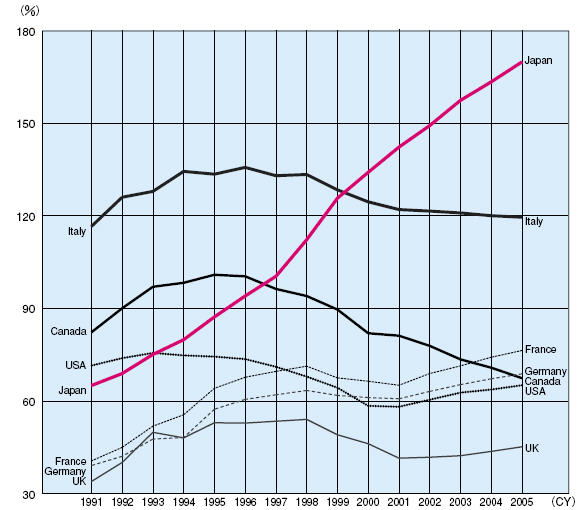
Japan's national debt as a % of GDP


Japan's net national debt


The above graphs were produced by Japan's Ministry of Finance.
The most current report I could find in English was from September 2005.
Japan's National Debt Hits New High
Japan's government debt ballooned to a record high of JPY 795.8 trillion (USD 7 trillion) at the end of June, according to a report released by the Japanese Finance Ministry. It was projected to be JPY 774 trillion for this fiscal year, so the national debt is growing faster than expected.

Japan has relied on government bond issues to make up for falling tax revenues. This has turned the nation into one of the world's most indebted countries. Japan 's public debt burden is now almost 160 per cent of its GDP, which makes it the highest in the industrialized world.
Even though Japan has a positive balance of trade with the US, Japan's government is squandering it. Basically, the private sector is saving and the government takes those savings and wastes them in imaginative ways.

On February 15th 2006 Japan's Fiscal Policy Minister said Japan May Have to Cut Spending by 20 Trillion Yen
The Japanese government may have to cut total spending by 20 trillion yen ($171 billion) by April 1, 2011, to meet its goal of balancing the budget if it does not raise taxes, Economic and Fiscal Policy Minister Kaoru Yosano said.

The projection was submitted at today's meeting of a government economic panel in Tokyo. Yosano made the comments following the panel's meeting.

Prime Minister Junichiro Koizumi has set a goal of balancing spending and revenue, without depending on new bond sales, by the early next decade. Japan can't stop the expansion of its public debt by spending cuts alone, Koizumi told parliament on Feb. 7, signaling Japan may have to raise taxes after he steps down in September.

Japan's public debt, combining that of both national and local governments, will reach 151 percent of gross domestic product by March 2007, the Ministry of Finance projected in December.
Given that it is already over 160% by earlier MOF projections I am not sure where the 151% comes from. Nonetheless, it should be quite clear by any means that the idea of Japan being a "nation of savers", as least as far as government deficit spending goes should be shattered.

What about that trade surplus?

On February 22nd Forbes reported Japan posts first trade deficit in 5 years, the largest since 1983.
Japan posted its first trade deficit in five years in January as surging crude oil prices bloated imports but economists believe that the trade gap was a one-off event.

The Ministry of Finance said the trade balance plunged into a deficit of 348.9 bln yen last month, against a surplus of 193.9 bln yen a year earlier, also due to a long New Year holiday at the start of the year.

'Due to a long New Year break, exports normally drop in January compared to other months, while surging crude oil prices and the cold weather helped imports stay at high levels, thereby resulting in the first trade deficit in five years,' an MoF official told a news briefing.

'Looking back at our records in the past 20 years, it was only in January that Japan has posted a trade deficit,' he added.

The last time Japan reported a trade deficit was in January 2001. The latest trade gap was the largest since January 1983 when the deficit reached 409.8 bln yen but nowhere near the deficit of 824.8 bln yen posted in January 1980.

Last month's figure was much wider than market expectations. Economists on average projected a deficit of 101.9 bln yen, according to a Nihon Keizai Shimbun poll of 23 research institutes. The forecasts ranged from a deficit of 378.6 bln yen to a surplus of 158.0 bln yen.

But the finance ministry said the trade deficit may be a blip and expects exports to remain brisk.
Let's explore the idea that "surging crude oil prices" are to blame.


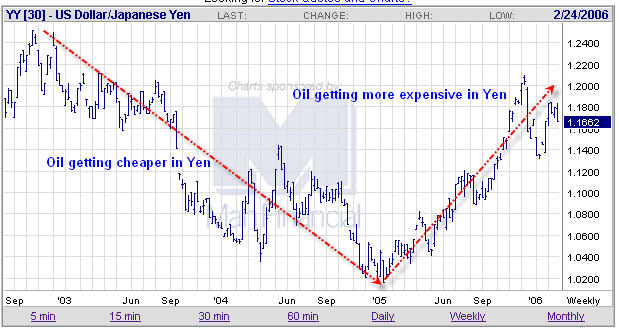
Given that crude prices ran up from $25 to $70 without causing a deficit and stayed in a range near $62 (8 dollars off the high) for about 6 months, can oil really be the culprit?

Let's see if the YEN has any clues.


Hmmm. Does that help answer the question?

Of course, Japanese exports should have been helped by been helped by a falling YEN. Were they? I suspect that a slowing world economy may be hurting exports everywhere. What we do know for sure is that the falling YEN did not help Japan at all on its oil purchases.

Bloomberg is writing Japan's Boom May Explode Yen-Carry Trade.
Surprisingly strong growth in Japan is raising many eyebrows, not least those at the central bank anxious to scrap its zero-interest policy.

There can be little doubt 5.5 percent growth between October and December pushed the Bank of Japan further in that direction. Oddly, there are few if any signs global markets are bracing for higher debt yields in Japan.

Why? Japanese rates have been negligible for so long that investors take them for granted. This, after all, is the economy that's cried wolf too many times. The reason investors from New York to Singapore aren't ecstatic about Japan's recovery is the sense we've been here before -- many times.

Yet Japan's latest growth figures should make believers of some of the biggest skeptics. Not only did exports boost the economy in the fourth quarter, so did personal spending -- a sign optimism is spreading to households around the nation.

Rest assured the BOJ is noticing and will soon begin pulling liquidity out of Asia's biggest economy. Once that process begins, there's no telling how aggressive the BOJ will be and what effect it will have on bond yields.

Where Liquidity Begins

There are two reasons Japan's rate outlook is a huge story for global markets. One, yields in the biggest government debt market will head steadily higher for the first time in more than a decade. Two, it may mean the end of the so-called yen-carry trade.

"All liquidity starts in Japan, the world's largest creditor country," said Jesper Koll, chief economist for Japan at Merrill Lynch & Co. "When rates go up here, rates go up everywhere."

What makes the carry trade so worrisome is that nobody really knows how big it is. For example, the BOJ has no credible intelligence on how many hedge funds, investors and companies have borrowed cheaply in ultra-low-interest-rate yen and re-invested the funds in higher-yielding assets elsewhere.

A popular form of the strategy exploits the gap between U.S. and Japanese yields. Anyone borrowing for next to nothing in yen and parking the funds in U.S. Treasuries received a twofold payoff: the 3-plus percentage-point yield difference and the dollar's rise versus the yen. The latter dynamic boosts profits by the time they're converted back to yen.

Yet as the BOJ raises rates and more investors buy into Japan's revival, the yen is sure to rise, much to the chagrin of carry-trade aficionados. Realization the trade is moving against investors may send shockwaves through global markets.

It would start slowly with speculators suddenly closing positions that are becoming more expensive: dumping Treasuries, gold, Shanghai real estate, shares in Google Inc. or whatever else they used yen borrowings to bet on. The chain reaction would accelerate once the mainstream media jumped on the story.

If all this sounds far-fetched, think back to late 1998, which offers an example of the damage a panic among carry-traders can do.

Remember 1998

In October of that year, Russia's debt default and the implosion of Long-Term Capital Management LP shoulder-checked global markets. The disorienting period culminated in the yen, which had been weakening for years, surging 20 percent in less than two months.

Suddenly, just about anyone who'd borrowed cheaply in yen rushed for the exits. It prompted frantic conference calls among officials in Washington, Tokyo and Frankfurt. Just how big was the yen-carry trade? How much leverage was involved? What could policy makers do, if anything, to regain control?
Although the Japanese carry trade has a history of blowing up in spectacular fashion, it now seems that all eyes are on it. That makes the carry trade far less likely to be any sort of economic trigger. The last time the Yen carry trade did blow up, nobody talked about it beforehand. A watched pot never boils. In 2000 Greenspan was worried the economy was too strong (it imploded). In 2001 the FED and Bernanke were worried about deflation (the economy roared when interest rates were slashed to 1%), now the FED is worried about inflation again while Japan is still worried about deflation.

Japan is arguably in its own state of Economic Zugzwang and very reluctant to make a move. On one hand, Japan has a desire to get off its ZIRP policy (which would tend to strengthen the YEN if they do) on the other hand Japan still has an overwhelming desire to maintain exports in a world economy that is clearly slowing. Compounding the problem is rising oil prices as the YEN weakens vs. a declining value of its massive US Treasury portfolio if the YEN would strengthen. Eventually the market is going to force Japan to do something. In the meantime this article should be a reminder that every major fiat currency has huge structural flaws lurking somewhere. One can only choose be between relative degrees of fiscal insanity. That unfortunately is the current sad state of affairs.

Mike Shedlock / Mish
http://globaleconomicanalysis.blogspot.com/

Wednesday, 22 February 2006

The Red Queen Race

In Lewis Carroll's Through the Looking-Glass there is an incident involving the Red Queen, a representation of a Queen in chess, and Alice constantly running but remaining in the same spot. The scene is often referred to as The Red Queen's Race.

The Queen kept crying "Faster!" but Alice felt she could not go faster, though she had no breath to say so. The most curious part of the thing was, that the trees and the other things round them never changed their places at all: however fast they went, they never seemed to pass anything. "I wonder if all the things move along with us?" thought poor puzzled Alice. And the Queen seemed to guess her thoughts, for she cried, "Faster! Don't try to talk!"

Not that Alice had any idea of doing that. She felt as if she would never be able to talk again, she was getting so out of breath: and still the Queen cried, "Faster! Faster!" and dragged her along. "Are we nearly there?" Alice managed to pant out at last.

"Nearly there!" the Queen repeated. "Why, we passed it ten minutes ago! Faster!" And they ran on for a time in silence, with the wind whistling in Alice's ears, and almost blowing her hair off her head, she fancied.

"Now! Now!" cried the Queen. "Faster! Faster!" And they went so fast that at last they seemed to skim through the air, hardly touching the ground with their feet, till suddenly, just as Alice was getting quite exhausted, they stopped, and she found herself sitting on the ground, breathless and giddy. The Queen propped her against a tree, and said kindly, "You may rest a little now."

Alice looked round her in great surprise. "Why, I do believe we've been under this tree all the time! Everything's just as it was!"


"Of course it is," said the Queen: "what would you have it?"

"Well, in our country," said Alice, still panting a little, "you'd generally get to somewhere else -- if you ran very fast for a long time, as we've been doing."

"A slow sort of country!" said the Queen. "Now, here, you see, it takes all the running you can do, to keep in the same place. If you want to get somewhere else, you must run at least twice as fast as that!"

The above image is thanks to the University of Virginia Library.

The Red Queen Race vs. the US Economy

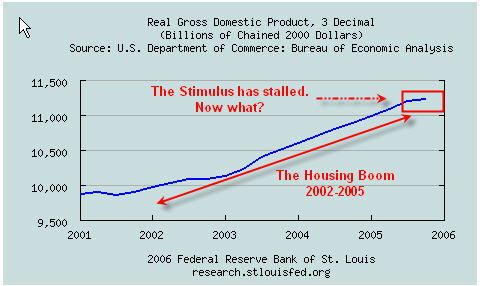
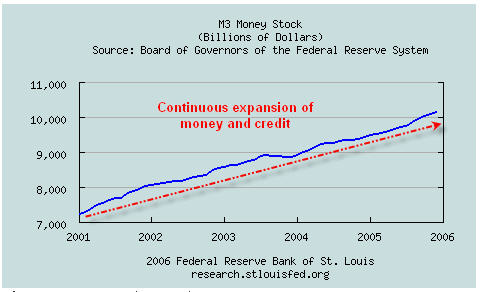
Following is a chart of US GDP. It seems to have stalled.


Yet money and credit is still expanding.


Can consumers forever keep spending more than they make?


Government spending still climbs at a steady pace.


Spending is increasing far faster than revenues.
Is this sustainable?


Following is a chart of the CPI as published by the government.
Does anyone believe it?


Mish notes:
Yes, I realize that M3 is grossly distorted.
Unfortunately practically all government numbers are.
The CPI is certainly inaccurate and is probably understated.
It is impossible to say by how much as noted in Inflation: What the heck is it?
What we can say is that the CPI is subject to massive government manipulation.
We can also say that the GDP is distorted by hedonics and imputations.
Those not familiar with the concept of paying oneself rent and adjusting the GDP for "the value" of free checking accounts may wish to read Grossly Distorted Procedures.

Let's take a look at 4th quarter US GDP

The US economy hits the brakes in fourth quarter.
US gross domestic product, after expanding by an annualized 4.1 percent over July-September, dropped to its weakest pace in three years after 10 consecutive quarters of growth above 3.0 percent.

Economists said the surprising report foreshadowed a more moderate pace of expansion for the world's biggest economy in 2006.

But Treasury Secretary John Snow dismissed the GDP slowdown as "anomalous" and stressed the preliminary report was subject to revisions.

"Economic fundamentals point to continued strong economic performance in the United States in 2006. The US economy is performing well," he said.

"This report is the worst-case scenario for the Fed and Mr. Bernanke, and the new Fed chair will be tested right off the bat," commented Joel Naroff of Naroff Economic Advisors.

"The economy is slowing, though clearly not as rapidly as the headline number would have you think. At the same time, inflation is slowly accelerating," he said.

The GDP report showed that over 2005, the personal savings rate of Americans was negative for the first year since the depths of the Great Depression in 1933.

A spending binge by US consumers on the back of a red-hot property market has done much to elevate GDP growth in recent years. But housing has shown signs of slowing, triggering fears that consumers could rein in spending.

Other figures out Friday showed that sales of new US homes increased a surprising 2.9 percent in December. But the inventory of unsold homes increased 2.4 percent to a record 516,000.

The GDP report showed that consumer spending increased at an annual rate of 1.1 percent, down heavily from 4.1 percent in the third quarter. It was the slowest spending pace since the last US recession in mid-2001.
Notice how backwards the thinking is: "But housing has shown signs of slowing, triggering fears that consumers could rein in spending." Any rational person looking at the negative savings rate, the trade deficit, and rampant government spending should not be fearing a slowdown in consumer spending, the fear should be that consumer spending continues!

Posting on Kitco, Trotsky writes:
Since 2000, the US economy has officially grown by $1.4 trillion (inflation-adjusted GDP growth) . Over the same period, total credit market debt outstanding has grown by an astounding $9 trillion. Personal (household) debts alone have exploded by 60% over the past 5 years, from already elevated levels ($6.9 trillion to $11 trillion) . Nearly 90% of the reported GDP growth was in consumption and residential building.

The "recovery" continues to be the weakest post WW2 recovery on record, with capital spending stuck in limbo, real wages declining and job growth non-existent (private sector employment has risen only 1% since 2000 - compared to the 9% average of other post WW2 recoveries) .

Right now it takes a negative savings rate, expanding credit, and excessive government spending just to stand in one spot. The charts above prove it. Furthermore, if one subtracts imputations and hedonics, and adjusts the GDP by a CPI that better reflects reality, the logical conclusion is that the GDP was actually negative last quarter.

Let's consider one more passageway from Through the Looking-Glass:

I SHOULD see the garden far better," said Alice to herself, "if I could get to the top of that hill: and here's a path that leads straight to it -- at least, no, it doesn't do that -- -" (after going a few yards along the path, and turinng several sharp corners), "but I suppose it will at last. But how curiously it twists! It's more like a corkscrew than a path! Well, this turn goes to the hill, I suppose -- no, it doesn't! This goes straight back to the house! Well then, I'll try it the other way."

And so she did: wandering up and down, and "trying turn after turn, but always coming back to the house, do what she would. Indeed, once, when she turned a corner rather more quickly than usual, she ran against it before she could stop herself.


In "Wonderland" forward movements take one back to their starting point and rapid movements can cause very abrupt stops.

I picture Ben Bernanke as the new Red Queen.
He is now trapped in Zugzwang.

Definition: A German term for the obligation to move. All legal moves lead to a worsening of the position.

Click on the above link for multiple chess possibilities. Here is one example (taking poetic license) as the position shows a red king not a queen.


For non-chess fans who might not fully understand the above position: no matter which way Bernanke moves, white will next capture the red pawn, and march the remaining white pawn to victory. The red king can not capture the white pawn or move one square forward since either would put the king in "check" (subject to capture by the opposing king or pawn).

In economic terms, there is no magic mirror.
Bernanke is trapped in "Wonderland" but unlike Alice has no way out.
Bernanke gets to choose between hyperinflation and deflation.
The moment he can not run fast enough, the US economy will implode.
If he runs too fast, the value of the US dollar as well as the FED's power will both come to a very abrupt stop.
In effect Bernanke is in Zugzwang and he does not even know it.
Economic Checkmate.

Mike Shedlock / Mish
http://globaleconomicanalysis.blogspot.com/

A Toxic Mix in Ohio

The Akron Beacon Journal is reporting High-risk mortgages spread to Ohio's small towns.
COLUMBUS, Ohio - An increasing number of Ohioans who live in small towns and rural areas are losing their homes because of risky, high-interest mortgage loans, records show.

Sub-prime loans, which generally carry interest rates above 8 percent, are designed for people who can't qualify for traditional mortgages because of poor credit, low income or the lack of a down payment.

Mortgage brokers, who for years have marketed high-interest loans in poor city neighborhoods, have expanded their reach into the state's farmlands and Appalachian hills, The Columbus Dispatch reported for a story Sunday.

Ohioans signed 72,909 high-interest mortgages in 2004, about 16 percent of all mortgages signed that year.

That has contributed to Ohio's high foreclosure rate, the worst in the nation. About 10 percent of sub-prime borrowers were in foreclosure between July and September, triple the national figure, according to data from the Mortgage Bankers Association.

The state's biggest concentration of costly loans was in Hardin County in rural north-central Ohio. About 32 percent of mortgages there carried a high interest rate in 2004, a time when interest rates on a conventional loan averaged just 5 percent.

Sub-prime loans can provide a financial lifeline for people who otherwise couldn't buy or refinance a home, but they are also more expensive.

When Sammy and Tracy Bogue of Kenton, 56 miles northwest of Columbus, signed for a 7.5 percent adjustable rate loan, they understood that the rate could go up. In fact, the fine print shows that it will never go lower and could climb as high as 14.5 percent.

A foreclosure notice on their home was published this month in the local newspaper.

More than 59,000 foreclosure notices were filed in Ohio in 2004. In the first half of 2005, 3.3 percent of state home loans were in foreclosure, more than triple the national average, according to the Mortgage Bankers Association.

Hardin County registered the eighth-highest jump in foreclosures in Ohio from 1999 to 2004 - a spike of 181 percent. A similar acceleration occurred across much of rural and suburban Ohio, according to state Supreme Court statistics.

Ohio lawmakers are considering a predatory-lending bill called the Ohio Homebuyers' Protection Act.

The bill would remove a provision that exempts mortgage brokers and lenders from a state law prohibiting deceptive sales practices.

Doing so would open up brokers and lenders to lawsuits by the attorney general and individual borrowers who think they have been cheated or misled.

The bill also would make disciplinary action against brokers a matter of public record.
Three key sentences:

"Sub-prime loans can provide a financial lifeline for people who otherwise couldn't buy or refinance a home, but they are also more expensive."

"Ohio lawmakers are considering a predatory-lending bill called the Ohio Homebuyers' Protection Act. The bill would remove a provision that exempts mortgage brokers and lenders from a state law prohibiting deceptive sales practices."

"In the first half of 2005, 3.3 percent of state home loans were in foreclosure, more than triple the national average, according to the Mortgage Bankers Association."

Just Two Questions:
  1. Are subprime loans more likely to be a lifeline or an anchor?
  2. What kind of bill would have exempted mortgage brokers and lenders from deceptive sales practices in the first place?
The Toxic Mix:
  • A rust-belt economy and outsourcing of jobs
  • Predatory lending
  • Incredibly weak laws that seem to encourage deceptive sales practices
  • Juicy sub-prime fees
  • Ease in passing the loan on to Fannie Mae or other mortgage backed securities buyers
As the economy weakens, expect the affects of this toxic mix to spread.
It's far too late to do much of anything about it.

Mike Shedlock / Mish
http://globaleconomicanalysis.blogspot.com/

Tuesday, 21 February 2006

Trade Wars Over Shoes

According to Bloomberg the EU will Impose 20% Duties on Shoes From China, Vietnam.
The European Union will impose import duties as high as 20 percent on some leather shoes from China and Vietnam starting in April, to prevent the footwear from being sold below cost on the bloc's markets.

The EU, which in the last year imported 120 million pairs of shoes from Vietnam and 95 million pairs from China worth 5 billion euros ($6 billion), said it will impose rising tariffs over six months, to a maximum of almost 20 percent of their value. China has threatened to retaliate if the European Trade Commissioner Peter Mandelson levies the additional duties.

"This is a very consumer-hostile measure and would be particularly burdensome to low-income families as well as traders, importers and retailers," said Ralph Kamphoener, senior trade adviser at EuroCommerce, which represents European companies that employ more than 22 million people in the EU.

The EU's proposal adds to a series of disputes with China over textile and apparel imports and piracy of copyrights, trademarks and patents. China's emergence as an industrial economy has also provoked tensions in the U.S., prompting calls from lawmakers and the administration of President George W. Bush for a revaluation of the yuan.

By phasing in the penalties from April 7, the European Commission, the bloc's executive agency, hopes to avoid the kind of distribution blockages that occurred when the EU limited imports of Chinese textiles last year. The categories under investigation range from tennis shoes to stiletto boots covering 8 percent of all shoes sold in Europe.

Commission spokesman Peter Power said there is "compelling evidence of serious state intervention in the leather footwear sector" in both China and Vietnam. That intervention takes the form of "cheap finance, non-market land rent, tax breaks and improper asset valuation leading to dumping," he told journalists in Brussels today, adding that "there's evidence of both dumping and injury."

Mandelson will propose the punitive duties to the EU's anti-dumping committee on March 9.

The duties would "have a serious impact on the export of Vietnamese shoes to the EU," said Do Thanh Hong, a vice chairman of the Vietnam Leather and Footwear Association. "Importers will buy shoes from countries that have lower prices, for example, Indonesia."
If ever there was a violation of free trade it would be the EU with its agricultural subsidies. That aside, the EU is now attempting to protect a bunch of inefficient Italian shoemakers at the expense of all of Europe's consumers.

This line says it all:
The duties would "have a serious impact on the export of Vietnamese shoes to the EU," said Do Thanh Hong, a vice chairman of the Vietnam Leather and Footwear Association. "Importers will buy shoes from countries that have lower prices, for example, Indonesia."

This measure simply will not stop importers from looking for the cheapest shoes they can get. In the meantime, consumers in all of Europe will be hurt in order to please a handful of Italian shoemakers. The plain truth of the matter is that importation and distribution of shoes from Asia is a far bigger business in Europe than Italian shoemaking. The tariffs will do immediate harm to business and consumers as well.

No one can win with the actions taken by the EU. Consumers will look elsewhere, Italian shoemakers will not recapture lost market share, and supply channels will be disrupted (at expense) to places like Indonesia. In short, it is a lose lose situation.

Expect to see more actions like this.
Trade wars and tariffs are one of the hallmarks of deflationary times.

Mike Shedlock / Mish
http://globaleconomicanalysis.blogspot.com/

Monday, 20 February 2006

Horton Slashes Prices in Sacramento

Is anyone shocked by some of the latest price reductions?
Check out these Sacramento price cuts :


The Chisholm
Was $434,136
Now $299,990
============
$134,146 or 30.9% reduction

The Tuolomne
Was $412,884
Now $319,990
============
$92,894 or 22.5% reduction

The Pacific Crest
Was $452,890
Now $324,990
============
$127,900 or 28.2% reduction

The Shasta
Was $480,828
Now $349,990
============
$130,838 or 27.2% reduction

If you paid full price for any of these, you might break even in 8-10 years.
Or you might not.
Imagine, putting 0% down and waking up $134,000 in the hole before commissions.

Hmmmm.
Here are two things that just do not seem to matter much anymore:
  • "They are not making land anymore"
  • "Everyone wants to live in California"
As shocked as anyone might be, this is just a down payment.
How long will it be before we hear "No one could possibly have seen this coming?"

Mike Shedlock / Mish
http://globaleconomicanalysis.blogspot.com/

Sunday, 19 February 2006

Deceptive Pricing or Deep Discounts?

D.R. Horton is having a Spectacular President’s 3-day Sale at Savannah in Frederick.

METRO DENVER – “America’s Builder” is hosting a spectacular 3-Day President’s Weekend Sale on Saturday, February 18th through Monday, February 20 th at three master-planned communities in the metro Denver area. D. R. Horton – Melody Series and D. R. Horton’s Continental Series are offering incredible savings of up to $65,000 on select single-family homes at Savannah in the town of Frederick and Sapphire Pointe in Parker, respectively. Buyers in the market for a carefree condominium can visit D. R. Horton’s Trimark Series at Balterra in Aurora and enjoy a very generous savings worth up to $20,000.

A question came up on my blog as to whether or not the discounts offered by Centex, Meritage, KBHomes, and now Horton are real.

To kick this discussion off, let's refer to FTC Guides Against Deceptive Pricing .

§233.1 Former price comparisons.
(a) One of the most commonly used forms of bargain advertising is to offer a reduction from the advertiser's own former price for an article. If the former price is the actual, bona fide price at which the article was offered to the public on a regular basis for a reasonably substantial period of time, it provides a legitimate basis for the advertising of a price comparison. Where the former price is genuine, the bargain being advertised is a true one. If, on the other hand, the former price being advertised is not bona fide but fictitious -- for example, where an artificial, inflated price was established for the purpose of enabling the subsequent offer of a large reduction -- the ``bargain'' being advertised is a false one; the purchaser is not receiving the unusual value he expects. In such a case, the "reduced" price is, in reality, probably just the seller's regular price.

(b) A former price is not necessarily fictitious merely because no sales at the advertised price were made. The advertiser should be especially careful, however, in such a case, that the price is one at which the product was openly and actively offered for sale, for a reasonably substantial period of time, in the recent, regular course of his business, honestly and in good faith -- and, of course, not for the purpose of establishing a fictitious higher price on which a deceptive comparison might be based. And the advertiser should scrupulously avoid any implication that a former price is a selling, not an asking price (for example, by use of such language as, ``Formerly sold at $XXX''), unless substantial sales at that price were actually made.

(c) The following is an example of a price comparison based on a fictitious former price. John Doe is a retailer of Brand X fountain pens, which cost him $5 each. His usual markup is 50 percent over cost; that is, his regular retail price is $7.50. In order subsequently to offer an unusual ``bargain'', Doe begins offering Brand X at $10 per pen. He realizes that he will be able to sell no, or very few, pens at this inflated price. But he doesn't care, for he maintains that price for only a few days. Then he ``cuts'' the price to its usual level -- $7.50 -- and advertises: ``Terrific Bargain: X Pens, Were $10, Now Only $7.50!'' This is obviously a false claim. The advertised ``bargain'' is not genuine.

(d) Other illustrations of fictitious price comparisons could be given. An advertiser might use a price at which he never offered the article at all; he might feature a price which was not used in the regular course of business, or which was not used in the recent past but at some remote period in the past, without making disclosure of that fact; he might use a price that was not openly offered to the public, or that was not maintained for a reasonable length of time, but was immediately reduced.

(e) If the former price is set forth in the advertisement, whether accompanied or not by descriptive terminology such as ``Regularly,'' ``Usually,'' ``Formerly,'' etc., the advertiser should make certain that the former price is not a fictitious one. If the former price, or the amount or percentage of reduction, is not stated in the advertisement, as when the ad merely states, ``Sale,'' the advertiser must take care that the amount of reduction is not so insignificant as to be meaningless. It should be sufficiently large that the consumer, if he knew what it was, would believe that a genuine bargain or saving was being offered. An advertiser who claims that an item has been ``Reduced to $9.99,'' when the former price was $10, is misleading the consumer, who will understand the claim to mean that a much greater, and not merely nominal, reduction was being offered.
Now that does not mean that homebuilders are abiding by the law, but it does certainly mean they could be in serious trouble if they are not.

Here is a simple way of looking at it:
  • Homebuilders raised prices because they could.
  • There was a mad last dash to buy houses out of fear of missing ouit.
  • Homebuilders raised prices into the consumer insanity.
I do not believe homebuilders raised prices just to offer discounts. The numbers of houses they sold at ever increasing prices proves it.

In situations like these, the obvious answer is not some sort of conspiracy just to be able to claim $150,000 off down the road. The obvious answer is builders have to take $150,000 off the prices in order to be able to sell them now.

To think otherwise is to believe yet another conspiracy theory as opposed to simply believing that buyers of homes were acting like "greater fools" outbidding each other for homes.

To someone that paid $150,000 or 15% higher or even $70,000 and 10% higher that is a very real discount and will keep that person underwater on their house for perhaps 10 years to come and perhaps even longer. The question is not whether repeated price hikes occurred (they did) the question was about whether prices were purposely raised just so later "discounts" could be advertised.

Nope. Sorry conspiracy theorists, prices of homes rose in response to blowoff demand, and prices are now declining as the bubble was pricked.
One can either believe that or one can believe in some sort of national price fixing and deceptive pricing scheme. Your choice.

That of course does not imply the value of "discounts" offered as upgrades, landscaping, etc are really at "fair price", but it does mean that someone likely overpaid by at least as much as the "discounts" say, and whoever did is now seriously now underwater.

I called a real estate broker in Florida to discuss this situation just today. He told me the discounts are real and substantial and things are even worse than I suspect. He cited two local homebuilders in Florida that just went bankrupt this past month on 60+ unit subdivisions that will never be built. Poof. Down payments vanished because subcontractors have first right to the money for work performed.

He also offered this explanation for the rising median prices we see: When a sale is booked, it is booked at full price even though substantial discounts are taken off. In other words we have dramatically inflated sales prices even though homes are really going for less money. Such distortions likely explain rising inventory and rising medium price in the face of declining sales and rising inventory. In other words, those rising medium prices (depending on area), could largely be total fiction.

The record home starts in January are only going to make matters worse. I had to laugh today when the president said the mortgage deduction would stay a part of tax law but added "If I were you I’d be worried about interest rates."

Mike Shedlock / Mish
http://globaleconomicanalysis.blogspot.com/