Sunday, 26 March 2006

Ignoring the Obvious

In Reflections on the Yield Curve and Monetary Policy, a speech before the Economic Club of New York on March 20, 2006 Bernanke listed four reasons "why the net demand for long-term issues may have increased, lowering the term premium". Let's take a look:
  • First, longer-maturity obligations may be more attractive because of more stable inflation, better-anchored inflation expectations, and a reduction in economic volatility more generally. With the benefit of hindsight, we now recognize that an important change occurred in the U.S. economy (and, indeed, in other major industrial economies as well) sometime in the mid-1980s. Since that time, the volatilities of both real GDP growth and inflation have declined significantly, a phenomenon that economists have dubbed the "Great Moderation." I have argued elsewhere that improved monetary policies, which stabilized inflation and better anchored inflation expectations, are an important reason for this positive development; no doubt, structural changes in the economy such as deregulation, improved inventory control methods, and better risk-sharing in financial markets also contributed.
  • A second possible explanation of the evident decline in the term premium is linked to the increased intervention in currency markets by a number of governments, particularly in Asia. According to this explanation, foreign official institutions, primarily central banks, have invested the bulk of their greatly expanded dollar holdings in U.S. Treasuries and closely substitutable securities, and these demands by the official sector have put downward pressure on yields. This interpretation has some support, including research that I did with two coauthors that found that longer-term yields came under significant downward pressure during episodes of heavy official purchases of dollars in 2004. However, these observations speak more to the existence of a short-term impact of large purchases and sales--the result of limits to liquidity in the very short run--than to the perhaps more important question of whether those transactions have a lasting effect on yields. On this latter issue, clear evidence is harder to come by. Several pieces of indirect evidence suggest that the long-term effect of foreign purchases on yields may be moderate. Notably, the global market for dollar-denominated bonds is enormous--perhaps around $25 trillion, including dollar-denominated debt issued by other countries as well as debt issued abroad by U.S. residents. In the long run, therefore, the market should be able to absorb purchases and sales of large absolute magnitude with relatively modest changes in yields. Indeed, long-term yields continued to fall over recent quarters even as foreign official holdings of Treasury securities increased at a slower pace than previously.
  • Changes in the management of and accounting for pension funds are a third possible source of a declining term premium. Reforms proposed in the United States, Europe, and elsewhere are widely expected to encourage pension funds to be more fully funded and to take steps to better match the duration of their assets and liabilities. Together with the increased need of aging populations in the industrial countries to prepare for retirement, these changes may have increased the demand for longer-maturity securities. We have seen little direct evidence to date of sizable pension-fund portfolio shifts toward long-duration bonds, at least in the United States. But judging from anecdotal reports, bond investors might be attaching significant odds to scenarios in which pension funds tilt the composition of their portfolios toward such assets substantially over time.
  • Fourth and finally, as investors' demands for long-duration securities may have increased over the past few years, the supply of such securities seems not to have kept pace. The average maturity of outstanding Treasury debt, for example, has dropped by 1‑1/2 years since its peak in 2001, a trend just now beginning to turn with the Treasury's reissuance of the thirty-year bond. Corporations and households, however, have taken advantage of low long-term rates to lengthen the duration of their debt in recent years, which has compensated to some extent for the reduced duration of available Treasury debt.
The Natural Interest Rate

Although it is possible that some of the above played small roles in what has transpired, Bernanke failed to list the most likely explanation for declining long term yields in the face of 15 consecutive hikes: This economy is ready to roll over and all it will take for that to happen is a prolonged housing slump. In all liklihood, the long bond sees that coming in a humongous credit repudiation ceremony and is simply reacting in advance.

Bernanke even went out of his way to dismiss both the inverted yield curve and the long bond yield in a silly discussion about the "natural interest rate":
Although macroeconomic forecasting is fraught with hazards, I would not interpret the currently very flat yield curve as indicating a significant economic slowdown to come, for several reasons.

First, in previous episodes when an inverted yield curve was followed by recession, the level of interest rates was quite high, consistent with considerable financial restraint. This time, both short- and long-term interest rates--in nominal and real terms--are relatively low by historical standards.

Second, as I have already discussed, to the extent that the flattening or inversion of the yield curve is the result of a smaller term premium, the implications for future economic activity are positive rather than negative.

Finally, the yield curve is only one of the financial indicators that researchers have found useful in predicting swings in economic activity. Other indicators that have had empirical success in the past, including corporate risk spreads, would seem to be consistent with continuing solid economic growth. In that regard, the fact that actual and implied volatilities of most financial prices remain subdued suggests that market participants do not harbor significant reservations about the economic outlook.

An alternative perspective holds that the recent behavior of interest rates does not presage an economic slowdown but suggests instead that the level of real interest rates consistent with full employment in the long run--the natural interest rate, if you will--has declined.
Paraphrasing Bernanke in 8 points:
  1. The slowdown in housing, even though it contributed 50% of the jobs during this recovery is irrelevant.
  2. There will be no lagging effect due to 15 consecutive rates hikes (counting March).
  3. Unlike Spring of 2000, complacency, merger mania, and stock buybacks no longer matter. Instead they are a sign of strength.
  4. Rising foreclosures and bankruptcies are not really a sign of stress.
  5. The trade deficit is really a sign of a global savings glut. Everyone, everywhere should spend more than they make. We can, so can everyone else. It's the proverbial "free lunch".
  6. Because of the brilliancy of the Fed, the natural interest rate has declined.
  7. The Fed is omnipotent against any and all financial obstacles. There is no problem the Fed can not print its way out of.
  8. The yield curve and the action of the long bond are simply wrong.
Paraphrasing Bernanke in a single sentence:

It's different this time!

Mike Shedlock / Mish
http://globaleconomicanalysis.blogspot.com/

Friday, 24 March 2006

The Apologists Club

I am pleased to announce the start of a new club. It is called the Real Estate Apologists Club (REAC). There are no dues or fees or membership drives. One can not ask or apply for membership although one can indeed be granted a membership without asking! Furthermore, one can not opt out either. If the club chooses you, you are in, whether you like it or not.

Those worthy of membership are simply granted active membership. Those unworthy are banned as outcasts. That is all there is to it. I will give some specific examples later in this blog to help clarify the membership rules and hierarchy, but first it is time to show some nice charts created by my friend Calculated Risk. The annotations and trendlines were added by me.

Click on any chart for an enhanced view of that chart.

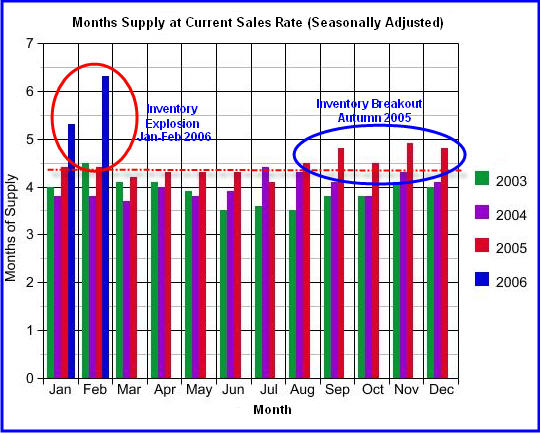
Current Housing Inventory

Notice how home inventories kept bumping up against the upper trendline for months. In Autumn of 2005, there was a trendline breakout followed by an inventory explosion in January and February of 2006.

Bear in mind that home builders are still building like mad.

Some even went on land buying sprees as late as last Autumn. Over the next few months that new inventory will be added to the existing supply. Note too that while sales have declined, they are still at very high levels. Should sales decline further the months inventory numbers could skyrocket.

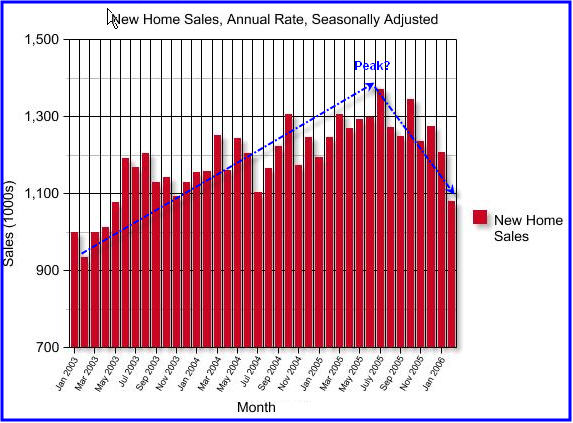
New Home Sales

This is yet another chart that only a true real estate believer could make excuses about.

Sales have been trending down ever since July.
There are no more stories about people camping out in Florida to get on a condo waiting list at absurd prices.

Florida, California, and other bubble areas have popped. Has that fazed any true blue believer in real estate one bit? Of course not and such people are likely card carrying REAC members.

REAC Admission Policy

OK Mish, who is in the club and who is out based on today's reporting?
Good question. Let's take a look:

The Financial Times is reporting Signs of slowdown in US housing.
Sales of new US homes plunged 10.5 per cent last month, prices fell and the stock of unsold homes hit its highest level in 10 years, providing the clearest indications yet that the red-hot housing market may be cooling.

New home sales slid to 1.08m, the fourth consecutive decline, and the price of new homes fell 3 per cent from a year ago. With a flood of new properties coming on to the market, at the present pace of sales, it will take 6.3 months to clear the backlog.

Ian Morris, economist at HSBC, said: “Over the next 12 months we suspect a hard landing is more likely.”
Whoa. Stop right there. Any economist even admitting the possibility of a hard landing, let alone thinking one is "more likely", is not what we are looking for as a certified REAC member. Ian Morris, this is your one and only warning. Any further talk like that and a black mark will be placed on your soul barring you from ever being considered for admission to the REAC. Clearly we are looking for much sterner stuff that that, so we simply move on.

The Herald Tribune is reporting Existing home sales drop, along with some prices
The Florida real estate market is definitely showing signs of doing what many economists have long predicted: slacking off the feverish tempo of 2004 and '05 and getting back to normal.

One area where that is becoming more evident is pricing, which has so far been almost unshakable bedrock in Southwest Florida's real estate market.

Though February's year-over-year median sales prices in the Sarasota and Charlotte County-North Port markets remained in the double digits -- 24 percent and 20 percent, respectively -- a report from the Florida Association of Realtors showed clear pricing pressures.

Bravo Realty's Thomas Heimann stands by his earlier bearish prediction of a 20 percent "price correction" this year.
Any predictions of 20% price corrections are pure blasphemy. There can be no warnings given for such outrageous talk. Thomas Heimann, a black mark has been placed on your soul and you must now pray to the REAC Pope for special dispensation.

The Palm Beach Post is reporting Home sales slow, prices dip.
The typical price of a house in Palm Beach County dipped for the third month in a row as the housing market continued its return to reality.

The median price for an existing single-family home sold in February was $391,000, the Florida Association of Realtors said Thursday. That's down slightly from January and well below November's peak of $421,500.

"We're not in a bust; we're in the middle of a correction," said Douglas Rill, a longtime broker and owner of the 140-agent Century 21 America's Choice in West Palm Beach. "That frenzied 2005 market is over."

The shift is a healthy one, said Kiku Martinson, director of real estate at Campbell & Rosemurgy, a 120-agent brokerage with offices in Boca Raton and Deerfield Beach.

"This is a better market for everyone," Martinson said. "We don't have the craziness that we had, where buyers had to make an offer right away. It's a little bit more relaxed, and buyers can study their options."

Still, many Realtors insist the slowdown is nothing more than a myth created by the media. Christian Angle, an agent at Earl A. Hollis Inc. in Palm Beach, said homes that are "priced right" are still selling.

"The market is very strong," Angle said. "My phone is ringing off the hook."
Ding Ding Ding, we have two "winners".
I am sorry Mr. Rill, you are not one of them. Your no-bust position is admirable of course, "We're not in a bust; we're in the middle of a correction" but talk of "corrections" are just too wishy washy right now. If you do not have a single sale for 6 months and then repeat your statement, we will place you back into consideration. For now, the REAC is looking for much sterner stuff.

This is more like it: The shift is a healthy one, said Kiku Martinson, director of real estate at Campbell & Rosemurgy, a 120-agent brokerage with offices in Boca Raton and Deerfield Beach. "This is a better market for everyone".

Wow! That is the kind of stern stuff we are looking for. Welcome to the club, Kiku.
We are also ringing the club inclusion bell for Christian Angle. "The market is very strong," Angle said. "My phone is ringing off the hook."

The Palm Beach Post is also reporting Potential foreclosures climb as housing market cools.
There's trouble in the bubble.

After three years of rapidly inflating real estate, loose credit and dicey financing, the number of court filings notifying Palm Beach County property owners they are facing foreclosure is rising.

Martin County's pre-foreclosure filings are at their highest level since February 2005, and in St. Lucie County 113 pre-foreclosure notices were filed between Jan. 1 and March 23.

The Palm Beach County numbers are not huge. February's 159 pre-foreclosure filings fall well below February 2005's 192.

But they represent a 34 percent hike from October, when the increase began.

"That is a trend, not a blip," said Jack McCabe, chief executive of McCabe Research and Consulting in Deerfield Beach, adding that too many good people took out too many bad loans.
I have been following this McCabe character for quite some time. He has a double black mark on his soul. That makes him ineligible for a plenary indulgence at any time in the future. He is forever banned from the REAC just as Pete Rose is from Baseball's Hall of Fame.

Triple black mark outcasts at this time include the evil Rich Toscano aka Professor Piggington, Patrick Killelea at Patrick.Net, Ben Jones at TheHousingBubbleBlog.Com and Robert Campbell at RealEstateTiming. Additional names will be added as appropriate.

The California Association of Realtors is reporting
California Sales ‘Plunge’, Inventory At Multi-Year High California Sales ‘Plunge’, Inventory At Multi-Year High
“Existing-home sales dropped significantly in California in February, falling 15.5 percent from the same period a year ago, as inventory levels climbed and median prices continued to escalate, an industry trade group reported today. Meanwhile, the February 2006 median price of an existing home in the state decreased 2.9 percent compared with January’s $551,300 median price.”

The state’s builders think the solution is more construction. “‘We may be producing some of America’s best college graduates, but we’re exporting them to states where owning a home is more than just a fantasy,’ said Alan Nevin, chief economist at the California Building Industry Association. The state’s 57 percent homeownership rate, the second lowest behind New York, lags far behind the national average of nearly 70 percent.”
Ding Ding Ding. We have another winner.
Alan Nevin, welcome to REAC. Anyone that thinks the solution to high inventory is more building and more condos is clearly a candidate for the REAC upper hierarchy. Perhaps Mr. Nevin would make a good Bishop.

I have two questions for Mr. Nevin:

1) If extra supply lowers prices as the CBIA suggests, how do prices not drop?
2) True believers think that housing prices will never drop, so why did median price drop 2.9% now year over year and how do you explain #1?

If those questions can be properly explained or avoided by Mr. Nevin, then he is eligible for promotion to Cardinal. A Papal candidate, however, would never put himself into such a tough predicament. We must look further to find the Pope of the REAC.

The Baltimore Sun is reporting New home sales drop by 10.5%.
"The new home market looks like it is starting to stagger," said Joel Naroff, chief economist at Naroff Economic Advisers, a Pennsylvania forecasting firm. "Bubbles do burst, they really do."

David Seiders, chief economist for the National Association of Home Builders, said he still believes that sales of new homes will post a moderate decline of around 8 percent this year, with home price gains slowing from double-digit increases of around 12 percent to about half that level.
Ding Ding Ding. Welcome to the club David Seinders, and a pox on your soul Mr. Naroff.

In a quote that I can not now find via Google search, but nonetheless I am positive I recorded accurately earlier today, I must ring the bell for Ian Shepherdson chief US economist at High Frequency Economics who described the figures as "awful" but said they did not yet provide convincing evidence of a collapse. "One bad month is not a trend, and sales may have been hit mid-month by the record snowstorm on the Atlantic seaboard." he said.

We had the third best Winter weather in recorded history and he is blaming a "mid-month snowstorm"? That is just what is needed for the REAC hierarchy: creative attacking thinking no matter how wrong that thinking is. Unfortunately he used the word "awful". That I am afraid is a no-no.

We are still ringing the bell, however, for his creative thought processes, yet we must caution Mr. Shepherdson for the obvious flaws in his thinking.

Highest praise and certain cardinalship would have been awarded for a statement like this: "Sales are extremely good given the mid-month record snowstorm on the Atlantic seaboard. One bad month is not a trend. Naysayers will be proven wrong just as they have for the last 32 years. A rebound can be expected anytime soon and smart buyers will be snapping up these bargains now ahead of the crowd. This is a good market for everyone. There has never been a better time to buy than now. They do not make land anymore and they never will again."

Repeated statements like the above, with no intermittent slips or mistakes, would make one eligible for Popedom, and then REAC sainthood. As for now, the search continues.

OK enough silliness.
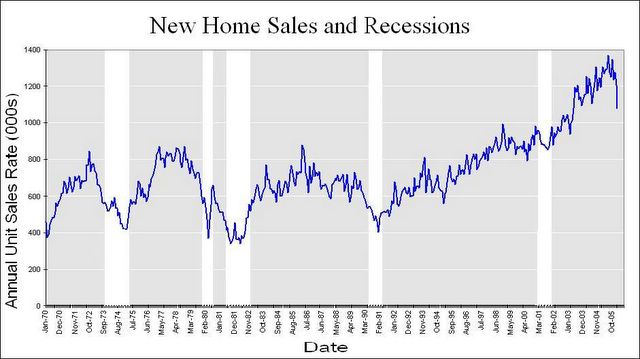
Calculated Risk put out one more chart today and gave me permission to share it.

New Home Sales vs. Recessions


Anyone that fails to understand the significance of the above charts is likely to become a card carrying member of REAC. A real estate bust and recession are both coming our way.

Mish note: No offense is meant nor should any be taken by anyone of any religious faith. I used Catholic hierarchy analogies for this post only because I am familiar with them by upbringing. This was an attempt to poke fun at "The Apologists Club", no more no less, using ideas that I could easily relate to from personal experience.

Mike Shedlock / Mish
http://globaleconomicanalysis.blogspot.com/
Imaginary Numbers

Today's post is on Imaginary Numbers.
Some people are not aware of it but, there are actually two kinds of imaginary numbers.

For a mathematical answer to the question "What is an imaginary number?" all one has to do is Ask Dr. Math .

The other kind of imaginary number comes from CEOs, the US government, and places like the National Association of Realtors (NAR). Today's lesson is about the NAR.

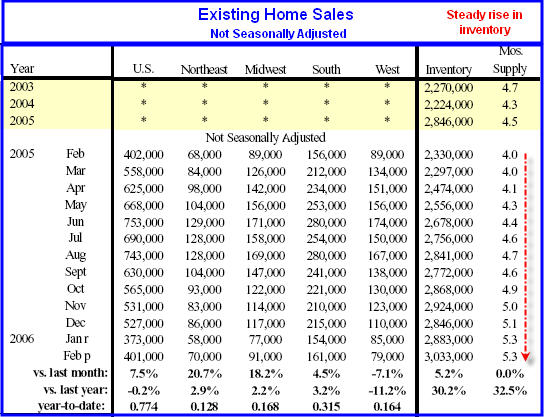
The National Assn. of Realtors reported Thursday that sales of existing single-family homes rose 5.2% last month to a seasonally adjusted annual rate of 6.91 million units. The biggest increase in two years took economists by surprise. They had expected a drop of about 1% after five months of declines.

Here are a couple of charts:


Notice the steady rise in inventory.
Notice also that although sales were "reportedly" up vs. last month, they were still down as compared to the same month last year.

The telepathic question lines are now open.
I am flooded with two questions.
1) OK Mish so what?
2) Why do you call those numbers imaginary?

Those are both good questions.
Here is one explanation as to why they are imaginary: The NAR existing home sales numbers are "survey numbers". The NAR should easily be able to provide exact numbers by adding up the numbers from all the local real estate boards. Can this be difficult with today's computers? Instead they do a quick survey of questionable accuracy.

Let's take our own sample.

California

Sales fell for 5th consecutive month and were 1.7% below February 2005. Inventory is up from a year ago by 40.5%. Nominal year over year prices fell for 2nd month in a row.

The Orange County Register says: Selling a home? You're not alone.
Let's face it. There's only reason to look at the Realtors' monthly existing-home-sale report: the dirt on inventories. So here's February's "Unsold Inventory Index" for single-family detached homes being sold by owners:

* The O.C.: 10.4 months worth of homes to sell vs. 5.7 months for the same period a year ago.
* California: 6.7 months vs. 3.2 months a year ago.
* U.S.: 5.3 months vs. 4 months a year ago.
Inman News is reporting California home sales plunge 15.5%
Unsold inventory levels climb to highest in several years, trade group says.

Existing-home sales dropped significantly in California in February, falling 15.5 percent from the same period a year ago, as inventory levels climbed and median prices continued to escalate, an industry trade group reported today.

Closed escrow sales of existing, single-family detached homes in California totaled 513,745 in February at a seasonally adjusted annualized rate, down from 608,160 a year ago, according to the California Association of Realtors. Median prices increased 13.7 percent to $535,470 from $470,920 a year ago.

Meanwhile, the February 2006 median price of an existing home in the state decreased 2.9 percent compared with January's $551,300 median price.
Florida

The Florida Association of Realtors is reporting a 20% decrease in sales.
ORLANDO, Fla., March 23, 2006 Statewide, sales of single-family existing homes totaled 13,539 in February compared to 16,916 homes a year ago, for a 20 percent decrease, according to the Florida Association of Realtors® (FAR).
Virginia

Seven out of eight 7 out of 8 areas comprising the Northern Virginia Association of Realtors had fewer sales. All eight reported higher inventory levels.

Another telepathic question just came in:
Mish, do you have any evidence at the national level?
Yes, actually I do. Here goes:

MBA Applications

The Mortgage Bankers Association (MBA) reports Mortgage Application Volume Down Slightly In Latest Survey.
WASHINGTON, D.C. (March 22, 2006) — The Mortgage Bankers Association (MBA) today released its Weekly Mortgage Applications Survey for the week ending March 17. The Market Composite Index — a measure of mortgage loan application volume was 565.0 – a decrease of 1.6 percent on a seasonally adjusted basis from 574.4 one week earlier. On an unadjusted basis, the Index decreased 1.6 percent compared with the previous week but was down 13.8 percent compared with the same week one year earlier.

The seasonally-adjusted Purchase Index decreased by 2.3 percent to 393.6 from 403.0 the previous week whereas the Refinance Index decreased by 0.6 percent to 1574.5 from 1583.6 one week earlier. Other seasonally adjusted index activity includes the Conventional Index, which decreased 1.4 percent to 833.4 from 845.2 the previous week, and the Government Index, which decreased 4.4 percent to 117.4 from 122.8 the previous week.

The four week moving average for the seasonally-adjusted Market Index is down 0.2 percent to 574.0 from 575.3. The four week moving average is down 0.4 percent to 401.5 from 401.9 for the Purchase Index while this average is down 0.2 percent to 1588.8 from 1593.4 for the Refinance Index.

The refinance share of mortgage activity increased to 38.1 percent of total applications from 37.7 percent the previous week. The adjustable-rate mortgage (ARM) share of activity decreased to 28.3 percent of total applications from 28.8 percent the previous week.
Hmmm. Lets see... The Purchase Index four week moving average is down to 401.5. It was 470 in October, 448 in December, and 447 in January. Does that sound like nationally increasing sales? Whatever is going on with the February numbers, be it real or imaginary, the overall trend should be clear to all but the most obstinate of real estate bulls: Sales Lower, Inventories Higher.

Missouri

Let's look at one more item hot off the press today:

The Kansas City Star is reporting First default, then despair.
Rising interest rates and a cooling real estate market conspire to undermine the financial well-being of homeowners and feed an increase in foreclosures.

More first-time and lower-income homebuyers are losing the American dream to foreclosures on the courthouse steps.

Real estate experts in Kansas City and nationwide say they are seeing a trend in which homeowners — often using adjustable-rate mortgages — have been unable to keep up with fast-rising interest rates, forcing them to balance higher monthly payments against already soaring energy costs and living expenses.

Making matters worse, experts say a cooling real estate market makes it less likely that financially strapped consumers can count on rising home values and equity to bail them out.

“Many people are living on the razor’s edge,” said Kansas City mortgage attorney Berry S. Laws III. “When their interest rates go up, they automatically have to pay more for the mortgage. People are betting their homes will appreciate, but if the value of their homes flattens out, they face a deficit.”

The warning signs are everywhere:
  • The Mortgage Bankers Association reports that the number of home-loan delinquencies nationwide in the last quarter of 2005 grew to a 2½-year high.
  • The association also noted a growing inventory of foreclosed homes, suggesting that banks are getting stuck with repossessed homes they can’t resell.
  • Foreclosure.com recently reported that the total number of foreclosures listed for sale in December rose 12.7 percent, reversing a recent trend of declining foreclosures. The online foreclosure-tracking firm estimated that about 92,000 foreclosed homes were on the U.S. market.
Last year, foreclosures rose 25 percent, according to RealtyTrac of California.

Nationally, bank regulators worry that mortgage delinquencies and resulting foreclosures will continue to increase this year.

“Rising mortgage delinquencies in 2005 apparently mark the end of a period of generally improving mortgage loan performance between 2002 and 2005,” said Richard A. Brown, chief economist for the Federal Deposit Insurance Corp., which insures banks.

According to FDIC statistics, the average 30-day past-due rate for subprime mortgages — those made to borrowers with limited or less than perfect credit — rose from 5.4 percent at the beginning of 2005 to 7.1 percent at year’s end, reversing an eight-year decline.

Missouri and Kansas borrowers may be faring worse.

Missouri’s average 30-day past-due rate rose last year from 7 percent to 9.2 percent, the FDIC said. Kansas’ rose from 5.7 percent to 7.6 percent.

Myra Batchelder, who heads the economic opportunity program at Demos, a New York think-tank on consumer issues, sees an ominous future for many Americans.

“The recent jump in foreclosures is a sign of a much larger problem: The American household economy is at a breaking point,” Batchelder said.

Bankruptcy obstacles

Some experts are predicting that the bankruptcy reform law that was adopted last year threatens to fuel an additional round of foreclosures.

The idea behind the law was to make it harder for consumers to shed debts. One big change requires credit counseling 180 days before filing for bankruptcy.

In the past, consumers who couldn’t pay their debts could go to a bankruptcy lawyer and immediately stop a foreclosure and at least keep a portion of their home’s value.

Not anymore, said Laws, the Kansas City mortgage attorney.

If homeowners can’t make house payments during the 180-day period before being approved to file for bankruptcy, Laws predicted, “they won’t be able to save their house. It’s a mess.”
Real Numbers
  • Mortgage indebtedness grew by $2 trillion in 2004 and 2005 alone.
  • Subprime lending grew 25 percent annually from 1994 to 2003, accounting for one of 10 home loans.
  • Qualifying debt-to-income ratios for subprime loans have risen from 28 percent to more than 55 percent.
  • U.S. average 30-day past due rates for subprime loans rose from 5.4 percent to 7.1 percent in 2005.
  • Average 30-day past due rates for subprime loans in Missouri rose from 7 percent to 9.2 percent in 2005.
  • Average 30-day past due rates for subprime loans in Kansas rose from 5.7 percent to 7.6 percent in 2005.
The Sad Truth

“The recent jump in foreclosures is a sign of a much larger problem: The American household economy is at a breaking point.”

Mike Shedlock / Mish
http://globaleconomicanalysis.blogspot.com/
Wednesday, 22 March 2006

Take the Package and Run

CNN Money is reporting GM offers workers up to $140K to leave.
General Motors is offering hourly workers as much as $140,000 each to leave the troubled automaker as it extends its push to cut labor costs and put an end to billions of dollars in losses.

GM announced the agreement with the United Auto Workers union Wednesday, though it did not give the details of the offer extended to all of its 113,000 U.S. hourly employees.

But a person familiar with terms of the offer said that UAW members with at least 10 years of service at the world's largest automaker will get $140,000 if they give up the retiree health care coverage that has become a crippling burden for GM. Those workers will keep their accrued pension benefits.

Those with less than 10 years service will get $70,000 if they leave without the health care coverage.

Industry experts said that relatively few GM employees were likely to take the buyouts, though, since most of them are eligible for an alternative early retirement package announced Wednesday that would allow them to keep their health care coverage.

Some workers could receive more than $100,000 under the early retirement plan, and that could limit the cost-savings to GM, analysts said.

"It's a major step forward but it's certainly no where near all what they have to accomplish to turn North America around," said David Healy at Burnham Securities, who does not have a formal rating on the stock.

The company announced the early retirement package as part of long-awaited contract agreement with bankrupt auto parts maker Delphi and the UAW -- a deal seen as key to avoiding a crippling strike at the parts supplier.

Some analysts said GM's moves were not enough to change their view of the stock, and the stock barely edged higher in afternoon trading on the New York Stock Exchange.

Efraim Levy, an auto analyst at Standard & Poor's, reiterated his "sell" recommendation on GM stock after the announcement. "I don't look at it as a particular positive by itself," he said.

Levy said most workers know the value of the retiree health care plan at GM and will not forfeit that benefit. "I'm sure there are people who could use an immediate cash infusion, but I don't think it'll be a big percentage," Levy said. "I don't think I would take that deal."

He said most who do take it will have another source for health coverage, such as a spouses' health plan, or will be those who doubt GM's retiree health care plan will survive in the long run.

He also said the agreement with Delphi, while an important step to avoiding a strike there, also is not a final solution to the negotiations between the bankrupt auto parts maker and the union.

UAW President Ron Gettelfinger said that while the union leaders support the buyout and early retirement offers, they still have serious disagreements with Delphi.

The top pay for a GM hourly employee is $27 an hour, but with benefits and future health care costs GM estimates that hour of work costs the company $73.73. The flat wage works out to about $56,000 a year before overtime, so those taking a $140,000 buyout would get about 2-1/2 years of pay in the lump sum.

GM has an incentive to offer buyouts and early retirement because of job guarantees for UAW members that run through September 2007. It announced plans in November to close a dozen plants and slash 30,000 jobs in North America, but without employees taking early retirement or the buyouts, GM will have to keep paying them almost their full salary.

GM also has contract obligations to the union members at Delphi, which it spun off in 1999. It said those costs could have gone as high as $12 billion, though last week it said the cost would likely be closer to the $5.5 billion pretax charge it took in the fourth quarter.

GM announced Wednesday it will take additional charges this year as part of the new offer.

Delphi executives, who are seeking steep concessions and set a March 30 deadline for a deal, have threatened to go to the bankruptcy court to have its labor deals thrown out without an agreement. The union has threatened a strike if Delphi takes that step.

Delphi said it will keep talking to try to reach a pact with the UAW and other unions at Delphi. But the three-way agreement announced Wednesday could clear the way for those pacts.

S&P's Levy is among those who do not think there will be a strike at Delphi. "There's too much at risk not to reach an agreement," he said.

Under the early retirement offer, GM's eligible workers are being offered $35,000 to retire now. GM also will offer 13,000 Delphi employees with 30 years of service the same $35,000 to retire. And GM is also offering jobs at GM to 5,000 Delphi employees to help its former parts unit cut costs.

GM has 36,000 U.S. hourly employees with at least 30 years of service who are eligible for retirement. Another 27,000 are within three years of that threshold, according to GM.

The latter group will also get an early retirement offer of $30,000 to $36,000 a year as they accrue service. The GM and Delphi employees who take those retirement incentives will retain their health care coverage.

The company says the average GM hourly employee is 50.4 years old and has 24 years of service, so a majority of the U.S. hourly work force is within a couple of years of retirement and will probably not even have to weigh giving up their retiree health care coverage.
I am struggling to reconcile two paragraphs from the article:

1) UAW members with at least 10 years of service at the world's largest automaker will get $140,000 if they give up the retiree health care coverage that has become a crippling burden for GM. Those workers will keep their accrued pension benefits.

2) Under the early retirement offer, GM's eligible workers are being offered $35,000 to retire now. GM also will offer 13,000 Delphi employees with 30 years of service the same $35,000 to retire. And GM is also offering jobs at GM to 5,000 Delphi employees to help its former parts unit cut costs.

It seems the difference between $35,000 and $140,000 is in giving up retiree health coverage. At $140,000 per employee, does anyone think these terms will ever get better?

Given that GM has an incentive to offer buyouts and early retirement because of job guarantees for UAW members that run through September 2007, it would seem likely that any such offers would be likely to decrease over time. Offers would end abruptly if GM decided to heck with it all and just filed for bankruptcy.

GM has 36,000 U.S. hourly employees with at least 30 years of service who are eligible for retirement. Another 27,000 are within three years of that threshold.

If everyone with 27 years of service takes the offer and drops the medical coverage, that would be 63,000 workers at $140,000 each or $8,820,000,000. That is quite a bit of cash given that Those workers will keep their accrued pension benefits.

Does GM even want to get rid of 63,000 workers? The announced cutback was 30,000 workers. Assume they are willing to get rid of another 15,000 workers. 45,000 workers at $140,000 each would set GM back $6,300,000,000.

But how does that even let GM off the hook? It would chew up considerable cash and GM would still have pension obligations.

It seems to me that this is a more than fair offer and the employees should take it.
Wouldn't $140,000 buy a lot of medical coverage if one wanted it?
Those over 65 would be eligible for Medicare would they not, so why not take the money and run?

I just do not comprehend this position by the S&P: Levy said most workers know the value of the retiree health care plan at GM and will not forfeit that benefit. "I'm sure there are people who could use an immediate cash infusion, but I don't think it'll be a big percentage," Levy said. "I don't think I would take that deal."

In light of the fact that the S&P has the odds of a GM bankruptcy at 30% and Levy himself "reiterated his "sell" recommendation on GM stock after the announcement. "I don't look at it as a particular positive by itself" he said, one can only wonder "What the heck is he thinking?" One can get 2 1/2 years pay and still not lose pension benefits or stay and worry about bankruptcy and the terms thereof for the rest of his life!

As I see it, there should be 63,000 workers scrambling for a mere 30,000 to 45,000 potential offers.

I did a quick post on this earlier today on the Motley FOOL without crunching through the numbers and this is what Kestral had to say:
Having seen people around me who have been offered packages, the right choice so far has always seemed to be to TAKE THE PACKAGE.

A typical example: a friend of mine worked for a school board for 20 years as a teacher assistant and the board needed to cut budget, so they offered her and some of her colleagues a package. She took the package which was a lump sum of money.

The board started doing things to those that stayed to "motivate" them to leave (e.g. assigning the TAs to two schools, one in the morning in the east side of town, then one in the afternoon on the west side). Those people got no package.

In other cases, packages were offered again but a lower amount.

So from what I've seen, when the offer a package: Do not pass GO, bypass Boardwalk, take a ride on the Reading Railroad and go directly to PACKAGE. TAKE IT.
On the assumption that $140,000 is indeed a valid offer I have to agree with Kestral "Do not pass GO, bypass Boardwalk, take a ride on the Reading Railroad and go directly to PACKAGE. TAKE IT."

Mike Shedlock / Mish
http://globaleconomicanalysis.blogspot.com/
In Praise of Saville

Steve Saville wrote a very nice piece on inflation entitled The Non-Stop Inflation. Although we disagree on the "end game" it sure is nice to see someone properly explain what inflation is, what it is not, and why measuring the CPI is fraught with so many problems as to make it useless. Steve wrote:
The definition

The correct definition of inflation is an increase in the supply of money that CAUSES a decrease in the purchasing power of money, but we usually define it as simply an increase in the supply of money. This is done, in part, for the practical reason that it's impossible to measure changes in the purchasing power of money on an economy-wide basis.

It is not possible to measure changes in the overall purchasing power of money because it is not possible to come up with a meaningful number that represents the average price level within an economy. There are, of course, price indices such as the CPI that purportedly represent the average price level, but these indices are generally worse than useless because they are calculated in such a way that they are guaranteed to paint a misleading picture. And in any case, even an honest attempt to determine the average price level would fail. The reason is that even if it were somehow possible to determine a meaningful number that represented the average of things as different as eggs and new cars, a calculation that was valid today would, in a dynamic economy, be obsolete tomorrow.

To illustrate just one of the insurmountable challenges of coming up with a price index that accurately represents the EFFECTS of inflation let's consider the hypothetical example of the $2 widget made in the US. In our example we'll assume that monetary inflation within the US over many years pushes up manufacturing costs such that these widgets can no longer be made in the US and sold at a profit for anything less than $3; in other words, if nothing else changes then the inflation will cause the dollar's purchasing power to fall from 0.5 widgets (2 dollars = 1 widget) to 0.33 widgets (3 dollars = 1 widget). But something else does change. Instead of raising the selling price of the widget from $2 to $3 in response to the increase in costs, what actually happens is that our hypothetical widget manufacturer keeps the selling price the same and opens a factory in a part of the world where manufacturing costs are much lower. Therefore, in our example inflation causes the dollar's purchasing power to fall and this, in turn, leads to the closure of a factory in the US and an increase in the quantity of imported goods. Inflation has obviously had an important effect, but it's unlikely that any price index will capture this effect.
There can be no real meaningful discussion of inflation or deflation unless one agrees on a definition. I am pleased to see that in spite of one of us being an inflationist and the other a deflationist, we have independently surmised what the real problem is: expansion of money supply and credit.

In Inflation: What the heck is it? and Inflation Monster Captured, I wrote many reasons why attempting to measure inflation by looking at the CPI was a fool's game. It is good to see someone who has a radically different view of the end game than I do at least agree as to what the problem is.

Given that the problem is a rampant expansion of money and credit, the solution can not possibly be a "price stability" policy that attempts to measure consumer prices. With all the hedonic adjustments (many justified but probably all overstated), with all the nonsense about core inflation vs. non-core inflation, with all the imputed economics, with all the understating of medical costs, and with enormous discrepancies between rental costs vs. housing ownership costs, there is not a person on this earth that could possibly know 2% price increases if it hit them smack in the face.

Right now I am in a huge debate with someone on Silicon Investor. It seems that even otherwise reasonable people (which I think both of us are), simply can not come to agreement about whether or not quality improvements should be factored into the CPI.

My position is that quality improvements should be factored in otherwise one is not comparing apples to apples. Take autos for example: antilock brakes, seat belts, air bags, improved gas mileage, air conditioning, CD players, electronic ignition, fold down seats, windows that safely shatter, better gas mileage, intermittent wipers, reduced emissions, etc, are all quality improvements that have appeared in cars over time.

As compared to 1924 even the amount of raw materials going into cars has gone up dramatically (copper, electronics, rubber, aluminum, steel, glass, etc). On a component basis alone (forgetting about quality improvements like intermittent wipers and safer glass) I just do not see how one can reasonably claim that the difference in price of a car today vs. 1924 can all be chalked up to "price inflation". Yet somehow there is a disagreement as to whether or not either component changes or quality improvements should be factored in. No wonder people have wildly differing views of price increases. In practice, it seems that people see the every price increase as "inflation" but fail to see or account for obvious improvements in quality. Getting agreement as to how to measure quality improvements is of course impossible if one can not even get agreement that it should be done at all.

To be sure, the government overstates those quality improvements and does so on purpose so as to lower the CPI. This makes Social Security and other cost of living adjustments (COLAs) as small as possible. Such manipulation is of course is another reason why CPI price targeting is wrong.

While I agree with Saville about the necessity of tracking money M3 is probably not the best way to do it. Shostak has pointed out problems with the "M-series" of money supply measures in Making Sense of Money Supply Data as well as other articles that he has written.

The distinction between money and credit it is an important one, and each needs to be tracked separately given the extent of our fractional reserve lending. In Japan, the government continually injected money for 18 years in an attempt to fight deflation but credit contracted at a greater rate nearly the entire time. I believe the same will happen here.

For those that want to compare my end game scenario with Steve's here they are.

Saville:
The End Game

Mish:
End Game Analysis
The Red Queen Race


For now, I want to thank Steve Saville for continuing to spread the word as to what inflation is and what it is not. Time will tell which (if either) of us has the "end game" pegged.

Mike Shedlock / Mish
http://globaleconomicanalysis.blogspot.com/

Tuesday, 21 March 2006

No Payments until January 2007

I called Ryland today about their "Choose-It" promotion. It was quite hard getting any information out of them.

Here is what I can gather:
This seems to be some kind of "fluff offer" that perhaps they are praying will work. It does not appear to me to be any substantial offering of any kind nor any real panic by Ryland.

I tried like mad to get the salesperson to tell me how much they would take off of homes (price reductions), but the best I could get was $30,000 - $60,000 in "select" Phoenix locations. He asked me where I wanted to live (and this is where it got harder as I do not know a thing about Phoenix). He gave me a friendly lecture about picking a section of the city first and starting there.

All I wanted to know was how big are the discounts and on what price homes. He was trying hard to NOT tell me that on a model by model or price range basis. It was my first unsuccessful attempt to get info. With Centex and others I was able to go model by model and have someone tell me what the reductions were. Not so with Ryland.

In Bubble Busting Phoenix I reported there were 14,601 Vacant Homes in greater Phoenix area. At the moment that does not seem to be of much concern to Ryland. I could only find a dozen or so homes on the Ryland site that were "available soon" and only one of them was "immediate".

Although the message boards I frequent were talking about this campaign, it does not seem to be panic but rather much ado amount nothing. Still Ryland will quickly be adding to the already mammoth supply of Phoenix inventory.

Here is an anecdote from StB on the Motley FOOL just today about Phoenix:
Well, we have had our house on the market for five months, nearly to the day. The first three months were capped by the holidays, non-aggressive pricing on our part, and non-aggressive marketing. In the subsequent two months, we got very aggressive on our price and marketing, but it took us cutting our list price $5k under where we thought it would move to get significant traffic through the doors.

We are now under contract for $12k under our list price...again, more than we thought. Over the timeframe, our list price dropped by $30k, and our final sell price is also $30k less than we originally thought it would sell for. During the time our house was on the market, we saw identical floor plans in this community sell for continually decreasing price: September (before ours went on the market) the price has steadily declined by about $10k every six weeks. Folks, if you needed any further confirmation that the PHOENIX market is declining, here is your anecdotal evidence.
I am making a note to check back into Ryland Phoenix in a few months when more houses will be available. It will be interesting to see who wants to buy a home and for what price in the dead heat of summer. I am also wondering how long it will be before we see "No payments until January 2009".

Mike Shedlock / Mish
http://globaleconomicanalysis.blogspot.com/
Saturday, 18 March 2006

The Current Account and Credibility Gaps

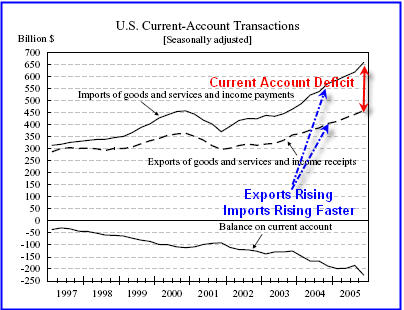
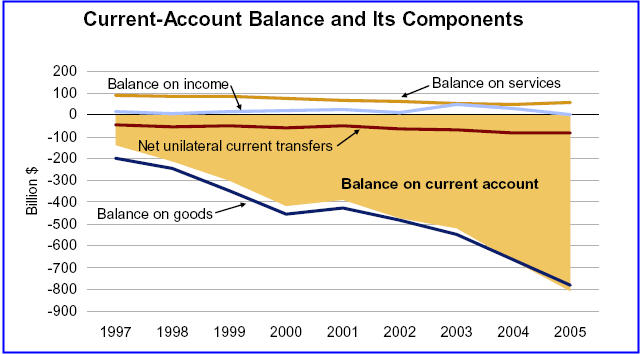
The U.S. current account deficit widened by 21.3% to a record $224.9 billion for the fourth quarter of 2005 the Commerce Department reported Tuesday March 14th. The deficit was 7.0% of the nation's gross domestic product, also a record.


For all of 2005, the current account balance grew to a record deficit of $804.9 billion, totaling a record 6.4% of GDP.

The current account balance is a broad measure of the nation's economic balance sheet with the rest of the world. It encompasses both trade and capital flows. It essentially measures the nation's debt with the rest of the world, which must be financed by loans from abroad or asset sales to foreigners. It was the ninth annual record in the past ten years. The deficit in the third quarter was revised to a record $185.4 billion, compared with the original estimate of $195.8 billion.


Alice in Wonderland

In our current Alice in Wonderland scenario, the US (one of the richest per capita income countries in the world) is borrowing heavily from China (one of the poorest).

In Save More! Save Less! Stephen Roach had this to say Mar 09, 2006:
The two major players in the global economy, the US and China, are operating at opposite ends of the saving spectrum. Thrifty Chinese have taken saving to excess, while profligate Americans have spent their way into debt.

Last year China saved about half of its gross domestic product, or some $1.1 trillion. At the same time, the US saved only 13% of its national income, or $1.6 trillion. That's right, the US, whose economy is six times the size of China's, can't manage to save twice as much money.

And that's just looking at national averages that include saving by consumers, businesses, and governments. The contrast is even starker at the household level — a personal saving rate in China of about 30% of household income, compared with a US rate that dipped into negative territory last year (-0.4% of after-tax household income).

These are extreme readings by any standard. The US hasn't pushed its personal saving rate this far into negative territory since 1933, in the depths of the Depression. And the Chinese rate is higher than it has been at any point in the past 28 years, since its modern reforms began. Similar extremes show up in the consumption shares of the two economies — the mirror image of trends in personal saving rates. US consumption has held at a record 71% of GDP since early 2002, while Chinese consumption appears to have slipped to a record low of about 50% of GDP in 2005.

America's lack of saving has also put unprecedented demands on the rest of the world, since the US must import surplus saving from abroad in order to grow. America's current account deficit hit a record of nearly 6.5% of GDP in 2005 and could well be headed north of 7% this year. That translates into a lifeline of foreign capital totaling about $3 billion per business day.

There is a more insidious connection between the saving postures of China and the US: Chinese savers are, in effect, subsidizing the spending binge of American consumers.
In Tripwires on Mar 13, 2006 Stephen Roach went on to say:
The Dubai port incident, unfortunately, is only the tip of a much bigger iceberg. There was also last year’s high-profile rejection of a bid to buy Unocal by a Chinese oil company. Moreover, in recent weeks, Washington’s increasingly xenophobic politicians have gone even further. A leading US senator floated the possibility of legislation preventing cross-border acquisitions of US companies by foreign state-owned entities. And during last week’s negotiations over the debt ceiling bill -- with a lifting of the government’s debt limit required only because a saving-short US has decided to up the ante on deficit spending -- there was actually an attempt made to restrict foreign ownership of US Treasuries. The good news, if you want to call it that, is that this latter attempt has since been watered down “only” to require a detailed accounting of the overseas holding of US government debt. But the irony of these politically motivated efforts to throw “sand in the gears” of America’s external funding mechanism is especially striking: At precisely the moment when the US has pushed its external funding requirements into unprecedented territory, it is becoming more and more aggressive in dictating the terms of the requisite inflows.

To me, all this speaks of an increasingly treacherous endgame for the current state of tranquility in world financial markets -- especially the all-important expectational underpinnings of the dollar and longer-term US real interest rates. Investors are nearly unanimous these days in dismissing the mounting economic and political tensions of an unbalanced world -- arguing that it is in everyone’s best interest to keep the game going. The retort of increasingly smug US fund managers is typically something along the lines of, “What else are the Chinese going to buy -- euros?”

Add in the current tensions associated with widening income disparities, real wage stagnation in developed countries, and the growing outbreak of trade frictions and protectionism, and today’s world looks far from secure. The tripwires of globalization are now being set.
Bernanke Washes His Hands

On March 14th Ben Bernanke attempted to wash the US Government's hands as well as the FED's own hands by claiming Imbalances are driven by markets not policy.
Global trade imbalances are a market-driven phenomenon that government policies can do little to address, U.S. Federal Reserve Chairman Ben Bernanke said in a letter released on Tuesday.

"In the absence of a shift in market perceptions of the relative attractiveness of U.S. and foreign assets, government policies would likely have only limited effects on the trade balance," Bernanke said in the March 9 letter to New Jersey Democratic Sen. Robert Menendez.

The letter was in response to a question the senator submitted in connection with a February 16 Senate Banking Committee hearing on the Fed's semiannual report on monetary policy. "This excess saving has been attracted to the United States by our favorable investment climate, strong productivity growth, and deep financial markets," he said.
Quite frankly this is preposterous. The FED slashed interest rates to 1%, which spawned off a global property bubble, reignited the stock market bubble, and embarked on the greatest liquidity experiment the world has ever seen. Meanwhile the Bush administration slashed taxes, increased spending and Ben Bernanke wants us to believe that somehow this is China's fault and not US government and FED policies largely responsible for this situation?!

To top it off, not only do we run enormous imbalances with the rest of the world we want to tell them what they can or can not buy with THEIR dollars. At precisely the moment when the US has pushed its external funding requirements into unprecedented territory, [the US] is becoming more and more aggressive in dictating the terms of the requisite inflows.

Last year we refused to let China buy controlling interest in Unocal , and recently refused to let the United Arab Emirates take over operations of our ports. For the record, oil is fungible and it would not have mattered one bit whether we sold Unocal to China vs. anyone else. Just Last week Congress actually had the audacity to propose restricting foreign ownership of US Treasuries (quite frankly that is laughable or scary depending on how you look at it). We also restrict "sensitive" software, military hardware, and anything else they really want.

Ben Bernanke, care for a little debate on this idea of yours that "Market Forces" and not the government that is the culprit here?

Protectionism

Does anyone believe US threats of "protectionist barriers" unless China takes action on currency reform?
Speaking on Tuesday, US Commerce Secretary Carlos Gutierrez said that if China did not take action on currency reform it would encourage those in the US seeking to put up "protectionist barriers".

Support for legislation which would slap tariffs of more than 25% on certain Chinese goods if Beijing does not further revalue the yuan is thought to be gaining support among sections of Congress. Pressure is growing for China to act ahead of a visit by Chinese president Hu Jintao to the US next month.

"If our economic relationship is to stay afloat, China needs to lighten the load by carrying out reforms and delivering results," Mr. Gutierrez said.
I am wondering if that is a credible threat. Are we really hell bent on raising prices of Chinese goods 25% to save 300 underwear manufacturing jobs in the US? Then again it could be a serious mistake to underestimate blatant stupidity on behalf of Congress in general and this Congress in particular. It will be shades of Smoot-Hawley if we pass such legislation.

Quite frankly, and unfortunately there are credibility gaps of this nature everywhere you look: on the budget, on social security, on WOMDs, on Iraq, on housing, on wiretapping, on Medicaid, on homeland security, on jobs and on the war on terror. Furthermore there is a blatant bombardment of BS from both the public an private sectors.

Housing Credibility Gaps

David Lereah, the National Association of Realtors chief economist, said the latest housing reading shows a flattening that is in line with "the soft landing we've been expecting." for the housing market. "We are at a much more sustainable level of home sales now - a welcome cooling from the super-heated conditions that were driving exceptional price gains."

How can he possibly know we are experiencing a soft landing when we have not landed yet? Furthermore does anyone find his statement credible that Realtors "welcome" this cooling?

What is that saying about swampland in Florida? I think it goes something like this: "If you believe 'that' then I've got some swampland in Florida to sell you." Is that what is happening here? St. Joe Company Introduces "FloridaWild" Land Parcels of 40 Acres and More, Ideal for Outdoor Enthusiasts and Conservationists.

Ideal? Ideal for what? Wading in muck and getting attacked by swarms of mosquitoes?
I think there is a serious credibility issue here.

Snow is Confident

Back on March 3rd treasury Secretary Snow said the Failure to save shows confidence in future paychecks.
In a telephone interview with The Chronicle, Snow said that he thinks wages now are at a "tipping point" where they will start rising. Snow also put a positive spin on Americans' negative savings rate. Recent studies have shown that in 2005 average spending outpaced earnings for the first time since 1933 as people financed consumption by dipping into savings or taking on debt.

"One way to look at it is that people tend to consume out of their expected long-term income," he said. "The strong consumption could be interpreted, probably should be interpreted, as a vote of confidence in the direction of the economy and the fact that people feel good about their prospective earnings, the sustainability of their jobs and the strength of the job markets."
Does anyone really find that credible? If so, I've got some swampland in Florida to sell you.

Bernanke Praises Derivatives

On March 15 Ben Bernanke was quoted as saying Derivatives make economy resilient
"Although no single factor accounts for this favorable performance, derivative instruments undoubtedly have contributed to this resilience because they offer firms means for managing their risks," Bernanke said.
His comment was in response to a question submitted in writing from Republican Sen. Mike Crapo of Idaho in connection with a February 16 Senate Banking Committee hearing on the Fed's semiannual report on monetary policy.
Bernanke said derivatives, whose value is based on that of some underlying factor, "have contributed to our understanding of the measurement and management of risk" and thus helped make the financial system as a whole more resistant to shocks.
"Certainly, derivatives instruments pose challenges to risk managers and to supervisors, but these risks are manageable and thus far have been managed quite well," Bernanke said.
"Market discipline has provided strong incentives for effective risk management, the key to ensuring that the benefits of derivatives continue to be realized," he added.
On March 15 Bloomberg reported Credit Derivatives Market Expands to $17.3 Trillion.
The global market for credit derivatives increased by 39 percent to $17.3 trillion in the second half of 2005 on demand for contracts to bet on corporate credit quality or insure against defaults, the International Swaps and Derivatives Association said.

Credit-default swaps, which pay compensation in the event of borrowers defaulting on their debt, expanded 105 percent in the full year, leading an increase in the $236-trillion market for derivatives, or contracts based on underlying assets. The market's growth was slower than 123 percent increase in 2004, ISDA said in a report today at its annual meeting in Singapore.

Regulators are worried that credit derivatives are increasing too quickly for banks to control. The Federal Reserve Bank of New York has demanded action to tackle a backlog of contracts left unsigned for weeks or months, and for banks to address a shortage of bonds to settle contracts.

Contracts to swap between fixed and floating interest payments, the biggest derivatives market, increased 6 percent to $213.2 trillion, ISDA said. The growth rate was slower than the 10 percent expansion in the first half, said New York-based ISDA, a trade group representing more than 700 banks, securities firms and institutional investors.
The other side of the Derivative Debate

Back on March 7th, Howard Simmons (one of my favorite contributors to RealMoney.com) wrote an interesting piece entitled Dana Bonds Show Ugly Credit Incentive . Following are a few snips:
One of the sadder and more predictable outgrowths of the expansion of the Federal Savings and Loan Insurance Corp. (FSLIC) insurance in 1980 to $100,000 per account was the emergence of the "Texas Run" toward troubled S&Ls. That's right, toward. As word spread that an S&L was in trouble, it was forced to pay a higher rate on its certificates of deposit. CD brokers, not to be confused with homonymous seedy brokers, bundled all sorts of small deposits into $100,000 packages and sent them to the troubled S&L. Who cared if the S&L then failed? The CDs were insured.
Credit Default Insurance

The topic of credit default swaps (CDS) and how they are used was outlined here last April and then again in May. These instruments act as put options; they allow the bondholder to deliver the bonds at par, the bond's face value, to the CDS writer in the event of a credit event. As the risk of bankruptcy or another credit event rises, the price of a CDS expressed in basis points rises as well. CDS writers, like those who write put options, are on the hook to buy the bonds at par to deliver to the CDS buyers.

Just as the open interest of a futures or options contract can swell to a quantity greater than what is available for delivery, the volume of CDS contracts created in this over-the-counter market can swell way beyond the physical quantity of the actual corporate bonds being covered. And I do mean way beyond; while actual data are hard to come by, some estimate that the volume of outstanding CDS contracts on bonds for now-bankrupt auto parts manufacturer Delphi was 140 to 175 times the actual quantity of bonds available.

The world of distressed-security hedge funds and the emergence of credit traders have created a situation wherein the bondholder gets rewarded when the company gets in trouble. Every corporate bond with an excess of CDS written on it now embeds a call option on the firm's bankruptcy. Once a firm gets into trouble and blood is in the water, the bondholders may have a positive incentive to see the firm fail.

Yes, insurance changes behavior. Free stock options created problems in the 1990s boom. Will these "free" call options on bankruptcy create incentives among the bondholders, especially those who hold CDS protection, to see the firm fail? Absolutely, and the sooner we address this issue, the fewer next-generation Enrons and WorldComs we will see.
So we have a world where 14,000% to 17,500% of the total bonds of a corporation are in play via credit derivatives and this according to Bernanke "makes the economy resilient"? Is infinite leverage is a good thing? It must be according to Bernanke.

Ben Bernanke ($Ben) has long ago blown his credibility. Every time he opens his mouth the credibility gap seems to widen. I apologize for not posting a chart of the combined total credibility gap. It simply went off the scale.

Notes:
There is an audio covering this blog and much more on Howe Street.
Please look in the left hand column for "Startling stats and a Credibility Gap" by Mike 'Mish' Shedlock. In the past, some people have reported problems playing those podcasts. I think most of the problems have been solved, even for Apple users. Please play that podcast and let me know of any problems you are experiencing, and I will pass them on to HoweStreet.

I am also pleased to announce that I am starting a newsletter called the "Survival Report" with a good friend, Brian McAuley, a superb chart technician. For more details please subscribe to Whiskey & Gunpowder, a free publication. The current edition is available for free at The Survival Report. Brian and I welcome your feedback and your suggestions.

Mike Shedlock / Mish
http://globaleconomicanalysis.blogspot.com/