


If ever words were spoken that will quickly be eaten here they are:
Paulson says "Absolutely" no recession.
Treasury Secretary Henry Paulson said he's talking with Wall Street leaders on Tuesday about how to strengthen the U.S. economy and capital markets. Paulson commented in an interview on CNBC television ahead of a public speech at Columbia University. Paulson made no changes in U.S. policy, saying that a strong dollar is in the national interest, and calling on China to embark on structural reforms that would create more flexibility in its currency and allow for greater domestic consumption. He said the fiscal deficit is improving, but its long-term stability depends on reforms in entitlement spending. Asked if the economy faces a recession in the near term, Paulson declared, "Absolutely not."
I find it interesting that Bush has managed to find yet another shill willing to say that "a strong dollar is in the national interest" while prodding China float the RMB in hopes that the dollar will sink.
As for a recession, the treasury market has a different opinion as I noted earlier today in CPI Tops Fed Target.
An inverted yield curve has only once failed to predict a recession.
Right now we have not only had our second inverted yield curve in a year, but housing is collapsing by any reasonable measure one looks at.
One can either believe shills like Paulson or one can believe the yield curve and housing. It's your choice. Believe what you want.
Mike Shedlock / Mish
http://globaleconomicanalysis.blogspot.com/
Tuesday, 1 August 2006

CPI Tops Fed Target
CNN Money is reporting Inflation again tops Fed targets
Here is what caught my eye.

The above chart is thanks to Bloomberg. It was created at roughly 12 Noon central. As of 12:30 there was virtually no change on the long end at all. Basically the only reaction was for the yield curve to invert further.
The market has weighed in.
My interpretation follows:
We are witnessing the final stages of the lagging effects of past Fed policy.
Future inflation is not much of a concern and if Bernanke hikes once more the curve will invert by a full 50 basis points if not more.
Of course this interpretation could be fraught with error. Perhaps today’s reaction is just a one day random event. I just doubt it. The yield curve has been singing this tune for some time now after flirting with it most of the year. We are now well into our second inversion this year. The first came back in January but the curve flattened out in February. This inversion has been deeper and has lasted longer.
There are those that think the bond market is being "manipulated". Not me, I do not think it can be done, at least not effectively or for a sustained duration. The primary trend can be slowed or enhanced but not stopped.
Look at all the money the Bank of Japan wasted selling Yen to buy US dollars over the last few years. It did them no good. Furthermore, the YEN tanked as soon as they stopped (contrary to everyone's belief at the time). How is that for irony?
A close look at the numbers says the treasury market is right now more worried about a recession than the likelihood of continued inflation. In this case I think the inverted yield curve is the window, and the CPI is the rear view mirror. Please look out the window. There is a curve ahead that can not be seen by watching the CPI.
Mike Shedlock / Mish
http://globaleconomicanalysis.blogspot.com/
Key core price gauge up 2.4% over 12 months, fastest in 4 years; spending, income numbers match forecasts.Supposedly this "caught the eye of traders".
Core consumer prices rose a moderate 0.2 percent in June for a third straight month, but the year-on-year rate hit a nearly four-year high, keeping financial markets on edge over a possible Federal Reserve interest-rate hike.
In the same report, the Commerce Department said Tuesday that personal income rose 0.6 percent in June, with nominal spending up 0.4 percent. The data, which was incorporated in a report released Friday on second-quarter economic growth, matched Wall Street expectations.
Still, the 2.4 percent rise in prices excluding food and energy over the past year, the biggest gain since September 2002, caught the eye of traders on Wall Street.
"This should alleviate any fears that folks had after seeing that GDP number that showed the economy was slowing more than we thought," said Mark Vitner, senior economist at Wachovia Securities in Charlotte, North Carolina.
"It looks like the economy has very good momentum going into the third quarter," he said of the spending and income figures.
Here is what caught my eye.

The above chart is thanks to Bloomberg. It was created at roughly 12 Noon central. As of 12:30 there was virtually no change on the long end at all. Basically the only reaction was for the yield curve to invert further.
The market has weighed in.
My interpretation follows:
We are witnessing the final stages of the lagging effects of past Fed policy.
Future inflation is not much of a concern and if Bernanke hikes once more the curve will invert by a full 50 basis points if not more.
Of course this interpretation could be fraught with error. Perhaps today’s reaction is just a one day random event. I just doubt it. The yield curve has been singing this tune for some time now after flirting with it most of the year. We are now well into our second inversion this year. The first came back in January but the curve flattened out in February. This inversion has been deeper and has lasted longer.
There are those that think the bond market is being "manipulated". Not me, I do not think it can be done, at least not effectively or for a sustained duration. The primary trend can be slowed or enhanced but not stopped.
Look at all the money the Bank of Japan wasted selling Yen to buy US dollars over the last few years. It did them no good. Furthermore, the YEN tanked as soon as they stopped (contrary to everyone's belief at the time). How is that for irony?
A close look at the numbers says the treasury market is right now more worried about a recession than the likelihood of continued inflation. In this case I think the inverted yield curve is the window, and the CPI is the rear view mirror. Please look out the window. There is a curve ahead that can not be seen by watching the CPI.
Mike Shedlock / Mish
http://globaleconomicanalysis.blogspot.com/
Friday, 28 July 2006
Look at the Numbers
 2006-07-28
Today's Thought of the Day comes from John Succo at Minyanville.
The CEO of DOW was on financial TV last month telling the world how great things were and how positive he was on the company. Yesterday the stock blew up.
We never listen to what people say. We don't listen to Ben Bernanke. No one can tell you anything about the future. You can have an understanding of the state of things, but not how people will react to that state. Trends are uncertain and even CEOs can't tell you much about them. Trends in products that have wide profit margins (insurance) can change overnight; trends on products with small profit margins (toothpaste) are more stable, but the companies are more levered.
We only listen to numbers. The sooner people understand this the sooner they will stop losing money trading stocks. Everyone has an agenda. Numbers do not: people can make the presentation of numbers false, but they cannot make the numbers themselves lie.
So the next time any media says something, take it with a grain of salt. Before you invest your hard earned money, look at the numbers.
John Succo / Minyanville
Mish:
Thanks to Professor Succo and Minyanville for that thought of the day.
Today's number to look at is the GDP.
Here it is in all its glory:
==========================================================Well the market "seemed" to like the fact that the GDP is slowing but no one can "really" say much of anything othere than the market rallied because it wanted to. Perhaps a better way of looking at it is "risk takers are willing (once again) to plunge back in on any bad news". Bad news has been bought for three straight years so why not buy bad news today?
!Gross Domestic Product 2nd 1st 4th Consensus: !
! Overall GDP Growth 2.5% 5.6% 1.8%r +3.2% !
! PCE Price Index 4.1% 2.0% 2.9% Actual: !
! +2.5% !
==========================================================
Rest assured GDP at 2.5% with housing collapsing and 2.5 trillion dollars worth of ARMS resetting over the next two years is not good news. Those too are important numbers but today those numbers do not matter. Perhaps those numbers matter tomorrow.
Supposedly the spin of the day is the market is looking forward to a pause. Of course the pundits have been saying the market has been looking forward to a pause for 5 months now. If and when the Fed pauses, slow growth will be one of the reasons.
The odds of a seeing a sustained rally on a Fed pause has been a losing bet. Not only did it take a pause but several surprise cuts by the Fed in 2000 and 2001 to get a rally. The first couple of rally attempts were eventually sold very hard. In fact, the market did not make a sustained rally until the Fed has slashed rates all the away to 1%.
Historically the time to buy is after the second cut. That would not have worked in 2001 and it may not work next time either given the extreme gross imbalances in our economy.
In spite of the fact that it took rates at 1% to get the economy humming last time, people are still speculating on a pause, a pause that has not yet happened. One wonders what all these "riskloves" are thinking.
I suspect that people are finally starting to believe the Fed can cure anything by throwing money at it. I have heard many comments on message boards over the last year or so "The Fed will NOT let this market fall". My answer has been and still is "The Fed is not in control. They are irrelevant." The Fed is clearly not in control and if they have any sense left at all (debatable of course) they should be scared half to death about increased speculation in the face of a slowing economy.
This market depends on the ability of consumers to consume, and "riskloves" to keep taking more and more risk at decreasing volatilities.
If the Fed could control things, there would not be recessions, there would not be market plunges, and there would not be asset crashes. How quickly we forget the lessons of 2000-2001 just six short years ago. We are about to re-learn that lesson. This time housing will be the driver.
It is clear the economy is weakening, substantially weakening in fact.
In Econ 101 Applied to Existing Homes, Paul Kasriel at the Northern Trust claims housing is in an outright recession. From Kasriel:
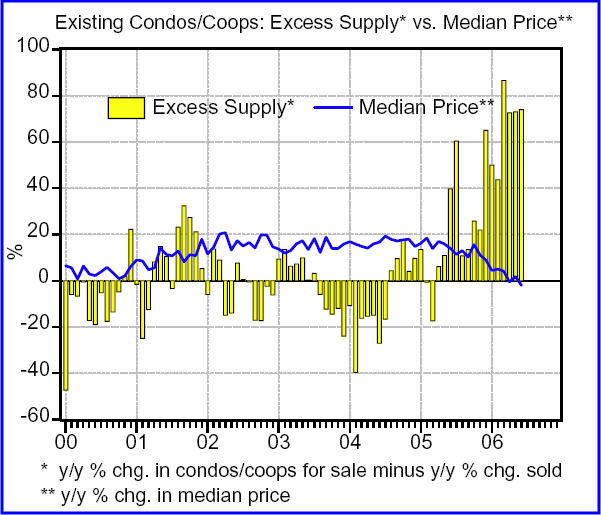 In the months ahead, Econ 101 predicts that the prices of existing dwellings will continue to soften.
This will serve to reduce the excess supply as some not-so-serious sellers take their homes off the market and as those sellers who have to sell acquiesce to the reality of lower prices.
Mish:
The knock-on effects of all this will be subdued consumer discretionary spending as those “home ATMs” are not refilling as rapidly as before. Another factor that will curtail consumer discretionary spending is slower income growth in housing-related industries as employment and sales commissions moderate further. I said it last week and I will say it again – the residential real estate sector has entered a recession. Whether the economy as a whole enters a recession early next year depends on how severe the housing recession gets. Further Fed interest rate increases can only increase the depth of the current housing recession and geometrically increase the odds of an economy-wide recession.
The numbers are what they are, but it is also important to understand what they represent. If we calculated GDP the way Europe did, we probably would be showing something like .5% growth (if that) rather than the 2.5% that was reported. I talked about this in Grossly Distorted Procedures.
Also note that if we calculated unemployment numbers the way they did in Europe (or for that matter the way we did here about 20 years ago), unemployment would be at 8%-9% vs. the 4.6% we report. So while "numbers may be numbers" and "numbers don't lie" please be aware that what those numbers represent can and does change over time. I am quite positive that I am not explaining anything in that regard to either Succo or Kasriel.
Yes, I am looking hard at those numbers. So is Kasriel, and so is Succo. "Sammy the Snake" is concerned about those numbers as well (even if it seems like he only has one eye on them).
On behalf of Professor Succo and "Sammy the Snake" please keep at least one eye on the numbers, preferably two. Any further sustained weakening of those GDP numbers and will be in a recession (even though no one will admit it).
Mike Shedlock / Mish
http://globaleconomicanalysis.blogspot.com/
Thursday, 27 July 2006
Lights Out in Georgia
Following is a set of posts from a real estate broker who goes by the name "Sonnypage" on the Motley Fool. This synopsis is with his permission. Follow the progression from 2006-01-04 through 2006-07-20. You might find it interesting.
2006-01-04
Many of you know by now that my wife and I are both Realtors and associate brokers. We live and work north of Atlanta in the suburbs of Alpharetta and Roswell. I made the point in a post last month that I have always thought that our business gives us some unique insights into the economy, not just here in Atlanta, but across the country.
We are seeing an extremely high level of relocation activity. Our business last year was very solid, we closed twenty six transactions. So far this year, days into the year, we have two transactions pending, booked in the fourth quarter, plus twenty five prospects. If only two thirds of those prospects close, then we already have eighteen or so deals. They are evenly split, buyers and sellers, but much more importantly, nineteen involve relocations. This is a very high level of relocation activity, the highest we have seen in years.
More relocation prospects than any January in memory. The economy remains very strong.
Mish and I would seem to have very different points of view on what 2006 holds in store. I am basing my forecast on what I am seeing, and what I am seeing is a strong economy.
There will be no recession in 2006.
Sonnypage
2006-01-30
Last week my wife and I met our out of town buyers at the home that we had put under contract earlier in the month. It was time to meet a home inspector at the home for the inspection. The inspection took most of the day, so we had plenty of time to talk about anything and everything. The mortgage lender and I were both amused by all the chatter in the popular press about the "real estate bubble". He told me that his business is up about 20% over last January. I told him that we were having the strongest January we have ever had. It is truly remarkable. About then his sister, the buyer wife, walked into the room where we were talking. I asked them both, what would this home be worth back in northern Virginia? We were under contract here in Alpharetta at $1.1 million. The buyer wife paused for just a second, then said she thought about $2 million. Her brother, the mortgage lender, thought a second longer, then said he thought perhaps closer to $2.5 million.
Where's your housing recession, Mish? In actuality, if our economy is growing, the nations' total wealth is growing, then real estate as a whole, nationwide, continues to appreciate.
Our business here on Atlanta's north side is very strong. We have four contracts year to date, we will get number five this week. This compares with twenty six closings in 2005, so we are clearly off to a strong start. The unemployment rate here is 3.2 %, below the national average. Business is booming. I know of no one complaining of slow business, or worried about losing their job. Everyone is too busy making money to have time to worry. As for us and our business, our average transaction continues to move up in dollar size. If 2000 was our biggest year with forty four transactions, we could easily make more dollars this year with as few as perhaps thirty deals. We are seeing lots of money out there, it's full speed ahead. A very bright year lies ahead.
All of which leaves me free to make my biggest and strongest Sonnypage prediction ever. This time next year, I will still be making money hand over fist, and Mish and Gary Shilling and the rest of the doomsday crowd will still be pumping the next depression. And as always, it will still be just over the horizon, not quite here yet, but surely coming, right?
Sonnypage
2006-04-07
If I am reading Mish correctly, he still is calling for a sharp pullback in residential housing in the U.S. that will lead us into a recession. Mish, if I am misstating you please correct me, and I am still taking the other side of your bet. It's not going to happen.
Real estate is local. I have no doubt that Florida, southern California and other hot spots are having contractions. The speculative money has bailed out and that's what happens. But here in Atlanta, where my wife and I have our residential real estate business, it's a very different story. We never had a speculative run up in prices here and so far, this year, it's shaping up as a normal year. We have nine transactions closed or pending year to date, which is exactly where we were this time last year. We currently have six listings, two of which are pending, and those pending listings, plus two others that have already closed, are going at about 97% of list price. Obviously, that does not translate as a distressed market. We have the same situation on the buy side. Our buyers under contract are paying about 97% of list. We have not been able to find distressed sellers for our buyers in upscale neighborhoods willing to sell at major discounts to list price. The only other part of the country that I can offer direct evidence of is Houston. My brother in law is a builder while my sister and one of her daughters are a mother-daughter realtor team. Here is an email from my sister from last week about the Houston real estate market.
We put a $ 1.5 mil house under contract today and met with someone yesterday about our $2.7 mil spec. (*Daughter*) showed a house to a couple her age that was priced at $469,000- a 3/2 one story bungalow in West U. They were one of five competing bids and did not get it with their offer of $475,000. It was not under priced. We are having the best market we have ever had city wide.
A collapsing real estate market, Mish? I don't think so.
Sonnypage
2006-04-30
Most of you know by now that my “day job” is real estate. My wife and I practice real estate north of Atlanta up in Roswell and Alpharetta. As Mish continues to pound away trying to make the point that residential real estate is doomed or worse, I feel honor bound to jump in every now and then and remind everyone that real estate is local, local, local. That means that even if real estate is in trouble in say, Florida, it's still, according to my sister, doing extremely well in Houston, and very well, I would say, in Atlanta. We have twelve deals closed or pending through April which is about where we were this time last year. It's looking like a twenty five deal year which is fine.
Sonnypage
2006-06-10
This year is quickly becoming what might euphemistically be called a character building experience. We are off to the slowest start in the twelve years we have been in business. Here's a taste of what we are up against. Two months ago we took a great listing in Alpharetta just to the north of us. It's a beautiful three sides brick, full finished basement, in a cul de sac. They listed at $550,000, which was actually a little below what we recommended. They are definitely motivated to sell. When we had lots of looks but no offers, they agreed to drop the price to $535,000. I emailed all agents who had previously shown the house to advise of the price drop, and sure enough, one agent brought his buyers back for a second, then third, look. They offered $495,000. We countered at $530,000. Our sellers said they really did not want to go that much lower. I was not too concerned. I expected a counter from the buyers, then another counter from my sellers and we would eventually get there. The next morning, when I did not hear back from the buyer's agent, I gave him a call. Did I get a shock, they were done, that was it, no higher offer. So what we have are buyers who just don't want to pay too much, who are really skittish, and sellers who are having trouble accepting that things are slowing down. Two years ago, or even last summer, we would have that house under contract. But not this year. We now have a total of six listings, five of which have reduced, the other is brand new. Only one really active buyer, plus two of the listings who will buy locally if they can first sell. If things don't pick up fairly quickly, this will be our slowest year ever. We have closed or have pending a total of only twelve transactions year to date. We have booked only one contract since May 1st which is really slow. Our business plan was thirty transactions, I would have been o.k. with twenty six, but at this rate we will not reach twenty. This is normally our peak season. If Atlanta, which has been a solid market with no speculative price run ups, is faltering, then I suspect that this slow down has become national at last, no longer just local.
The economy is slowing and is doing so rather quickly. In my opinion, at least, the chances of a recession starting no later than the first quarter have increased significantly.
Sonnypage
2006-07-20
Most of the regulars here know that my wife and I are a Realtor team associated with one of the major national firms here on Atlanta's north side, out in Roswell and Alpharetta. It's been a “character building year” as another agent in our office put it the other day. What makes it more stunning, at least to me, is that it started out so well. We ended the first quarter with nine deals pending or closed, which is a very solid start. Then we hit a brick wall with only three deals in the second quarter and that would make it our worst second quarter ever in our twelve years.
Then it got worse. Normally, over the years, about one in fifteen deals fall out, that is, they fail to close. Usually it's over the inspection contingency amendment but not always. At any rate, two of our three second quarter contracts failed to close. Unbelievably we booked and closed only one contract in the second quarter. So here we are, July 20th, with only ten deals for the year. What a mess.
How those two contracts failed just might tell a story about this years' market and the economy in general. First, one of them was indeed over the inspection amendment. Most of you understand that after going under contract, the buyer is entitled to have a qualified home inspector do an inspection. The buyer then presents a copy of the inspection to the seller along with an amendment to the contract asking for the repair of defects affecting safety or the structural integrity of the home. In this instance, the buyer went far beyond that, asking for, at least in my opinion, cosmetic items and home improvements. Our sellers' response, I thought, was more than fair, but the buyer would not yield. Normally we can work these differences out but not this time. Looking back, it is clear that the buyer was determined to wring additional concessions out of the seller or not close. We had a failed agreement and both parties signed a termination and release as required. That listing is back on the market.
Then the other failed contract was even more unusual. We had been working with relocation buyers from Cincinnati for several months. We found them a great house and went under contract. Ten days before closing they called to say they had decided they did not want to move. [Instead] he is leaving the company [that was] trying to move him to Atlanta. My take on this is he was afraid they would move him down here and then let him go. His company is facing a management reshuffle. But, who knows? At any rate, it cost him $5500, his forfeited earnest money.
So here we are with ten deals and needing a total of about twenty to meet our cash flow needs; personal and business plus taxes. The last year we failed to “make a living” so to speak in real estate was about 1994. Without a strong finish we just may be looking at that again. What are our chances of pulling it out? It's still possible. We have several buyer prospects plus we have ten listings and listings are the life blood of any real estate business. We will, with certainty, get one more listing by month's end. On the other hand, we have a listing that expires at midnight Monday and we don't expect them to renew. They have had two lowball offers and have refused both. My take is that they can't reduce without going under water.
What do you do if you owe more on your home than you can sell it for? Apparently, you just decide to sit on it and hope for a better market, at least for now.
Sonnypage
Mish (from here on down):
For one reason or other realtors across the country thought "It's different here".
"We are unique". "Real estate is local". "It won't happen here". "There is no bubble".
Look at all the reasons given:
The "strong economy" was (and still remains) an illusion. What we had was an economy totally propped up by homebuilding and real estate transactions. 40% of all home buying in both 2004 and 2005 was for second homes or for "investments". In addition people were all too quick to spend that increased "wealth" from home price appreciation (and then some), going deeper and deeper in debt.
The economy has not crashed (yet) because homebuilders are still building. That supports jobs. But when those houses don't sell (and they won't - without enormous discounts) all this "paper wealth" of homeowners is going to vanish overnight. As soon as someone drops their price by $100,000 every house in the neighborhood will be repriced. Comps will drop like a rock. Consumers used to seeing nothing but rising prices are in for a rude awakening. Their house will no longer be an ATM. Consumer spending is 75% of the economy and it has only one way to go and that is down. There are going to be a lot of people hurt badly in the recession of 2007.
The Blame Game
It will be interesting to see who the scapegoats will be.
A recession is just around the corner.
Ironically enough, it has already started for Sonnypage.
Mike Shedlock / Mish
http://globaleconomicanalysis.blogspot.com/
2006-01-04
Many of you know by now that my wife and I are both Realtors and associate brokers. We live and work north of Atlanta in the suburbs of Alpharetta and Roswell. I made the point in a post last month that I have always thought that our business gives us some unique insights into the economy, not just here in Atlanta, but across the country.
We are seeing an extremely high level of relocation activity. Our business last year was very solid, we closed twenty six transactions. So far this year, days into the year, we have two transactions pending, booked in the fourth quarter, plus twenty five prospects. If only two thirds of those prospects close, then we already have eighteen or so deals. They are evenly split, buyers and sellers, but much more importantly, nineteen involve relocations. This is a very high level of relocation activity, the highest we have seen in years.
More relocation prospects than any January in memory. The economy remains very strong.
Mish and I would seem to have very different points of view on what 2006 holds in store. I am basing my forecast on what I am seeing, and what I am seeing is a strong economy.
There will be no recession in 2006.
Sonnypage
2006-01-30
Last week my wife and I met our out of town buyers at the home that we had put under contract earlier in the month. It was time to meet a home inspector at the home for the inspection. The inspection took most of the day, so we had plenty of time to talk about anything and everything. The mortgage lender and I were both amused by all the chatter in the popular press about the "real estate bubble". He told me that his business is up about 20% over last January. I told him that we were having the strongest January we have ever had. It is truly remarkable. About then his sister, the buyer wife, walked into the room where we were talking. I asked them both, what would this home be worth back in northern Virginia? We were under contract here in Alpharetta at $1.1 million. The buyer wife paused for just a second, then said she thought about $2 million. Her brother, the mortgage lender, thought a second longer, then said he thought perhaps closer to $2.5 million.
Where's your housing recession, Mish? In actuality, if our economy is growing, the nations' total wealth is growing, then real estate as a whole, nationwide, continues to appreciate.
Our business here on Atlanta's north side is very strong. We have four contracts year to date, we will get number five this week. This compares with twenty six closings in 2005, so we are clearly off to a strong start. The unemployment rate here is 3.2 %, below the national average. Business is booming. I know of no one complaining of slow business, or worried about losing their job. Everyone is too busy making money to have time to worry. As for us and our business, our average transaction continues to move up in dollar size. If 2000 was our biggest year with forty four transactions, we could easily make more dollars this year with as few as perhaps thirty deals. We are seeing lots of money out there, it's full speed ahead. A very bright year lies ahead.
All of which leaves me free to make my biggest and strongest Sonnypage prediction ever. This time next year, I will still be making money hand over fist, and Mish and Gary Shilling and the rest of the doomsday crowd will still be pumping the next depression. And as always, it will still be just over the horizon, not quite here yet, but surely coming, right?
Sonnypage
2006-04-07
If I am reading Mish correctly, he still is calling for a sharp pullback in residential housing in the U.S. that will lead us into a recession. Mish, if I am misstating you please correct me, and I am still taking the other side of your bet. It's not going to happen.
Real estate is local. I have no doubt that Florida, southern California and other hot spots are having contractions. The speculative money has bailed out and that's what happens. But here in Atlanta, where my wife and I have our residential real estate business, it's a very different story. We never had a speculative run up in prices here and so far, this year, it's shaping up as a normal year. We have nine transactions closed or pending year to date, which is exactly where we were this time last year. We currently have six listings, two of which are pending, and those pending listings, plus two others that have already closed, are going at about 97% of list price. Obviously, that does not translate as a distressed market. We have the same situation on the buy side. Our buyers under contract are paying about 97% of list. We have not been able to find distressed sellers for our buyers in upscale neighborhoods willing to sell at major discounts to list price. The only other part of the country that I can offer direct evidence of is Houston. My brother in law is a builder while my sister and one of her daughters are a mother-daughter realtor team. Here is an email from my sister from last week about the Houston real estate market.
We put a $ 1.5 mil house under contract today and met with someone yesterday about our $2.7 mil spec. (*Daughter*) showed a house to a couple her age that was priced at $469,000- a 3/2 one story bungalow in West U. They were one of five competing bids and did not get it with their offer of $475,000. It was not under priced. We are having the best market we have ever had city wide.
A collapsing real estate market, Mish? I don't think so.
Sonnypage
2006-04-30
Most of you know by now that my “day job” is real estate. My wife and I practice real estate north of Atlanta up in Roswell and Alpharetta. As Mish continues to pound away trying to make the point that residential real estate is doomed or worse, I feel honor bound to jump in every now and then and remind everyone that real estate is local, local, local. That means that even if real estate is in trouble in say, Florida, it's still, according to my sister, doing extremely well in Houston, and very well, I would say, in Atlanta. We have twelve deals closed or pending through April which is about where we were this time last year. It's looking like a twenty five deal year which is fine.
Sonnypage
2006-06-10
This year is quickly becoming what might euphemistically be called a character building experience. We are off to the slowest start in the twelve years we have been in business. Here's a taste of what we are up against. Two months ago we took a great listing in Alpharetta just to the north of us. It's a beautiful three sides brick, full finished basement, in a cul de sac. They listed at $550,000, which was actually a little below what we recommended. They are definitely motivated to sell. When we had lots of looks but no offers, they agreed to drop the price to $535,000. I emailed all agents who had previously shown the house to advise of the price drop, and sure enough, one agent brought his buyers back for a second, then third, look. They offered $495,000. We countered at $530,000. Our sellers said they really did not want to go that much lower. I was not too concerned. I expected a counter from the buyers, then another counter from my sellers and we would eventually get there. The next morning, when I did not hear back from the buyer's agent, I gave him a call. Did I get a shock, they were done, that was it, no higher offer. So what we have are buyers who just don't want to pay too much, who are really skittish, and sellers who are having trouble accepting that things are slowing down. Two years ago, or even last summer, we would have that house under contract. But not this year. We now have a total of six listings, five of which have reduced, the other is brand new. Only one really active buyer, plus two of the listings who will buy locally if they can first sell. If things don't pick up fairly quickly, this will be our slowest year ever. We have closed or have pending a total of only twelve transactions year to date. We have booked only one contract since May 1st which is really slow. Our business plan was thirty transactions, I would have been o.k. with twenty six, but at this rate we will not reach twenty. This is normally our peak season. If Atlanta, which has been a solid market with no speculative price run ups, is faltering, then I suspect that this slow down has become national at last, no longer just local.
The economy is slowing and is doing so rather quickly. In my opinion, at least, the chances of a recession starting no later than the first quarter have increased significantly.
Sonnypage
2006-07-20
Most of the regulars here know that my wife and I are a Realtor team associated with one of the major national firms here on Atlanta's north side, out in Roswell and Alpharetta. It's been a “character building year” as another agent in our office put it the other day. What makes it more stunning, at least to me, is that it started out so well. We ended the first quarter with nine deals pending or closed, which is a very solid start. Then we hit a brick wall with only three deals in the second quarter and that would make it our worst second quarter ever in our twelve years.
Then it got worse. Normally, over the years, about one in fifteen deals fall out, that is, they fail to close. Usually it's over the inspection contingency amendment but not always. At any rate, two of our three second quarter contracts failed to close. Unbelievably we booked and closed only one contract in the second quarter. So here we are, July 20th, with only ten deals for the year. What a mess.
How those two contracts failed just might tell a story about this years' market and the economy in general. First, one of them was indeed over the inspection amendment. Most of you understand that after going under contract, the buyer is entitled to have a qualified home inspector do an inspection. The buyer then presents a copy of the inspection to the seller along with an amendment to the contract asking for the repair of defects affecting safety or the structural integrity of the home. In this instance, the buyer went far beyond that, asking for, at least in my opinion, cosmetic items and home improvements. Our sellers' response, I thought, was more than fair, but the buyer would not yield. Normally we can work these differences out but not this time. Looking back, it is clear that the buyer was determined to wring additional concessions out of the seller or not close. We had a failed agreement and both parties signed a termination and release as required. That listing is back on the market.
Then the other failed contract was even more unusual. We had been working with relocation buyers from Cincinnati for several months. We found them a great house and went under contract. Ten days before closing they called to say they had decided they did not want to move. [Instead] he is leaving the company [that was] trying to move him to Atlanta. My take on this is he was afraid they would move him down here and then let him go. His company is facing a management reshuffle. But, who knows? At any rate, it cost him $5500, his forfeited earnest money.
So here we are with ten deals and needing a total of about twenty to meet our cash flow needs; personal and business plus taxes. The last year we failed to “make a living” so to speak in real estate was about 1994. Without a strong finish we just may be looking at that again. What are our chances of pulling it out? It's still possible. We have several buyer prospects plus we have ten listings and listings are the life blood of any real estate business. We will, with certainty, get one more listing by month's end. On the other hand, we have a listing that expires at midnight Monday and we don't expect them to renew. They have had two lowball offers and have refused both. My take is that they can't reduce without going under water.
What do you do if you owe more on your home than you can sell it for? Apparently, you just decide to sit on it and hope for a better market, at least for now.
Sonnypage
Mish (from here on down):
For one reason or other realtors across the country thought "It's different here".
"We are unique". "Real estate is local". "It won't happen here". "There is no bubble".
Look at all the reasons given:
- Demographics - Florida & California
- Strong Jobs - California
- Relocations - Atlanta and SE
- Retirement - Las Vegas, Phoenix, Florida
- Strong economy - Everywhere but the rust belts
- This place is unique - Damn near everywhere
- Home prices have outstripped wages by 4-5 standard deviations from normal
- Home prices have outstripped rents by 4-5 standard deviations from normal
- This can't continue
- What can't continue won't continue by definition
The "strong economy" was (and still remains) an illusion. What we had was an economy totally propped up by homebuilding and real estate transactions. 40% of all home buying in both 2004 and 2005 was for second homes or for "investments". In addition people were all too quick to spend that increased "wealth" from home price appreciation (and then some), going deeper and deeper in debt.
The economy has not crashed (yet) because homebuilders are still building. That supports jobs. But when those houses don't sell (and they won't - without enormous discounts) all this "paper wealth" of homeowners is going to vanish overnight. As soon as someone drops their price by $100,000 every house in the neighborhood will be repriced. Comps will drop like a rock. Consumers used to seeing nothing but rising prices are in for a rude awakening. Their house will no longer be an ATM. Consumer spending is 75% of the economy and it has only one way to go and that is down. There are going to be a lot of people hurt badly in the recession of 2007.
The Blame Game
It will be interesting to see who the scapegoats will be.
- Some will blame Realtors
- Some will blame the Fed for hiking rates too far
- Some will blame the homebuilders for slashing prices
- Some will blame their neighbors for selling too low
- On the Fed (not for raising rates) but for cutting them to 1% in the first place and flooding the world with dollars in the biggest liquidity experiment the world has ever seen
- On banks and Fannie Mae for loose lending standards
- On government for promoting the "ownership society"
- On themselves for getting caught up in bubble madness just as they did with stocks in 2000, then taking cash out refis and spending like drunken fools further fueling a runaway economy
A recession is just around the corner.
Ironically enough, it has already started for Sonnypage.
Mike Shedlock / Mish
http://globaleconomicanalysis.blogspot.com/
Wednesday, 26 July 2006
The Case for Treasuries
 2006-07-26
Today's Thought of the Day is a joint venture from Bennet Sedacca and John Succo at Minyanville.
From Bennet Sedacca:
I have received many inquiries about treasuries. Let's discuss why I am looking heavy into 2's, not 10's, and avoiding corporates altogether and now mortgages as well.
Obviously, a two year Treasury has less duration than a two note and has less volatility for a given change in rates. My firm is negative on the economy and expect the Fed to ease. So why not 10's? Because of the current shape of the curve. We already own some 2's from 5.25% and took some profits in 10's as mentioned here previously.
Let's say 2's go to 3.5%. I think the curve will be in a 'curve steepener.' In other words, rates on 2's will fall faster than the rest of the curve, taking the curve from flat to a more normal, steeper curve, prior to the end of the Fed's ending their easing campaign. So we buy TWICE AS MANY 2's as we would 10's and think we can actually make more money with the same or less amount of risk. In addition, we always like to ask ourselves, "what if we are wrong and rates rise?" Obviously, 2's will crush 10's in performance and we have our 2's to sell to extend into more duration.
Why only Treasuries? Well. Put it this way. I have been in the business 26 years or so. I have never seen, relative to an economic backdrop like we have now, so little value in corporates, agencies, mortgages, etc. I think spreads will eventually widen, perhaps DRAMATICALLY, which is normal in slowdowns.
Email Bennet at Atlantic Advisors.
From John Succo:
After reading the comment in Professor Bennet Sedacca's article, "I have never seen, relative to an economic backdrop like we have now, so little value in corporates, agencies, mortgages, etc." prompted me to write this.
What Bennet means by value is that investors are buying risky assets like corporate bonds at only a slight discount to non-risky asset like treasuries. They are willing to incur the risk of default, which should be higher for a company than for the U.S. government, for only a very small increment in yield. Bennet is describing an investor who is willing to take on too much risk for too little yield.
This is a phenomenon directly born of government policy, central bank intervention.
All central banks around the world have purposely driven real interest rates to zero or even below. Money is free. This means the worst of the worst, those willing to speculate and go bankrupt if necessary are free to buy risky assets. This forces risk premiums lower and lower. Even relatively conservative investors feel the pinch, the pressure to go out on the risk curve to just make a little money.
And the central banks want this. They have actually targeted lower volatility to encourage investors to take risk that they don't really see. Not until volatility rises does risk become apparent. So they are doing everything they can to keep volatility low and investors taking risk.
What happens if investors decide to take less risk? Heavens forbid they actually want to save money and not take on more debt. That would reduce risk and reduce liquidity. Volatility would go up and it would feed on itself. The credit bubble that has driven nominal asset prices to these levels (risky assets) would begin to unwind and the opposite would occur.
It is all about liquidity. Risk premiums are the largest variable in driving liquidity. People will be very surprised at how fast people want to reduce risk when they decide to. A very gradual and incremental process that has reduced risk premiums over the last several years can reverse quickly.
Central banks are doing everything they can to avoid this. Credit is being offered (money supply is high); will the market continue to keep taking it? My firm's work is showing the market on the margin is taking that credit less and less and it is going to the more and more speculative.
Hedge funds, mutual funds, and even pensions are taking the risk for the investor more than ever. These are in general managers that are once removed from the consequences of risk so they take more than the actual owner of the money would.
Bennet is saying that it [the risk vs. reward of corporates, of agencies, of junk bonds, etc as compared to treasuries] is not there, not by a long shot. I agree.
From Mish:
I was asked just yesterday by someone on Silicon Investor what duration I recommended. My reply was that the "sweet spot" was probably between two and three years. I went on to say that IF my deflation scenario pans out that the place to be might be 10 year notes or even the 30 year long bond. Obviously this depends on the amount of risk that one wants to take and I pointed that out as well.
Bennet raises an interesting twist that perhaps double weighting 2's might be a better strategy. Certainly that strategy has a better out. One can ride out a 2 year note far easier than the 30 year long bond if proven wrong, or one can convert (at a relatively small loss) to 10's or 30's for tremendous extra potential down the road.
I also need to comment on professor's Succo's observation. Risk premiums in general have been driven to zero. Risk has been not only encouraged but embraced. The case for treasuries goes far beyond just treasuries vs. agencies or junk. The case for treasuries extends across a multitude of asset classes. We are seeing emerging market ETFs, gold and silver ETFs, oil ETFs, etc etc, most of which opened up only after tremendous five year runs.
I remember the day JDSU leaps (long term options) were offered. I remember commenting "that marks the top in JDSU". I think I was close. For those of you not familiar with the JDSU fiber story, it fell from 100 to 2 and sits near that level still today.
Flash forward to today. Virtually no one likes treasuries. They are universally despised. This is somewhat odd given that treasuries are sill in a bull market (long term) and if we are about to head into K-Winter (as I think we are) treasuries may outperform every other asset class. Those unfamiliar or needing a review on the K-Cycle may wish to read The Kondratieff Cycle Revisited.
At no time in history have investors turned bearish at a market peak. I suspect it will never happen either. Yet that is what treasury bears want you to believe.
Yes, I know all of the arguments. Treasuries are manipulated, it's the "Caribbean Connection", if it was not for Japan or China treasuries would tank, etc etc. Yet many of those same people are willing to plow into stocks, junk bonds, real estate or whatever. It makes no sense. If treasuries collapse, the last place you will want to be is in junk bonds, housing, or US equities.
Yes there is an alternative, but it is not without risk. That alternative is of course gold and/or energy stocks. If I could pick two other sectors that were universally despised it would be gold and energies. The risk is what happens in global recession. That can't happen? Then again, I believe gold will do well in deflation (once all of the inflationists panic out).
Barron's recently came out with a cover touting big caps like CSCO and Home Depot. I talked about it in Think Outside the Box Score. If and when Barron's comes out touting treasuries, gold, or energies, it will be time to take the profit and run.
Mike Shedlock / Mish
http://globaleconomicanalysis.blogspot.com/
The American Nightmare Initiative
Democrats, led by Hillary stepped up to the plate today in an attempt to buy more votes than the Republicans can in the mid-term elections. This may sound like the start of a political post but it goes well beyond that. I am of course talking about budget deficits, the US dollar, "affordable housing", and long term problems with Social Security and Medicaid.
Both parties act as if there are no consequences to wasting trillions of dollars in the present while promising trillions more down the road. We do not have the money now, nor will we have it in the future. Yet no one from either party seems to care. The Bush Administration blew a half trillion dollars in a war that should not have been fought and arguably produced negative benefits for both the US and Iraq (and most likely the rest of the world too). The amount of money we are wasting on homeland security is staggering as well. Does anyone feel more secure? We are also building bridges to nowhere in Alaska. We waste tons of money on "affordable housing" projects of all kinds and at every governmental level. The list goes on and on.
Does anyone in government, other than Ron Paul, understand basic economics?
Please consider the "American Dream Initiative".
Government waste penetrates every governmental body, from state and federal governments all the way down to the local level, regardless of the party in power. "Affordable housing" is one of the main culprits. Please consider the Miami Herald article House of Lies.
Offering $5000 tax credits to make housing more affordable will make housing less affordable.
Back in December I wrote about Alternative Underwriting.
One of the reasons that housing is not affordable is there are 350 or so government programs to make housing affordable. It simply is not the government's place to make housing affordable. That is the market's problem. Throwing money around and giving it away is guaranteed to make housing less affordable. Yet we persist with policies that are guaranteed to fail right from the start.
An applicable quote came up just yesterday in Think Outside the Box Score.
"When I started writing I thought if I proved X was a stupid thing to do that people would stop doing X. I was wrong." Source: Moneyball, Michael Lewis
This is not a Dream Initiative, it is yet another nightmare based on policies that have proven to fail every time. That is the sad economic reality regardless of what party you intend to vote for. If we persist with such nonsense, it ultimately will be bad news for the US dollar and for the US itself.
Mike Shedlock / Mish
http://globaleconomicanalysis.blogspot.com/
Both parties act as if there are no consequences to wasting trillions of dollars in the present while promising trillions more down the road. We do not have the money now, nor will we have it in the future. Yet no one from either party seems to care. The Bush Administration blew a half trillion dollars in a war that should not have been fought and arguably produced negative benefits for both the US and Iraq (and most likely the rest of the world too). The amount of money we are wasting on homeland security is staggering as well. Does anyone feel more secure? We are also building bridges to nowhere in Alaska. We waste tons of money on "affordable housing" projects of all kinds and at every governmental level. The list goes on and on.
Does anyone in government, other than Ron Paul, understand basic economics?
Please consider the "American Dream Initiative".
The initiative was unveiled Monday at the annual meeting of the centrist Democratic Leadership Council by Democratic Sen. Hillary Rodham Clinton of New York with support from Sen. Evan Bayh of Indiana and Iowa Gov. Tom Vilsack. All three may run for president in 2008.Corruption in Miami Dade
"This American Dream initiative is a series of proposals to renew and strengthen the middle class and to help pave the way for the poor to work their way out of poverty," Clinton told about 375 local and state Democratic elected officials.
Democrats outline 'dream' project
- $3,000 college tuition tax credits to help families pay for college.
- A permanent "saver's credit" aimed at helping low-income families build equity by having the government match 50% of their savings, up to $2,000 a year.
- $500 savings bonds for each of the 4 million children born annually in the United States and letting families with income under $75,000 augment the bonds by putting existing annual tax credits in them.
- Pooling small businesses into a single national insurance purchase pool to augment bargaining power and streamline administrative costs.
- Universal health care for children. The DLC says 9 million Americans under age 18 are uninsured.
- Setting up an independent commission to crack down on business subsidies, which Clinton, Vilsack and their compatriots believe save the government $250 billion over 10 years.
- Tax credits for employers that offer employee housing assistance programs, especially for public employees, and a $5,000 tax credit for first-time home buyers.
Government waste penetrates every governmental body, from state and federal governments all the way down to the local level, regardless of the party in power. "Affordable housing" is one of the main culprits. Please consider the Miami Herald article House of Lies.
Riverside Homes. Miami-Dade Housing Agency Funded Project.That is what happens when government gets in the way.
The dirt lot that cost taxpayers $764,000 sits on a grungy corner just outside Miami, strewn with slashed tires and beer cans and an official white sign, now covered by weeds, announcing Miami-Dade's promise to the poor:
Here, behind a sagging chain-link fence, developer Oscar Rivero promised to build 24 houses for low-income families. Across town he promised 54 more, but that lot, too, is barren, occupied only by a contractor who uses the spot to hose down cement trucks.
For these two affordable housing projects, the Miami-Dade Housing Agency paid Rivero's development companies almost $1.6 million -- but not a single house was built.
It was the beginning in a series of ill-fated government deals that shook the foundation of public housing in one of the poorest and most distressed communities in the nation.
In the past five years, the Miami-Dade Housing Agency squandered millions of dollars on failed projects, pet programs and insider deals even as thousands of families languished in rotting and unsafe homes.
Aided by the agency's longtime director, a cadre of developers made out, raking in millions of dollars for homes that have never been built. From Little Havana to Liberty City, they took the money but left only empty lots, with broken baby cribs and bags of trash where houses had been promised.
Overall, the Housing Agency pledged more than $87 million to put up 72 developments for the poor, including apartments, houses and complexes for the elderly. The expected payoff: more than 8,300 new homes.
The agency diverted another $5 million -- money earmarked by state law to build homes for the poor -- to pay for a new office building complete with a $287,000 bronze sculpture of stacked teacups called Space Station that was shipped from Italy.
The Housing Agency paid more than $12 million to developers who promised dozens of houses but built only two, and years later, never returned the money.
One of the agency's most high-profile projects -- replacing dilapidated public housing in Liberty City with 411 new homes -- is so marred by mismanagement that only three houses have been built in six years. More than $22 million has been spent while 800 poor families have been forced to relocate.
Offering $5000 tax credits to make housing more affordable will make housing less affordable.
Back in December I wrote about Alternative Underwriting.
Illinois Governor Rod Blagojevich went off the deep end on Sunday when he announced an Opportunity I-Loan mortgage loan program for illegal aliens.In what way shape or form can government backed loan guarantees for illegal aliens help make housing more affordable, for anyone?
The state-backed mortgage loan program is aimed at making home ownership more accessible to first-time buyers, regardless of immigration status.
The move comes as a similar year-old program in Wisconsin is coming under fire for offering loans to undocumented immigrants. A bill that would end that program is under consideration.
One of the reasons that housing is not affordable is there are 350 or so government programs to make housing affordable. It simply is not the government's place to make housing affordable. That is the market's problem. Throwing money around and giving it away is guaranteed to make housing less affordable. Yet we persist with policies that are guaranteed to fail right from the start.
An applicable quote came up just yesterday in Think Outside the Box Score.
"When I started writing I thought if I proved X was a stupid thing to do that people would stop doing X. I was wrong." Source: Moneyball, Michael Lewis
This is not a Dream Initiative, it is yet another nightmare based on policies that have proven to fail every time. That is the sad economic reality regardless of what party you intend to vote for. If we persist with such nonsense, it ultimately will be bad news for the US dollar and for the US itself.
Mike Shedlock / Mish
http://globaleconomicanalysis.blogspot.com/
Tuesday, 25 July 2006
Think Outside the Box Score
2006-07-25
Today's Thought of the Day comes from Ryan Krueger at Minyanville.
This is longer than I like, but Ryan has a great tale to tell. Of course that means I had to add my 2 cents worth as well.
The following is all from Ryan until the end.
The transition from Ryan's thought to mine will be at the very end starting with "Mish". Here goes:
The Stock Market's Box Score
I was talking to a new partner about my two favorites, baseball and the markets, last week. He was a professional ballplayer and major league scout for the better part of four decades. He convinced me to share an old book report I wrote. It follows:
Moneyball
Many investors know the risk of being incorrect, but few consider the even greater risk that can come with being “correct.” Looking for good ideas that are clear to see often prove surprisingly disappointing investments if they already had “good” prices asked for them. What may be visible to most people, even when true, can provide terrible payoffs because the common knowledge was already inside the price of that asset. So, being correct can cost even more money than being incorrect; that is the danger of agreement.
MoneyBall is the name of the last book my partner and I each reviewed. The book had absolutely nothing to do with investing, yet came closer than any we have ever read in describing how we approach money management. The vocabulary for the book was from one of the two most beautiful languages in the world: baseball statistics. We will translate it here back into the other, a box score with a little more riding on the outcomes: the Stock Market.
The background to the book needs to be explained for baseball and non-baseball fans and should interest each because the comparison to the Stock Market will follow. A few years ago, a blue ribbon panel was assembled to address the economic landscape of Major League Baseball’s completely un-level playing field for its competing teams. With no salary cap, rich teams could buy the best players. Money was seen as the only problem and the only solution. The Commissioner of Major League Baseball, Bud Selig, said that a team like the Oakland A’s “…can’t compete. They’re not viable without a new stadium.” The majority of the panel agreed that poor teams needed more money for better players, and the rest of the country agreed. There was only one dissenting opinion on the entire panel, cast by the only voter with a financial background. It was the former Federal Reserve Chairman Paul Volcker who asked, “If poor teams are in such dire financial condition, why did rich guys keep paying higher prices to buy them?” Another little noticed item drew some curiosity from the panel as well. “If poor teams had no hope, how did the Oakland A’s, with the second lowest payroll in all of baseball, win so many games?”
The fascinating answers to that second question were explored in this book Moneyball, written by Michael Lewis, one of our favorites for many years but who had no knowledge of baseball before this story captured his interest.
If the conventional wisdom in baseball were correctly assessing the value of ballplayers, then all of the best talent would be bought up by the rich teams, and the Oakland A’s would not stand a chance. Yet they not only stood a chance, they won. Why? [The book goes on to describe describe the Oakland A’s and their General Manager Billy Beane and his approach to the game - Mish]
In a parallel story that we write every day in the Stock Market, if prices rationally reflect all known information then stocks would theoretically trade efficiently based on those fundamentals. Yet, in our opinion, they do not. Why?
The Book:
“Too many people make decisions based on outcomes rather than process.”
Source: Moneyball, Michael Lewis
The Market's Translation:
Investors who read about the Stock Market being up or down 100 points, and believing their investments had a “good day” or a “bad day” are focusing on the outcome, and a misleading one at that. We believe the most overrated question in the country is, “How’d the market do?”
The Book:
“Traditional yardsticks of success for players and teams are fatally flawed.”
“The naked eye was an inadequate tool for learning what you needed to know.”
Source: Moneyball, Michael Lewis
A good portion of the Oakland A's general manager's Beane’s advantage is described as simply doing better homework. After graduating from Harvard, one of his assistants input the raw statistics of every baseball game ever played in the 20th century into their computer to analyze what most correlated with winning and losing. Think about how much sense this makes, yet realize that for those 100 years, assumptions trumped these facts that had never been compiled.
The study proved that almost all of the widely-followed statistics in a game of baseball never consistently correlated with which team won or lost. There were two striking exceptions: on-base percentage and slugging percentage. Simply having players getting on base any way they could, and having players making each successful contact count as much as possible, were the two Holy Grails. These two measurements proved superior to all others yet they are not followed as closely as the more popular statistics like batting average, runs batted in, and speed. These three were not only inferior indicators, but the players who possessed them became over-priced because everybody was bidding for the same wrong things.
The Market's Translation:
It is our belief that, just as in baseball, managers in the Stock Market rely on statistics that often do not help them. In our experience, the two most often used are P/E’s and Earnings. Over time, it has been difficult to prove the ability of either to give you a consistent edge in predictive power. Yet, until the end of time you will always read about stocks with “low P/E’s” and stocks with “better earnings growth” even though this data may not help performance when managing money. The only thing worse than owning something that does not work is paying dearly for it. Investors pay premiums for the assumptions of conventional wisdom since they all end up bidding for the same stocks.
Many people are willing to accept the risk of losing 50% if they can make 80%. But instead of looking for that kind of hit, do the math. $100,000 is worth $50,000 before becoming $90,000. You are not up 30%, you are down $10,000. Few investors consider that losing might hurt them more than winning helps them. But, that is the camouflaged truth and it will remain invisible in plain sight until a vaccine is developed for a debilitating disease called human nature.
The Book:
There were several little examples of scouts for baseball teams looking at the wrong things because of their inability to trade their subjectivity, based on years of “understanding baseball” with the objectivity that clear thinking, better data, and an open mind could have afforded them.
Scout: “He is a bad body catcher.”
Beane: “A bad body who owns the Alabama record books.”
Scout: “When he walks his thighs stick together…put him in corduroys he’d start a fire.”
Beane: “We are not selling jeans here.”
Scout: “He can’t run.”
Beane: “He’s leading the country in walks.”
They drafted him. Not only because Beane thought he was better than other teams believed, but due to that conventional wisdom he could underpay. To sign him to a contract, the Oakland A’s did not have to agree to traditional first round prices. They wanted a better player, and they wanted to underpay.
The Market's Translation:
When it comes to stock prices, we are focused on the same combination of better analysis along with the selectivity of only agreeing to prices when they are favorable to us. We need to be patient enough to wait for our price on the way in, but just as willing to part with those same shares however dear they may seem, if we are offered prices even more dear.
The best players in the draft are analogous to the S&P 500, the group of the biggest and best companies in the U.S. Those 500 blue chippers have an average of 20 scouts following each company. The scouts in this case are Wall Street analysts.
Price measures popularity, in ballplayers and stocks. The average market value of stocks in a dollar weighted S&P 500 Index is just under $90 billion per company as of this writing. By comparison, over 90% of our holdings are below (well below) that size. What is the point? The emptier the stadium of scouts and the more unrecognized the company, the more chances we have to find something others will not. The blue chippers attract all of the attention in any sport. Wal-Mart (WMT) is followed by 21 scouts, Cisco Systems (CSCO) has 22 scouts, General Electric (GE) has 19 scouts, and Johnson & Johnson (JNJ) has 23 scouts. If you take the sum total of all their scouts’ different opinions you would see the very highest 2006 earnings per share estimates compared to the very lowest are separated by a grand total of 30 pennies, combined!!! That comes out to an average difference between the extreme hi-low estimates of only 3% based on earnings per share, and it took 85 teams of analysts, countless hours and countless millions to create these “ different opinions.”
We believe the best ballplayers and the best companies do not often make the best investments because we are not looking for the most agreed-upon estimates; we are looking for the most disagreement.
The Book:
“When I started writing I thought if I proved X was a stupid thing to do that people would stop doing X. I was wrong.”
Source: Moneyball, Michael Lewis
The Market's Translation:
We believe this last quote is the most fascinating and timeless lesson from the book and from the story on Wall Street. No matter how much proof you have to support doing something a different way more successfully, people still like doing things the way they always have. This provides the mother of all misperceptions, and what we enjoy working on every day.
Mish:
How can Ryan Krueger possibly be more correct?
Intel, Home Depot, Malmart, IBM, Citycorp, Microsoft? Where are those "leaders" going. Yet, just this past week Barron's came out with what I think may be one of the greatest contrarian magazine covers on equities that we have seen for a long long time.
I talked about it on July 22 in Time To Sell.
Supposedly after all of this we have the greatest buying opportunity since 1994 on the basis of a mere 5% pullback in the S&P. Is this a joke?
Now we see a classic case of herding. Tech is out so SOMETHING must be in. The troops are now rallying around Home Depot (even though housing is collapsing), and other "bargains" such as Cisco (a company that is now nearly as irrelevant as Micron).
It is a classic case of plowing into yesterday's favorites 5 to 10 years too late. I have news for Barron's. The internet bubble has popped and the housing bubble is popping as I type. There is no "value" in most of the companies that everyone is following.
Just because I do not like tech does not mean I have to like non-tech. Just because I do not like big caps does not mean I have to like small caps. Yet the mantra of the day, day in and day out is to be 100% invested in stocks 100% of the time.
No one it seems likes treasuries.
I do as do a couple of other Professors on Minyanville.
Please take a good hard look at a piece I wrote back on July 16th called Time Preferences. No one domestically likes US treasuries. Cash is trash. Inflation is soaring. "The bond market is wrong". "Treasuries are manipulated by Japan and China".... and so on and so forth.
Value exists where no one else sees it. That may not make treasuries a screaming buy, but it sure beats the heck out what nearly everyone else is screaming about.
Mish Note: I have no idea of Ryan's views on treasuries. He may hate them for all I know. That is not the point of this article. If you missed the point, here is the three sentence summary:
Mike Shedlock / Mish
http://globaleconomicanalysis.blogspot.com/
Today's Thought of the Day comes from Ryan Krueger at Minyanville.
This is longer than I like, but Ryan has a great tale to tell. Of course that means I had to add my 2 cents worth as well.
The following is all from Ryan until the end.
The transition from Ryan's thought to mine will be at the very end starting with "Mish". Here goes:
The Stock Market's Box Score
I was talking to a new partner about my two favorites, baseball and the markets, last week. He was a professional ballplayer and major league scout for the better part of four decades. He convinced me to share an old book report I wrote. It follows:
Moneyball
Many investors know the risk of being incorrect, but few consider the even greater risk that can come with being “correct.” Looking for good ideas that are clear to see often prove surprisingly disappointing investments if they already had “good” prices asked for them. What may be visible to most people, even when true, can provide terrible payoffs because the common knowledge was already inside the price of that asset. So, being correct can cost even more money than being incorrect; that is the danger of agreement.
MoneyBall is the name of the last book my partner and I each reviewed. The book had absolutely nothing to do with investing, yet came closer than any we have ever read in describing how we approach money management. The vocabulary for the book was from one of the two most beautiful languages in the world: baseball statistics. We will translate it here back into the other, a box score with a little more riding on the outcomes: the Stock Market.
The background to the book needs to be explained for baseball and non-baseball fans and should interest each because the comparison to the Stock Market will follow. A few years ago, a blue ribbon panel was assembled to address the economic landscape of Major League Baseball’s completely un-level playing field for its competing teams. With no salary cap, rich teams could buy the best players. Money was seen as the only problem and the only solution. The Commissioner of Major League Baseball, Bud Selig, said that a team like the Oakland A’s “…can’t compete. They’re not viable without a new stadium.” The majority of the panel agreed that poor teams needed more money for better players, and the rest of the country agreed. There was only one dissenting opinion on the entire panel, cast by the only voter with a financial background. It was the former Federal Reserve Chairman Paul Volcker who asked, “If poor teams are in such dire financial condition, why did rich guys keep paying higher prices to buy them?” Another little noticed item drew some curiosity from the panel as well. “If poor teams had no hope, how did the Oakland A’s, with the second lowest payroll in all of baseball, win so many games?”
The fascinating answers to that second question were explored in this book Moneyball, written by Michael Lewis, one of our favorites for many years but who had no knowledge of baseball before this story captured his interest.
If the conventional wisdom in baseball were correctly assessing the value of ballplayers, then all of the best talent would be bought up by the rich teams, and the Oakland A’s would not stand a chance. Yet they not only stood a chance, they won. Why? [The book goes on to describe describe the Oakland A’s and their General Manager Billy Beane and his approach to the game - Mish]
In a parallel story that we write every day in the Stock Market, if prices rationally reflect all known information then stocks would theoretically trade efficiently based on those fundamentals. Yet, in our opinion, they do not. Why?
The Book:
“Too many people make decisions based on outcomes rather than process.”
Source: Moneyball, Michael Lewis
The Market's Translation:
Investors who read about the Stock Market being up or down 100 points, and believing their investments had a “good day” or a “bad day” are focusing on the outcome, and a misleading one at that. We believe the most overrated question in the country is, “How’d the market do?”
The Book:
“Traditional yardsticks of success for players and teams are fatally flawed.”
“The naked eye was an inadequate tool for learning what you needed to know.”
Source: Moneyball, Michael Lewis
A good portion of the Oakland A's general manager's Beane’s advantage is described as simply doing better homework. After graduating from Harvard, one of his assistants input the raw statistics of every baseball game ever played in the 20th century into their computer to analyze what most correlated with winning and losing. Think about how much sense this makes, yet realize that for those 100 years, assumptions trumped these facts that had never been compiled.
The study proved that almost all of the widely-followed statistics in a game of baseball never consistently correlated with which team won or lost. There were two striking exceptions: on-base percentage and slugging percentage. Simply having players getting on base any way they could, and having players making each successful contact count as much as possible, were the two Holy Grails. These two measurements proved superior to all others yet they are not followed as closely as the more popular statistics like batting average, runs batted in, and speed. These three were not only inferior indicators, but the players who possessed them became over-priced because everybody was bidding for the same wrong things.
The Market's Translation:
It is our belief that, just as in baseball, managers in the Stock Market rely on statistics that often do not help them. In our experience, the two most often used are P/E’s and Earnings. Over time, it has been difficult to prove the ability of either to give you a consistent edge in predictive power. Yet, until the end of time you will always read about stocks with “low P/E’s” and stocks with “better earnings growth” even though this data may not help performance when managing money. The only thing worse than owning something that does not work is paying dearly for it. Investors pay premiums for the assumptions of conventional wisdom since they all end up bidding for the same stocks.
Many people are willing to accept the risk of losing 50% if they can make 80%. But instead of looking for that kind of hit, do the math. $100,000 is worth $50,000 before becoming $90,000. You are not up 30%, you are down $10,000. Few investors consider that losing might hurt them more than winning helps them. But, that is the camouflaged truth and it will remain invisible in plain sight until a vaccine is developed for a debilitating disease called human nature.
The Book:
There were several little examples of scouts for baseball teams looking at the wrong things because of their inability to trade their subjectivity, based on years of “understanding baseball” with the objectivity that clear thinking, better data, and an open mind could have afforded them.
Scout: “He is a bad body catcher.”
Beane: “A bad body who owns the Alabama record books.”
Scout: “When he walks his thighs stick together…put him in corduroys he’d start a fire.”
Beane: “We are not selling jeans here.”
Scout: “He can’t run.”
Beane: “He’s leading the country in walks.”
They drafted him. Not only because Beane thought he was better than other teams believed, but due to that conventional wisdom he could underpay. To sign him to a contract, the Oakland A’s did not have to agree to traditional first round prices. They wanted a better player, and they wanted to underpay.
The Market's Translation:
When it comes to stock prices, we are focused on the same combination of better analysis along with the selectivity of only agreeing to prices when they are favorable to us. We need to be patient enough to wait for our price on the way in, but just as willing to part with those same shares however dear they may seem, if we are offered prices even more dear.
The best players in the draft are analogous to the S&P 500, the group of the biggest and best companies in the U.S. Those 500 blue chippers have an average of 20 scouts following each company. The scouts in this case are Wall Street analysts.
Price measures popularity, in ballplayers and stocks. The average market value of stocks in a dollar weighted S&P 500 Index is just under $90 billion per company as of this writing. By comparison, over 90% of our holdings are below (well below) that size. What is the point? The emptier the stadium of scouts and the more unrecognized the company, the more chances we have to find something others will not. The blue chippers attract all of the attention in any sport. Wal-Mart (WMT) is followed by 21 scouts, Cisco Systems (CSCO) has 22 scouts, General Electric (GE) has 19 scouts, and Johnson & Johnson (JNJ) has 23 scouts. If you take the sum total of all their scouts’ different opinions you would see the very highest 2006 earnings per share estimates compared to the very lowest are separated by a grand total of 30 pennies, combined!!! That comes out to an average difference between the extreme hi-low estimates of only 3% based on earnings per share, and it took 85 teams of analysts, countless hours and countless millions to create these “ different opinions.”
We believe the best ballplayers and the best companies do not often make the best investments because we are not looking for the most agreed-upon estimates; we are looking for the most disagreement.
The Book:
“When I started writing I thought if I proved X was a stupid thing to do that people would stop doing X. I was wrong.”
Source: Moneyball, Michael Lewis
The Market's Translation:
We believe this last quote is the most fascinating and timeless lesson from the book and from the story on Wall Street. No matter how much proof you have to support doing something a different way more successfully, people still like doing things the way they always have. This provides the mother of all misperceptions, and what we enjoy working on every day.
Mish:
How can Ryan Krueger possibly be more correct?
Intel, Home Depot, Malmart, IBM, Citycorp, Microsoft? Where are those "leaders" going. Yet, just this past week Barron's came out with what I think may be one of the greatest contrarian magazine covers on equities that we have seen for a long long time.
I talked about it on July 22 in Time To Sell.
In 1994 we had an internet boom to look forward to. In 2000 we had a housing boom to look forward to. The entire time we had a financial boom to look forward to as lenders were willing to finance anything, and the Fed was willing to accommodate the entire mess with what has become to be known as "The Greenspan Put".Odds of a continued bear market selloff increased today with this cover of Barron's. Magazine covers like this (especially at the end of a three year cyclical runup) are typically very contrarian in nature.
Overly depressed stocks -- particularly large caps -- look poised for a second-half rally, even if global political and economic turmoil lingers. The biggest bargains include familiar names such as General Electric, Home Depot, Cisco, Nestlé and Lehman Brothers.
Supposedly this is the best buying opportunity in big caps since 1994. What a bunch of nonsense. We are headed into a consumer and housing led recession.
This is the best selling opportunity on "familiar names" since 2000. The best selling time for the Nasdaq was earlier this year.

Supposedly after all of this we have the greatest buying opportunity since 1994 on the basis of a mere 5% pullback in the S&P. Is this a joke?
Now we see a classic case of herding. Tech is out so SOMETHING must be in. The troops are now rallying around Home Depot (even though housing is collapsing), and other "bargains" such as Cisco (a company that is now nearly as irrelevant as Micron).
It is a classic case of plowing into yesterday's favorites 5 to 10 years too late. I have news for Barron's. The internet bubble has popped and the housing bubble is popping as I type. There is no "value" in most of the companies that everyone is following.
Just because I do not like tech does not mean I have to like non-tech. Just because I do not like big caps does not mean I have to like small caps. Yet the mantra of the day, day in and day out is to be 100% invested in stocks 100% of the time.
No one it seems likes treasuries.
I do as do a couple of other Professors on Minyanville.
Please take a good hard look at a piece I wrote back on July 16th called Time Preferences. No one domestically likes US treasuries. Cash is trash. Inflation is soaring. "The bond market is wrong". "Treasuries are manipulated by Japan and China".... and so on and so forth.
Value exists where no one else sees it. That may not make treasuries a screaming buy, but it sure beats the heck out what nearly everyone else is screaming about.
Mish Note: I have no idea of Ryan's views on treasuries. He may hate them for all I know. That is not the point of this article. If you missed the point, here is the three sentence summary:
- Think outside the Box Score.
- That is where the profit lies.
- Profit is not found on the cover of Barron's touting yesterday's news.
Mike Shedlock / Mish
http://globaleconomicanalysis.blogspot.com/
Subscribe to:
Posts (Atom)


