Tuesday, 8 August 2006

Strike Four

Mish note: This post is about jobs. I talked about some of this last Friday in Rear View Mirror Jobs so a portion of this will be repeated. In the meantime I have attempted to figure out where and how the BLS missed the boat on their Birth/Death model and I also have new charts on employment trends as well as a brief discussion on Canada. The US is currently sitting on a called "Strike Four". Perhaps it is more significant that Canada just registered a swinging "Strike Two". Please read on.

MarketWatch reported U.S. nonfarm payrolls rise 113,000 in July.

The U.S. economy added fewer-than-expected 113,000 nonfarm jobs in July and the unemployment rate rose to 4.8%, its highest level since February, the Labor Department said on Friday. The payrolls number was weaker than the 143,000 gain economists surveyed by MarketWatch were expecting. "Overall, too soft to hike," said Ian Shepherdson, chief U.S. economist at High Frequency Economics. Shepherdson said the Fed was now done raising rates.

This is the fourth miss in a row vs. job expectations. I talked about the last miss in "Strike Three".

Birth/Death Model

The birth/death model took away 57,000 jobs in July. Those not familiar with the Birth/Death Model should read the afore mentioned "Strike Three" for an explanation otherwise the rest of this discussion may not make much sense.

Absent the Birth/Death adjustment, the jobs number was 170,000 rather than the reported 113,000. Yet, nearly 70% of employment gains this year came from birth/death model adjustments by the BLS.

Is the economy adding more jobs than is shown by the hard payroll data itself, or less? Is the BLS assuming one thing but the economy proving another?

The BLS does not disclose how they compute their birth/death numbers. Why the big secret? Do they know the process is so bad that people would laugh at it if they saw it? There is no doubt that the BLS model will miss the turn. Employment numbers will lag at both the top and the bottom. The BLS admitted that themselves.

But as goes housing, jobs will follow. So when I see marginal growth in jobs at a time housing is falling off the cliff, I am going to be very suspicious of those numbers. There can be no question about it. Housing has fallen off a cliff.

When I looked at today's numbers I expected to see huge negative revisions in the "Birth Death Model" but they were not there.

Here is the chart of Birth/Death assumptions: (click on the image for a larger view)


Housing peaked in July or August of 2005. Yet leading up to that peak we see the BLS assumed a total of 501,000 jobs for the months of April thru July. This year, in the midst of an enormous housing slump, the BLS assumed the creation of 600,000 jobs. Not only that, but the birth/death model only subtracted 57,000 jobs this July vs. 72,000 last July.

This is obviously total garbage. We may not know if 2005 was understated or if 2006 was overstated but we do have a glimpse that at least one set of the BLS's numbers is pure nonsense. No matter how you look at it, there is a problem.

I strongly suspect that the BLS model is looking in the rear view mirror when it comes to jobs. They are currently assuming that the economy is growing faster now in terms of job creation vs. a year ago (not for one month but for a 4 month average), at a time when GDP has fallen to 2.5% and housing starts and home sales have fallen off a cliff. Either that or their model has gone totally haywire.

We may not know what the real numbers are, but we do knows know that relative to last year, the last 4 months of birth/death assumptions from the BLS are insanely optimistic. That to me is useful information.

Had the numbers shown massive declines in the job assumptions for July, it would have been one thing, but the actual numbers shown above for April through July (year over year) are clearly a joke.

Still the reflex action of the market has been to buy bad news. This will work until it doesn't. The longer it "works" the bigger the eventual blowup will be. At some point, job losses will matter simply because they have to. People out of work will not be buying much regardless of whether or not interest rates pause, or even decline.

Employment Trends
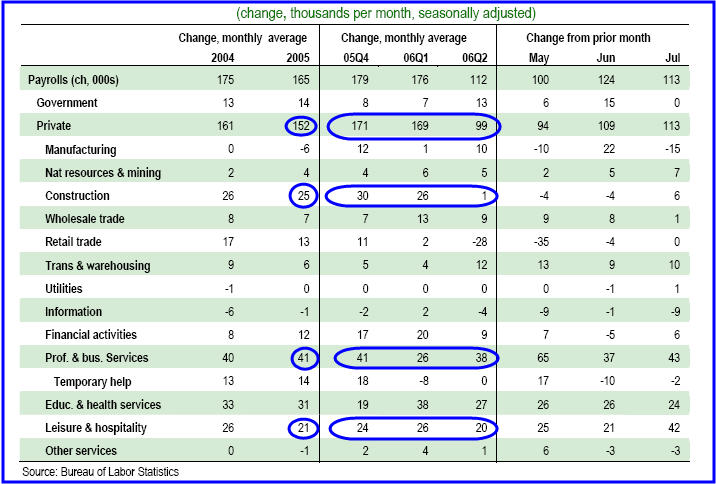


The above image is courtesy of UBS. The blue highlights are mine.

Notice the drop off in private sector employment and construction. Leisure and Hospitality is still holding up well as are professional business services and health services. Health services may continue to outperform but what about the others? I suspect they will not for reasons I will address shortly.

My neighbor is an architect, in fact, he customized designed our house. He told me last week that things have stalled and he will have to lay off one of his helpers. He is only one architect but multiply the situation by the thousands over the country and I think we see a dropoff in all kinds of professional services. Am I over extrapolating one local housing market to the entire nation? I think not. Ask Sonnypage. Also look at falling sales and looming inventory in Florida, California, DC, Boston, Phoenix, and many other places.

There is a new Walmart being built near us, and for the sake of argument I will assume they are expanding over much of the country. In essence I am giving the BLS birth/death model the benefit of the doubt because it matches what I see happening, even in this dismal month. I can say the same thing about Pizza Huts, Applebees, and other restaurants. Nail parlors seem to be everywhere. In essence, housing expansion was followed by lots of leisure and hospitality jobs. But as builders stop building new subdivisions, Pizza Huts and Walmarts and nail salons will stop going up around them. I think we are in the final stages of expanding leisure and hospitality jobs as well.

GDP

The BEA is reporting GDP in the second quarter of 2006 slowed from an annual rate of 5.6% to 2.5%.

Here are the numbers for 2005 and 2006:
Q1 05  Q2 05  Q3 05  Q4 05  Q1 06  Q2 06
3.4 3.3 4.2 1.8 5.6 2.5
Notice that the huge increase in GDP from the 4th quarter of 2005 at to the first quarter of 2006 produced no new jobs. The economy "boomed" but no jobs were produced. I have a suspicion that part of that boom was a mad rush by homebuilders to complete projects before all hell broke loose on the downside. I don't think they made it.

Although we did not produce jobs we did produce a massive increase in housing inventory. Did assumptions about a booming GDP throw off the birth/death model? I think so and it probably still is. (1.8+5.6+2.5)/3=3.3. That is slightly above trend growth. On the other hand if 5.6 is some sort of one time anomaly, we are near the stall rate which I propose to be around 2%.

Regardless of how one twists and turns, a huge percentage of this "recovery" was fueled by housing bubble economics. That engine of growth has stalled and will soon go into reverse. A recession looms.

Let's now turn our attention to our neighbor to the north.

Canada

It seems it was Strike Two in Canada. Bloomberg is reporting Canada Shed 5,500 Jobs in July, Unemployment Rises to 6.4%.
Aug. 4 (Bloomberg) -- Canadian employers unexpectedly shed 5,500 jobs in July, marking the first consecutive monthly declines in almost two years, strengthening the case for the Bank of Canada not to raise interest rates again this year.

The unemployment rate rose to 6.4 percent from 6.1 percent in June, which was the lowest since 1974, Statistics Canada said today in Ottawa. The labor force, the number of Canadians 15 and older holding or looking for a job, rose by 64,200.

Economists surveyed by Bloomberg News expected 23,500 new jobs in July and an unemployment rate of 6.1 percent, according to the median estimates of 20 and 19 economists, respectively. Canada lost 4,600 jobs in June.

The report suggests one of the most robust aspects of Canada's 15-year economic expansion may be weakening, as a strong currency slows exports and a higher benchmark interest rate make it harder for businesses and consumers to borrow and spend. The most recent StatsCan figures showed economic growth stalled in May for the first time in eight months.
Safe Havens

Every day I receive emails from people asking "What currency should I park my money in?" It is very difficult to give generic answers to those questions. Yet Brian McAuley and I discuss issues like those in every issue of The Survival Report. July was the last issue that will be free.

As for "Safe Currency Havens" I am sure that Brian and I are on different wave lengths with the masses. The number of people recently proposing out of the blue, safe havens in the Canadian or Australian dollar is rather interesting.

There is no guaranteed trade at this time, nor will there ever be a guaranteed trade at any time in the future, regardless of what anyone thinks. But the fact that so many want to plow into the Canadian dollar near these highs should be in and of itself a warning sign.

It is easy to say the US dollar is trash. We believe it is too (ultimately). But one also has to look against what, and in what timeframe. The questions may be simple but the answers are complex. Are you looking 3 months, 6 months, 1 year, or three years into the future? Each one of those might require a different answer. We (Brian and I) hope to stay on trends like these and provide guidance, most likely of a contrarian nature.

We went long treasuries at a point where everyone despised them. When everyone starts to love treasuries (and as impossible as that may seem we think it will happen) we will be out of them. We went short the Nasdaq and are still in that trade from months ago.

By no means have we gotten everything correct. Nor do we ever expect to. Perhaps the best thing we offer is a balanced look at things. We are not permabulls or permabears but rather look on things sector by sector. If we ever are correct about everything, please stop reading us because it won't last.

Addendum:
The Fed paused today and the market seems excited about CSCO after hours.
Rest assured both are irrelevant.

Mike Shedlock / Mish
http://globaleconomicanalysis.blogspot.com/

Monday, 7 August 2006

Consumer Credit

Today's question of the day is on consumer credit.
Here are the facts (the question will follow).
  • According to the Federal Reserve, consumer Credit rose $10.3 billion in June to $2.186 trillion. That rise followed a $5.9 billion Consumer Credit expansion in May. The increase exceeded Wall Street estimates for a $3.8 billion increase.
  • Revolving debt which mainly reflects credit card financing, grew $6.6 billion to $820.7 billion. This increase was on top of a $7.4 billion increase in May, making this the largest two month increase since autumn of 2004.
  • Nonrevolving credit grew $3.6 billion, following a reported $1.5 billion decrease in May.
  • Consumer credit grew in June at a seasonally adjusted annual rate of 5.7% while Revolving credit grew at a 9.8% annual rate after rising at an 11% annual rate in May.
The question of the day, asked by Kevin Depew of Minyanville is:
Is this a bullish or bearish report? Kevin Depew himself provides the answer.
Let's tune in:
The Consumer Credit numbers show that once again it was revolving debt - credit cards - that led the way, up 9.8% in June versus a 3.2% rise in nonrevolving debt, such as car loans.

Meanwhile, last month's release showed that in May households increased their revolving debt by $1.9 billion, or 11%, the largest increase since October 2004.

A bullish slant: people believe they can sustain an increased level of debt service.

A bearish slant: higher energy costs, among other things, are forcing people to turn to credit cards to maintain consumption levels and lifestyles.

Which slant to take?

Well, if the war is between who stands to benefit from the revolving consumer credit pie - those who sell things we need versus things we want - it's pretty clear from these charts who the market believes will win: Chevron (CVX), ExxonMobil (XOM), Target (TGT), Tiffany (TIF).

These charts are saying which side really has the upper hand, and it's not those who sell things people merely want. It's those who sell things people really need.
Mish:

Consumers are strapped. They are reluctant to refinance, perhaps because they can not whether they want to or not (they are underwater on their houses), or perhaps because they are scared to death of rising interest rates. That leaves consumers with two choices: do without or charge it.

The latter of course only postpones the problem while increasing the carrying costs. Those that absolutely can not cut back (there is no more to cut unless they give up eating) simply have no choice. They will keep plowing into credit cards until the interest rates eat them alive.

For some reason the market thinks this is all good news. Well it may be good news until it isn't. The stock market has yet to factor in sharply rising bankruptcies (I can easily say that by looking at loan loss provisions at credit corporations). Loan loss provisions are at or near all time lows even as bankruptcies and foreclosures are soaring.

Yes, foreclosures are rising from an extremely low level, but the mammoth complacency regarding this increase is staggering.

Wall Street is not only NOT factoring in increased credit losses (perhaps on the assumption that the bankruptcy reform act of 2005 will protect them), they are not factoring in the possibility that the law will be reversed. As best as I can tell, the only difference is that the current law will prolong the agony while a reversal might make things a bit shorter.

Over the last 20 years (with Japan in deflation), how many times did we criticize Japan for failing to write off bad loans? Yet the bright minds in the credit industry who write US laws (you did not really think senators and congressmen write laws did you?), tried to prevent these writeoffs in advance by that bankruptcy reform act. It is as likely to work as I am to win the Illinois Lotto.

Mike Shedlock / Mish
http://globaleconomicanalysis.blogspot.com/

Ron Paul on Gas Prices

Ron Paul
Texas Straight Talk

What Congress Can Do About Higher Gas Prices
July 31, 2006

Gasoline prices are soaring and the American people are angry. They want something done about it—now!

$100 rebate checks to American motorists won’t cut it, nor will mandatory mileage requirements for new vehicles. Taxing oil profits will only force prices higher. But there are some very important things we can do immediately to help.

First: We must reassess our foreign policy and announce some changes.
One of the reasons we went into Iraq was to secure oil. Before the Iraq war oil was less than $30 per barrel; today it is over $70. The sooner we get out of Iraq and allow the Iraqis to solve their own problems the better. Since 2002 oil production in Iraq has dropped 50%. Pipeline sabotage and fires are routine; we have been unable to prevent them. Soaring gasoline prices are a giant unintended consequence of our invasion, pure and simple.

Second: We must end our obsession for a military confrontation with Iran. Iran does not have a nuclear weapon, and according to our own CIA is nowhere near getting one. Yet the drumbeat grows louder for attacking certain sites in Iran, either by conventional or even nuclear means. An attack on Iran, coupled with our continued presence in Iraq, could hike gas prices to $5 or $6 per gallon here at home. By contrast, a sensible approach toward Iran could quickly lower oil prices by $20 per barrel.

Third: We must remember that prices of all things go up because of inflation. Inflation by definition is an increase in the money supply. The money supply is controlled by the Federal Reserve Bank, and responds to the deficits Congress creates. When deficits are excessive, as they are today, the Fed creates new dollars out of thin air to buy Treasury bills and keep interest rates artificially low. But when new money is created out of nothing, the money already in circulation loses value. Once this is recognized, prices rise-- some more rapidly than others. That’s what we see today with the cost of energy.

Exploding deficits, due to runaway entitlement spending and the cost of overseas engagements, create pressure for the Fed to inflate the money supply. This contributes greatly to the higher prices we’re all paying at the pump.

If we want to do something about gas prices, Congress should greatly reduce federal spending, balance the budget, and eliminate regulations that interfere with the market development of alternative fuels. All subsidies and special benefits to energy companies should be ended. And in the meantime let’s eliminate federal gas taxes at the pump.

Oil prices are at a level where consumers reduce consumption voluntarily. The market will work if we let it. But as great as the market economy is, it cannot overcome a foreign policy that is destined to disrupt oil supplies and threaten the world with an expanded and dangerous conflict in the Middle East.
It is good to see that our one friend in Congress understands what inflation is. Most people still do not have a clue.

I have to disagree about $20 per barrel oil though. It seems Ron Paul is forgetting about a little thing called "Peak Oil". Demand is rising worldwide, and supplies are falling. In that scenario oil prices are bound to rise. Yet, a rise caused by normal market forces (supply/demand) as opposed to throwing money around will not have anything to do with inflation.

As Ron Paul suggests, the market if left alone will provide a solution. It always does. When the Government interferes with market forces things happen, and they are always bad. Supposedly our invasion of Iraq would "pay for itself" in lower gas prices. Well not only did it not pay for itself we wasted close to a half trillion dollars in that sinkhole and the flow of oil out of Iraq is only half of what it was before we invaded. We also started a civil war. Even the most optimist administration supporter can no longer deny that truth. Many unforeseen consequences of our meddling in Iraq have not even been felt. They are coming.

Ron Paul is not the only one asking for troops to be pulled out of Iraq.

John Murtha

Following is a letter from John Murtha, Ranking Member, House Defense Appropriations Subcommittee to the president.
Dear Mr. President:

While the world has been focused on the crisis in the Middle East, Iraq has exploded in violence. Some 6,000 Iraqis were killed in May and June, and sectarian and insurgent violence continues to claim American and Iraqi lives at an alarming rate. In the face of this onslaught, one can only conclude that the Baghdad security plan you announced five weeks ago is in great jeopardy.

Despite the latest evidence that your Administration lacks a coherent strategy to stabilize Iraq and achieve victory, there has been virtually no diplomatic effort to resolve sectarian differences, no regional effort to establish a broader security framework, and no attempt to revive a struggling reconstruction effort. Instead, we learned of your plans to redeploy an additional 5,000 U.S. troops into an urban war zone in Baghdad. Far from implementing a comprehensive "Strategy for Victory" as you promised months ago, your Administration=' strategy appears to be one of trying to avoid defeat.

Meanwhile, U.S. troops and taxpayers continue to pay a high price as your Administration searches for a policy. Over 2,500 Americans have made the ultimate sacrifice and over 18,000 others have been wounded. The Iraq war has also strained our military and constrained our ability to deal with other challenges. Readiness levels for the Army are at lows not seen since Vietnam, as virtually no active Army non-deployed combat brigade is prepared to perform its wartime missions. American taxpayers have already contributed over $300 billion and each week we stay in Iraq adds nearly $3 billion more to our record budget deficit.

In the interests of American national security, our troops, and our taxpayers, the open-ended commitment in Iraq that you have embraced cannot and should not be sustained.

Rather, we continue to believe that it is time for Iraqis to step forward and take the lead for securing and governing their own country. This is the principle enshrined in the "United States Policy in Iraq Act" enacted last year. This law declares 2006 to be a year of "significant transition to full Iraqi sovereignty, with Iraqi security forces taking the lead for the security of a free and sovereign Iraq, thereby creating the conditions for the phased redeployment of United States forces from Iraq." Regrettably, your policy seems to be moving in the opposite direction.

This legislation made clear that Iraqi political leaders must be informed that American patience, blood and treasure are not unlimited. We were disappointed that you did not convey this message to Prime Minister Maliki during his recent visit. Reducing the U.S. footprint in Iraq will not only give the Iraqis a greater incentive to take the lead for the security of their own nation, but will also allow U.S. forces to be able to respond to contingencies affecting the security of the United States elsewhere in the world.

We believe that a phased redeployment of U.S. forces from Iraq should begin before the end of 2006. U.S. forces in Iraq should transition to a more limited mission focused on counterterrorism, training and logistical support of Iraqi security forces, and force protection of U.S. personnel.

Additionally, every effort should be made to urge the Iraqis to take the steps necessary to achieve a broad-based and sustainable political settlement, including amending the constitution to achieve a fair sharing of power and resources. It is also essential to disarm the militias and ensure forces loyal to the national government. Finally, an international conference should be convened to persuade other governments to be more involved, and to secure the resources necessary to finance Iraq's reconstruction and rebuild its economy.

Mr. President, simply staying the course in Iraq is not working. We need to take a new direction. We believe these recommendations comprise an effective alternative to the current open-ended commitment which is not producing the progress in Iraq we would all like to see. Thank you for your careful consideration of these suggestions.
It is time for the people of the US to demand our troops come home. The quicker we admit we are the problem and not the solution, the quicker a solution will be found.

Ron Paul has it right. If we invade Iran, we might see gas prices as high as $6 or even $10, overnight. Yet this administration that has not done a single important thing right in six years, somehow wants to rattle the cage in Iran, Syria, and Lebanon.

If we want to do something about gas prices, Congress should greatly reduce federal spending, balance the budget, and eliminate regulations that interfere with the market development of alternative fuels.

That last sentence says it all. Brazil even offered to sell ethanol to the US at prices 35 cents a gallon cheaper than current US prices. We foolishly turned them down. Instead our policy involves corn subsidies although corn is one of the least efficient ways to produce ethanol.

It is time for government to get out of the way and stop wasting trillions of dollars we do not have in places like Iraq. It is also time to wasting countless billions of dollars building bridges to nowhere in Alaska, and on failed programs like "affordable housing". The ownership society is a complete failure as implemented. The best way to promote ownership is to get out of the way and let the market do the work.

Government can get away with these things only because the voting public allows it.

It's long overdue that we take back America from the war mongers, big spenders, and bureaucrats who only know how to do two things: waste taxpayer money and wreck havoc on the world. Write your Congressmen and let them know exactly how you feel (even if you feel differently than I do).

Mike Shedlock / Mish
http://globaleconomicanalysis.blogspot.com/

Sunday, 6 August 2006

Winchester Cathedral

The Winchester Star is reporting Promises Broken.
Local officials are trying to determine if a home builder took customers’ money and failed to complete the work.

Area police are investigating a builder who promised to construct several half-million-dollar homes for buyers in Winchester and Frederick County, but allegedly failed to follow through.

The Frederick County Sheriff's Office and the Winchester Police Department are trying to determine whether Gary Grimm, a Chantilly-based builder, committed construction fraud when he did not complete work on the homes.

Grimm, through his company G&M Homes, sold empty lots on Clayton Ridge Drive in the Meadow Branch subdivision of Winchester, and on Union View Lane off Glendobbin Road in Frederick County.

Buyers signed contracts with Grimm and paid deposits for their custom homes, many of which cost $450,000 to $550,000, according to records in local courts.

Grimm finished an undetermined number of the houses, but work was interrupted on nearly two dozen others months into the construction, owners said.

During late 2005 and early 2006, some of the homeowners began receiving notices of liens from contractors.

Subcontractors who worked on the G&M homes said they were not paid for their work or building materials, with bills ranging from about $1,000 to more than $59,000, according to court documents.

At least seven addresses in Frederick County and 16 addresses in Winchester have at least one G&M Homes-affiliated lien. Several homeowners are fighting the liens with attorneys, and some of the liens have been released.

Two of the homeowners who were allegedly affected by Grimm’s business practices filed civil lawsuits in Winchester Circuit Court, alleging that Grimm broke the contracts to build their houses, committed fraud, violated the Virginia Consumer Protection Act, and used money for the construction of their houses for other purposes — specifically Grimm’s personal use.

One of those lawsuits, from siblings Jerome and Christine Fasano, has been dropped for now, according to court records. Their Fairfax-based attorney, Daniel Rathbun, filed a no-suit motion, according to the court file.

No reason for the withdrawal is listed. Rathbun declined to comment for this article, as did Jerome Fasano.

The other lawsuit is active, though no hearing date has been set.

That court file now includes a notice that Grimm and one of his building companies, G&M Homes LLC Number Three, have filed for protection in the U.S. Bankruptcy Court for the Eastern District of Virginia.

Telephone numbers for the various G&M Homes names led to messages that the numbers had been disconnected.
Lindsay Wilson should thank her lucky stars.
Why?


Because her house could look like this instead.


The song for today is Winchester Cathedral by The New Vaudeville Band.

Winchester Cathedral
You're bringing me down
You stood and you watched as
My baby left town

G&M Homes skipped town.
Who is next?

This is really sad.
People's lives are being destroyed by the implosion of this housing bubble.
There is a lot more grief to come.

Mike Shedlock / Mish
http://globaleconomicanalysis.blogspot.com/

Scared in Atlanta

This post is a further continuation of the "Saga of Sonnypage", an Atlanta area real estate broker who posts on my investment board the Motley FOOL.

Previous Sonnypage highlights include:

Lights Out in Georgia on 2006-07-27
Soft Market Debris .... on 2006-08-02
Is the Fed irrelevant? on 2006-08-03

Sonnypage has this update to share, about "Scared in Atlanta".

Sonypage - 2006-08-06

All of the regulars here know by now that my wife and I are Realtors, a husband and wife team, associated with one of the major national franchises. We live north of Atlanta out in Roswell. The managing broker of the large mega office we work from holds an office business meeting every first and third Tuesday of the month. This past Tuesday performance awards were announced and handed out for July. The good news was that my wife and I won listing agents of the month with four new listings. The bad news was that we also lost two listings in July, but thankfully, that was not announced. Unbelievably, we lost one of those listings in a record 21 days!

Duke and Miriam called us on June 30th. They live in Sandy Springs, which is to the south of Roswell, across the river. Their friend Fran, who also lived in Sandy Springs, had told them that we had listed and sold her home this spring in only 40 days. We sounded like just the kind of Realtors they needed. Would we come and list their home? They were in a hurry to get started, they told us, so we went down that very day to preview, went back to our office to put together our proposal, and then met again that night. Based on comparables from last year but also taking into account a slow market, we recommended listing somewhere between $500,000-$525,000. But Duke had other ideas. When they refinanced last year, his mortgage lender appraised the home at $550,000. Duke wanted to start there, but at the same time explained they were closing in a few days on a new home up in the mountains where they planned to retire. They wanted top dollar, in a hurry, in a slow market. That's a tall order. I diplomatically suggested we start at $550,000, but reevaluate in 30 days after seeing how the market responded.

A couple of posts ago I introduced you to Sonnypage's Third Rule of Real Estate. Do you remember?

“In a soft market, marginal listings become flotsam and debris.”

In a strong market, everything sells. Buyers understand that if they don't buy that house they are looking at quickly, someone else will. Never mind the lousy back yard or the poor floor plan. Buy it, wait a few years, sell it for a profit and buy something better. In a soft market, of course, that does not work. Buyers have plenty of time and plenty of listings from which to choose. There are just not enough buyers to go around so the left over marginal listings do indeed become “flotsam and debris”.

The four listings we have closed this year, including Fran's, were perfect houses on perfect lots. But of the eight listings we currently have, six have been on the market over four months, which in a normal year would be quite unusual.

Duke and Miriam's home was far from being a perfect listing. There were several problems, but at the top of the list would be a very steep wooded ravine in the front that scared away families with kids. That first Sunday, we held an open house. I watched from the window as a van pulled up to the front. As the wife struggled to get the kids out of car seats, the husband walked over and took a look down the “ravine”. Then I watched as he motioned to his wife to hook those seats back up. They drove off without ever coming inside. We had only two showings in three weeks. In the meantime, Duke and Miriam's friends and neighbors were scaring them to death with stories of people they all knew who were unable to sell their homes after months of trying. Indeed, inventory levels all around town are way up, days on market, way up. Perfect houses in select neighborhoods are selling at full price or only small reductions, but for the vast majority of listings, those that are less than perfect homes, sellers are faced with either taking big reductions, or taking it off the market and hoping for better days.

Duke called us on day 21 and said he wanted to switch to a different Realtor, someone who lived close by, and might “understand” their neighborhood better. My wife reminded him that their friend Fran, who also had lived in Sandy Springs, had recommended us. We had sold her house. But no, he wanted to switch. Legally, a listing is a binding contract, but who wants a listing that does not want you? We agreed that if they would reimburse us our actual cash expenses, i.e., a virtual tour, a full page color spread in a real estate magazine, we would sign the transfer papers. When we stopped by to pick up our sign and lockbox, my wife told Duke that we were disappointed that we had not been given a fair opportunity to sell their home. Duke's response took us by surprise. He simply said, “We are scared”. In a good year, Duke could get his $550,000, but I just don't think that will happen this year.

I am hopeful that Bernanke and the Fed will pause on Tuesday. I believe that they will and that we can still, just maybe, avert a full blown real estate led recession in this country. The spring and summer markets are lost. Even if the Fed is done, I do not expect a pick up in housing until next year's spring market if then.

But I will leave you with this thought. What if this time next year we find ourselves in a deep recession, with housing, which has become so crucial to our economy and jobs, in a bigger mess than ever. Is there another rabbit in the hat that could be pulled out to save the day? Consider if you will that residential housing in this country is government subsidized. You are able to deduct mortgage interest paid on your home loan. What if our congress, in an effort to save our country in a national emergency, were to increase that deduction? Let's say a homeowner paid $10,000 in mortgage interest. Why not let those homeowners take, say, a $15,000 deduction? Would a fat check in the mail on April 15th jump start the housing market? Call it a federal jobs program if you will but would it work? I think that it would and in an economic disaster something like it will be tried. Will it come to that, who knows?

I am very long gold.

Sonnypage

Mish:

Duke and Miriam have every right to be scared. Their house might not sell for a year. When it does it might be for $100,000 less than they expect, if that. Can they afford the carrying costs of two houses? The more scared they are the more I suspect the answer is no. They may end up losing both houses out of this if they are not careful. I suspect they are underwater now on their new home in addition to possibly being underwater on the home they want to sell. That latest refinancing is a clue. Why would they be refinancing now in the teeth of rising interest rates. Did they need cash out for a down payment or to buy furniture for their new place?

If they are not underwater, then perhaps they are scared by the fact that unless it sells for what they thought, they can not afford the monthly mortgage on their new house. There are all kinds of reasons to scared.

I also think Sonnypage made two mistakes.

The first mistake was taking the listing. Sonnypage had to know that that listing would not sell, at least at the price listed. In a slumping market, carrying two mortgages that person needed to get out right of one of them ASAP. It was not realistically going to happen and I propose that surprises will happen to downside in a soft market and surprises will be on the upside in a strong market. Perhaps a month was lost. That month might have hurt the client.

I think the second mistake was doing a virtual tour and taking out a full color ad. I am less certain about this mistake as perhaps it would be needed to get any kind of response.

Is there some sort of compromise? Yes I think so, and I propose the following. Agent's should explain to their clients (in detail) Sonnypage's Third Rule of Real Estate: “In a soft market, marginal listings become flotsam and debris.”

If the client refuses to budge on the price then I see four options.

Four Options:
  1. Take the listing at an unreasonable price but do not heavily promote it (Tell the client there will be minimal promotion and why). The client may refuse to sign if the agent will not promote it, but at least the agent is not out any money on a listing that won't sell.
  2. Take the listing at an unreasonable price but only if the client covers promotion costs. I would expect clients to walk away from such a proposal but who knows? Perhaps the client appreciates honesty but still wants to try it their way first.
  3. Refuse the listing outright and explain why it is not in the client's best interest or the agent's best interest to take such a listing. Attempt one more time to explain "Rule 3", as well as the strong potential of "walking down the market" if the client's plan is to start high and reduce prices until it sells. Perhaps that will scare some sense into the client and the agent will get the listing at a price that will sell. Everyone then wins.
  4. Take the listing and promote it but only if you can get the listing for longer period of time with perhaps automatic price reductions down to some agreed upon rate.
Personally I think option #3 is in both the client's and agent's best interest. Option #4 also seems viable but in a rapidly sinking market runs the risk of "walking down the market".

A Rabbit in the Hat?

An increase in the mortgage deduction by $5,000 would not put $5,000 in anyone's pocket. A homeowner tax credit would put $5,000 into people's pockets but it would probably not do a thing for home prices or home activity.

$5,000 is peanuts compared to the median price of a home in major metropolitan areas. Would the money be spent? How? Those out of work would use it to pay their mortgage bill and property taxes. That might keep the average Joe going for another few months but we should recognize the plane for what it would be: a bailout of the credit industry. In the long run, it is exactly the wrong thing to do. It would just encourage more speculative lending in the belief that someone will bail them out. More importantly it would only delay the inevitable while adding to debt levels we already can't pay. The US dollars would sink and gold would likely soar on the news.

There are no more rabbits in the hat.
The mad hatter's party is now officially over.

Mike Shedlock / Mish
http://globaleconomicanalysis.blogspot.com/

Saturday, 5 August 2006

Blasphemy

I am outraged.
Just what kind of talk is this?

The Carroll County Times is reporting Housing prices may be falling.

Normally I would dismiss such insane talk right out. It is of course just the kind of bubble nonsense that one might see on Patrick or the Vancouver Housing Bubble blog or the mother of all bubble blogs, the Housing Bubble Blog. Apologies extended to all kinds of blogs that I failed to mention (but we know who you are and we are watching you closely)!

Make no doubt about it.
This is serious blasphemy.
Please pay attention.

The president of the Maryland Association of Realtors said he expects the cost of homes to drop later in the year.

The county's inventory of available homes has steadily risen since last year, up to nearly 1,100 in June, according to MAR. One year earlier, about 570 homes were available for sale.

Despite the growth in inventory, the median home price in the county has not fallen, and the housing affordability index, which compares the median income of first-time home buyers to the cost of starter homes, is at its lowest since it was first calculated in 2003.

"The prices of homes have not adjusted down as you would expect it to," said Al Ingraham, MAR president.


Mish fans everywhere know that I am totally outraged by such nonsense.
It would be bad enough to hear this on Patrick or Ben Jones but what kind of traitor is Al Ingraham, the president of the Maryland Association of Realtors?

I am so outraged that I am writing the most important person in the universe. No, not president Bush, but Davis Lereah the chief economist for the national association of realtors.

How many times do I have to state the obvious?

The Obvious
  • Home prices only go up.
  • Demographics are our friend.
  • Bubble talk is nonsense.
  • Patrick? Who is he?
  • Ben Jones? What the heck does he know?
  • Vancouver? Who cares?
  • Land? Do they make it anymore?
  • Japan? Please be serious.
By now all of you know that I am totally outraged by articles like the above mentioned article by the Carroll County Times. Just who do they think they are anyway?

There should be a law on "Defamation of Homebuilders".
I propose an extension to the widely loved Patriot Act to include unpatriotic acts of aggression against home prices and home builders.

What can possibly be more "American" than this idea?

Please write your Senators and Congressmen today and urge then to pass the proposed "Anti-Homebuilder Defamation Act".

Do it now or home prices will sink further.
Your future and that of America is at stake!

Mike Shedlock / Mish
http://globaleconomicanalysis.blogspot.com/

Friday, 4 August 2006

Rear View Mirror Jobs

2006-08-04

Today's "question of the day" comes from John Succo at Minyanville. Following are his questions and thoughts up to the label "Mish:".

As everyone stares at the employment number I ask why? 71% of all new jobs this year are accounted for in the birth death adjustment.

So all we have to do is decipher the birth death adjustment to see what is really going on. So exactly what is it? We don't know.

The BLS will not allow anyone, ANYONE, to see how they calculate this number.

So everyone clamors over a number that gives us no real information and only has meaning because other people attach meaning to it.

Meanwhile, housing is looking weaker and weaker and housing really is driving almost all economic activity...at least it has in the recent past. And housing is rolling over with rates here even if the Fed pauses.

Hovnanian (HOV), an important housing stock, just cut numbers dramatically citing lower sales and higher cancellations. That is a fact. So the company is having trouble NOW with rates HERE. In addition, the time lag essentially means that part of that trouble began at even lower rates.

Doesn't that mean that a pause by the Fed in rates is too late? What good would a pause do if housing is slowing dramatically with rates here? It would take a rate cut to help them marginally from here.

Bulls trading futures are buying because others are buying.

Mish:

MarketWatch reported U.S. nonfarm payrolls rise 113,000 in July.

The U.S. economy added fewer-than-expected 113,000 nonfarm jobs in July and the unemployment rate rose to 4.8%, its highest level since February, the Labor Department said on Friday. The payrolls number was weaker than the 143,000 gain economists surveyed by MarketWatch were expecting. "Overall, too soft to hike," said Ian Shepherdson, chief U.S. economist at High Frequency Economics. Shepherdson said the Fed was now done raising rates.

The birth/death model took away 57,000 jobs in July. Those not familiar with the Birth/Death Model should read "Strike Three" for an explanation or the rest of this discussion may not make much sense.

Absent the Birth/Death adjustment, the jobs number was 170,000 rather than the reported 113,000. Yet, nearly 70% of employment gains this year came from birth/death model adjustments by the BLS.

This is the fourth miss in a row vs. job expectations. I talked about the last miss in "Strike Three".

Is it that the numbers are irrelevant, or is it that the interpretation of those numbers is fraught with a ton of problems. Is the economy adding more jobs than is shown by the hard payroll data itself, or less? Is the BLS assuming one thing but the economy proving another?

Yes, I agree with professor Succo that looking at the raw figures from the government is meaningless. But is the process of trying to figure out trends to get a feel for what is really happening useless or not? I can not say for sure but I suspect he might agree with me that it is not.

There is no doubt that the BLS model will miss the turn. Employment numbers will lag at both the top and the bottom. They admitted as such themselves.

But as goes housing, jobs will follow. So when I see marginal growth in jobs at a time housing is falling off the cliff, I am going to be very suspicious of those numbers. There can be no question about it. Housing has fallen off a cliff.

When I looked at today's numbers I expected to see huge negative revisions in the "Birth Death Model" but they were not there.

Here is the chart of Birth/Death assumptions: (click on the image for a larger view)


Housing peaked in July or August of 2005. Yet leading up to that peak we see the BLS assumed a total of 501,000 jobs for the months of April thru July. This year, in the midst of an enormous housing slump, the BLS assumed the creation of 600,000 jobs. Not only that, but the birth/death model only subtracted 57,000 jobs this July vs. 72,000 last July.

This is obviously total garbage. We may not know if 2005 was understated or if 2006 was overstated but we do have a glimpse that at least one set of the BLS's numbers is pure nonsense. No matter how you look at it, there is a problem.

I strongly suspect that the BLS model is looking in the rear view mirror when it comes to jobs. They are currently assuming that the economy is growing faster now in terms of job creation vs. a year ago (not for one month but for a 4 month average), at a time when GDP has fallen to 2.5% and housing starts and home sales have fallen off a cliff. Either that or their model has gone totally haywire.

We may not know what the real numbers are, but we do knows know that relative to last year, the last 4 months of birth/death assumptions from the BLS are insanely optimistic. That to me is useful information.

Had the numbers shown massive declines in the job assumptions for July, it would have been one thing, but the actual numbers shown above for April through July (year over year) are clearly a joke.

Still the reflex action of the market has been to buy bad news. It happened again today (at least at the open) just as Succo commented "Bulls trading futures are buying because others are buying."

This will work until it doesn't. The longer it "works" the bigger the eventual blowup will be. At some point, job losses will matter simply because they have to. People out of work will not be buying much regardless of whether or not interest rates pause, or even decline.

Mike Shedlock / Mish
http://globaleconomicanalysis.blogspot.com/