Friday, 18 August 2006

Take a letter Maria

The Baltimore Sun is reporting that Countrywide is sending letters to Pay Option ARMs holders.
Countrywide Home Loans, quietly has begun sending out letters to thousands of borrowers who have been making only the minimum payments on the company's popular "PayOption" adjustable-rate mortgages.

The letters explain that "this is an early message to alert you that, based on your current payment trends and potential future interest rate changes, the monthly payment you will be required to pay may increase significantly."

A model letter provided to me by Countrywide includes this hypothetical example of what could be ahead for a California homeowner currently making only minimum payments monthly on a $402,000 loan.

The current full interest rate on the loan is 7.6 percent, but the borrower has been paying just $1,348.47, far less than what's needed to fully amortize the mortgage over its 30-year term.

If the loan reset at today's rates, the letter explains, the full payment required would be $2,887.50 - more than double what the homeowner has gotten used to paying. Future reset rates could be even steeper, making the potential payment crunch much worse.

John G. Walsh, a senior official at the federal Comptroller of the Currency, recently described his agency's concerns about poorly informed borrowers who don't realize that their artificially low monthly payments won't continue indefinitely.

"We've had consumers tell us they didn't know that after making 60 minimum payments on a [payment-option loan], they would owe more than they did when the loan was brand-new. They should certainly understand the basic bargain: The price of a low payment now is a much higher payment later.

"I think it goes without saying," added Walsh, "that someone, at some point, should have explained this" to borrowers with these loans.
Cramer: Pay Option Arms are Prudent

It seems like the good folks at Countrywide were not tuned in to Cramer when he said Panic Over Option ARMS Is Just Noise.
The borrowers are not morons. They can read the papers, too. They recognize that homes aren't selling.

I would bet that most of these borrowers are simply younger people with new jobs who are correctly taking advantage of a low rate. People who have taken this rate have been very right. The long end hasn't gone up. It seems like it won't go up now. So while they build up some savings with the low rate, they get stronger down the road and then can take the higher rate.

The media call it dangerous. I call it prudence.

These loans work as long as employment stays steady. The fact that it has tells me not to worry, that this is just another phantom problem not worth fretting about.
Prudence? No worries? Phantom Problem? Does anyone take this guy seriously?
How long is employment supposed to say steady and how many people are now upside down and trapped? Look at the comments from the Comptroller of the Currency about people not understanding how these loans work.

Lead Balloons in Virginia

The letters in Virginia are probably more likely to be foreclosure notices than anything else.
The Northern Virginia Real Estate Guide has some choice responses on What the insiders are saying about the local market.
Whenever I engage in a conversation with another local agent (especially those with several years in the business), I always get around to the question: What's going on with this market? I had one of these with an agent we are working with on the other side of one of our transactions. Her answer: "I don't know. I've been in this business for 36 years and experienced a lot of ups and downs. I have never seen it like this."

Responses from other agents include:
  • I'm not taking any more listings.
  • I can't afford to keep advertising property when the seller is so rigid on price.
  • I'm lucky I have buyers.
  • I've shown one buyer client over 100 homes and they still can't decide. (I'd be confused too if I looked at even 25% of that number)
  • Create two letters to listing clients: The first one to send is "you have to lower your price to sell. If they don't, send the second one asking to terminate the listing."
  • Only take a listing if the seller is willing to set their price at least 5% below anything that has recently sold around them. That's what it's going to take to attract buyers in this market.
  • My buyer can wait to watch the market come down even more. (I hear this on every low contract offer we get).
  • I have sellers that can't take a contract offer because they are upside down on their mortgage.
The Real Estate Bubble is turning out to be a lead balloon. I just hope it doesn't fall on my head. The next 12 to 24 months are going to be interesting indeed as we work through this cycle.
Here's a different twist on a letter writing campaign.

Create two letters to listing clients: The first one to send is "you have to lower your price to sell. If they don't, send the second one asking to terminate the listing."

How many real estate agents thought they would be rejecting listings a year ago?
Is there any good reason to suspect this cycle will be over in 12 months?
Can agents survive another 24 months like this?

Mike Shedlock / Mish
http://globaleconomicanalysis.blogspot.com/

Euro, Yen and Pound Going Nowhere Fast

Boris Schlossberg, Senior Currency Strategist for the DailyFX sent me an interesting article called Euro, Yen and Pound Going Nowhere Fast. Following are some highlights:
French non-Farm payrolls expanded at 0.3% versus 0.2% forecast but wage growth slowed in Q2 to 0.5% from 0.8% reading in Q1. The French wage data is consistent with the latest CPI releases from the Eurozone which suggest that while Producer prices continue to move relentlessly higher, pricing power in the 12 member region remains decidedly weak. The contrast between input costs and output prices should raise questions amongst euro longs regarding the probability of continued rate hikes from the ECB. While we doubt the European monetary authorities will flat our pause in their tightening campaign, they may choose to slow the pace of rate hikes perhaps ratcheting rates only to 3.25% rather than 3.50% by year end.

One key factor that may influence ECB official’s decision making process is the price action in EUR/JPY which reached all time highs in early European trade tonight coming to within a whisker of the 149.00 figure. Although the pair appears to have made a short term climax high, dropping 70 points soon thereafter, the long term implications of such high exchange rates clearly have to be a concern to EZ policy makers especially in light of the fact that exports are such a critical contributor to overall economic growth of the region. Last May, ECB much to the surprise of the market chose to hold rates steady resulting in a sharp sell off in EUR/USD. At the time, many analysts believed that the high rate of EUR/JPY was the true reason for the monetary policy makers hesitancy to raise rates. With EUR/JPY now trading nearly 300 points higher, traders would be well advised to watch this dynamic with care as it may suggest that further euro rate hikes are not nearly as certain as most market players believe.
By the way, Schlossberg is a short term trader yet the interest rate picture as painted above just may set the tone for quite some time. If expected hikes in Europe and the UK do not happen, it will likely be bearish for those currencies vs. the US dollar.

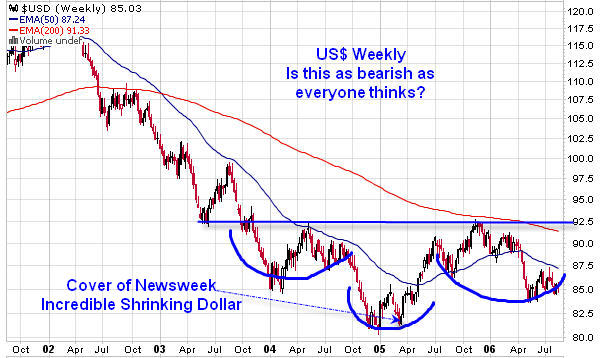
As far as sentiment goes, I can only speak for what I see on message boards like the Motley Fool, Silicon Investor, and articles posted from most other sources. Except for a rare article like the above, sentiment against the dollar seems excessively bearish. Back in February of 2005 everyone was yapping up the fact that Buffett and Gates were short the dollar. The US$ rallied significantly from that low. Even though there has been retracement of that rally, the US$ is making higher lows, thus that sentiment against the dollar still seems a bit unfounded.

The dollar was suppose to collapse when Japan stopped buying dollars, instead it rallied. The dollar was supposed to collapse when the US paused. Instead gold has collapsed.

Here is a chart to consider.


Admittedly that is a sloppy inverse H&S pattern but it seems to be a valid bullish interpretation at least for the time being. The fate of the US$ may lie more in the hands of what Japan, the UK and Europe do with interest rates as much as anything the Fed does (barring immediate and unexpected rate cuts).

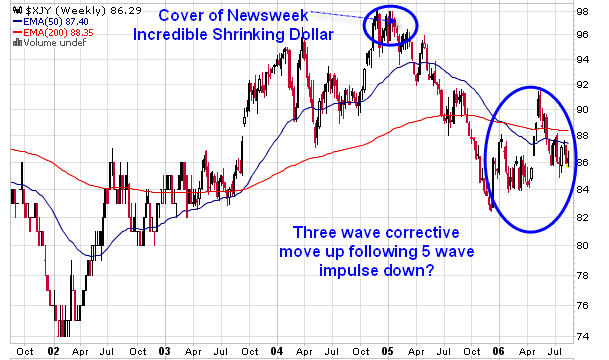
I have had my eye on the YEN for some time.
Please consider the following chart of the YEN index.


Last month Japan finally pulled the trigger on rate hikes. It was the first hike in 6 years ending years of ZIRP (Zero Interest Rate Policy). Japan seems concerned about their decision already.

Forbes is reporting Some Bank of Japan board members urged cautious policy.
Some members of the Bank of Japan's policy board called for a cautious policy stance to avoid leading markets to think the central bank's rushing to raise interest rates, according to the minutes of the BoJ's July 13-14 meeting released today.
Last month the nine-member board voted unanimously to end the central bank's zero rate policy by raising the target for the overnight call rate -- the interest commercial banks charge each other for short-term funding needs -- to around 0.25 pct from near zero.

The minutes said: "... some members said that it was important that the bank did not give the impression that it was rushing to raise the policy interest rate."

One member even said the BOJ "should avoid giving the impression that it would carry out successive raises of the policy interest rate like the Federal Reserve," the minutes said.
If Japan does hike rates substantially it will be a further drain on the world's carry trades. Yet refusal by the BOJ to normalize interest rate policy could conceivably cause a YEN crisis at some point.

People seem excessively worried about (or hoping for) a collapse of the US dollar. If anything suddenly collapses it might be what people least expect: The YEN.

Mike Shedlock / Mish
http://globaleconomicanalysis.blogspot.com/
Thursday, 17 August 2006

It's the oil, stupid!

Bush stepped up to the plate on Wednesday August 16th 2006 and finally admitted why we are in Iraq.

"Leaving before we complete our mission would create a terrorist state in the heart of the Middle East, a country with huge oil reserves that the terrorist network would be willing to use to extract economic pain from those of us who believe in freedom," Bush said.

I believe that speaks for itself.
The rough translation is "It's the oil, stupid!"

Oddly enough there were few terrorists in Iraq before we got there.

Since then this administration has "brilliantly" executed a plan that
  1. Increased ethnic violence in Iraq
  2. Increased persecution of women, minorities, and Christians
  3. Put in place a government that leans towards Iran
  4. Started a civil war
  5. Wasted half a trillion dollars
  6. Padded the pockets of Halliburton
  7. Erased the goodwill following 911
  8. Caused rifts with our allies
  9. Killed tens of thousands of innocent civilians
  10. Shut off the flow of oil
  11. Did nothing to reduce terrorism
  12. Made us look like fools in front of the world
If that was the plan, I have to admit it was brilliant. We succeeded in our every goal. Today was the first admission from Bush as to why we are in Iraq. The only thing is, most of the public knew it already.

Obviously the above 12 points puts to rest the idea that "This war would pay for itself with decreased oil prices". Cynics might suggest the real plan was to drive up the cost of oil while starting a perpetual war that we knew all along could not be won.

The major problem with "Cynic's Choice" is that it assumes that an administration that bungled Katrina by orders of magnitude more than anyone might have thought possible, bungled military intelligence in every way possible, and quite frankly appears incapable of finding its ass with both hands at the same time, could possibly conceive of such a plan and carry it out to perfection. On that basis "sheer stupidity" seems far more likely than what many cynics are suggesting.

Mike Shedlock / Mish
http://globaleconomicanalysis.blogspot.com/
Wednesday, 16 August 2006

Intermediate vs. Finished PPI

Table of PPI Data from the Labor Department, in Percent Changes
                             JUL    JUN    MAY
PPI, Finished Goods 0.1 0.5 0.2
PPI, Ex. Food, Energy -0.3 0.2 0.3
Energy 1.3 0.7 0.4
Foods -0.3 1.4 -0.5
Consumer Goods 0.2 0.6 0.2
Residential Electricity 1.8 -2.8 0.1
Residential Gas 0.9 -3.7 -3.1
Gasoline 0.7 6.3 2.2
Home Heating Oil -2.7 6.5 2.6
Drugs -0.2 0.3 1.9
Autos -0.8 0.9 -0.4
Tobacco 0.0 0.2 0.0
Capital Equipment -0.2 0.3 0.3
Intermediate Goods 0.5 0.7 1.1
Ex, Food, Energy 0.7 0.8 1.1
Crude Goods 3.1 -1.7 2.0
Ex. Food, Energy 1.3 1.7 6.2
BLS Discussion of the PPI
The Finished Goods Price Index is one of the Nation’s most closely watched indicators of economic health. Movements in this index are often considered to presage similar changes in inflation rates for retail markets, as measured by the Bureau’s Consumer Price Index. Still, there are many reasons why short-term movements in the PPI and the CPI may diverge. For example, by definition, the Finished Goods Price Index excludes services, which constitute a major portion of the CPI. Similarly, the Producer Price Index does not measure changes in prices for imported goods, whereas the Consumer Price Index includes imports. Conversely, the CPI does not capture changes in capital equipment prices, a major component of the Finished Goods Price Index. Finally, large swings in producer prices for foods and other items may be considerably dampened by the time retail prices are measured.

Other commodity-based SOP price indexes besides the Finished Goods Price Index also are used for general economic analysis. Because prices for food and energy have tended to be so erratic in recent years, some economists prefer to focus attention on an index measuring prices for finished goods other than foods and energy as a better measure of the so-called core or underlying rate of inflation. The Index for Intermediate Materials, Supplies, and Components is closely followed as an indicator of material cost pressures that may later appear in the Finished Goods Price Index or the CPI. The Index for Crude Materials Other than Foods and Energy is quite sensitive to shifts in total demand and can be a leading indicator of the state of the economy; its limited scope, however, makes it less reliable as an indicator of future inflation in general.
The following comments were made by Kevin Depew on Minyanville.
  • The producer price index for finished goods rose 0.1% in July, below the 0.3% gain expected, the U.S. Labor Department said.
  • The core PPI - which excludes food and energy prices - fell 0.3%, the first decline since October.
  • Prices for finished goods other than food and energy showed a an outright decline, 0.3% in July. Isn't that a sign that demand for finished goods is decreasing?
  • A close look at the figs show the 12-month change in the prices for finished goods still rising at a 4.2% annual rate.
  • Intermediate goods rose 0.5%, after a 0.7% rise in June. The 12-month change in intermediate goods is rising at an 8.9% annual rate.
Here is the question of the day:
Where is the pricing power?

Doesn't the spread between finished goods and intermediate goods suggest an inability to pass through costs?

Of course one month does not make a trend. Enquiring Mish readers want to see more rigorous proof or at least something longer than a one month stand. I offer the following chart of the long term trend of the finished goods PPI vs the intermediate goods PPI with thanks to Scott Reamer of Minyanville.

Click on chart for a sharper look.


I can not help but repeat myself.
Where is the pricing power?

In the wake of slumping home sales and weakening consumer demand for goods and services, expect the trend depicted in the above chart to continue and/or expect the intermediate PPI to take a turn south itself.

Thanks to Scott Reamer and Kevin Depew of Minyanville for this unique look at the PPI.

Mike Shedlock / Mish
http://globaleconomicanalysis.blogspot.com/

Saturday, 12 August 2006

Beware of Alligators

The Herald Tribune is reporting Rental market caught in real estate downturn.
The Southwest Florida market for rental properties is all whacked out.

Where demand is highest -- in the affordable segment -- the supply of apartments and rental houses is tight. But at the higher end of the market, there is a glut of properties aching for tenants.

Investors initially bought single-family homes in the hope of benefiting from the rapid appreciation in values. When prices of properties rose too high, they turned to condominiums and converted apartments.

Most of the neophyte landlords figured it would be easy to rent their properties at prices that would cover their costs until it was time to sell.

But it is now dawning on them that the rental market is not a no-brainer, and selling out during the current sales slump is not an option unless owners are prepared to dump their properties at significant discounts.

Rents up, occupancy down

Evidence of the disequilibrium in the real estate market can be most clearly seen in Sarasota County. According to RealFacts, a Novato, Calif.-based research company, the average rent of apartments in complexes with more than 100 units in Sarasota County reached $989 during the second quarter of 2006. That is a 19.9 percent increase from the average rent of $825 in the second quarter of 2005.

At the same time, average occupancy in Sarasota County apartment complexes fell to 90.7 percent in the second quarter of 2006 from 98.2 during the same period a year earlier.

The problem, Louis and others say, is that the new owners of the units want to cover their mortgages, taxes, insurance and maintenance costs. So they are offering units for as much as $200 more than the market will bear.

As renters refuse to pay such high prices, the units remain empty.

"There's a six-month supply of condos on the market right now," said Corbridge of Sarasota Management and Leasing. "That means that if no new rental units come to market, it will take six months to rent all the units we already have."

One way to resolve the glut would be for owners to sell their properties and get out of the rental business.

"But there's no one buying," said Holmes of the Sarasota Landlords Association.

"Owners will either have to drop their prices to a point where it makes sense for the next landlord to invest, or hang on until rents rise or real estate sales pick up."

Another way to solve the oversupply problem would be for landlords to drop rents.

"Instead of making money, landlords will see money going out." Holmes said. "It's called an alligator, and it will eat you every month.
Alligator Carry Costs

It seems like it is getting very expensive to feed that alligator. I gave Mike Morgan a call and asked him what the average carrying cost would be on a $400,000 condo and a high priced $1,000,000 condo.

Here is the monthly breakdown for a $400,000 condo at say 7% interest
$2,300 Interest
$0,300 Maintenance
$0,500 Property Taxes
==================
$3,100 Monthly Nut
$37,200 Annual carry cost if not rented

IF rented (a tough proposition) I asked mike what one could get.
Morgan thought $1500 - $2000 rents were possible. Possible does not mean likely given the current oversupply.

IF rented (most are not) the carry cost is (at $1750 a month in rent) is $3100-$1750= $1350 a month. Annualized that is $16,200.

Bear in mind that does NOT include special assessments. Anyone who knows anything about condos knows those will be coming. Special assessments will happen to cover tuckpointing, hurricane damage, mold, improvements, and lowball initial maintenance fees. Special and regular assessments do not include rental damage, repainting, recarpeting, etc, etc, to keep a unit rented.

The best case scenario on a $400,000 unit rented out is a loss of $16,200 annually. Unrented, the annual upkeep is $37,200.

On a $1,000,000 condo multiply the numbers by 2.5 minimally (it is more actually because rents do not rise proportionately)

Let's face it. That is a serious snapper.

Another problem is the demand to purchase condos has been dropping like a rock but supply is constantly being added by flippers wanting to bail out, and builders still foolishly building the damn things.

In my discussions with Morgan today, he mentioned that he is starting a consulting service. Morgan Florida Research will be offering weekly analysis of the latest housing trends in Miami, Orlando, Naples, Palm Beach, the Panhandle and the Treasure Coast. Morgan will also continue to offer statewide tours to hedge fund managers, reporters, analysts and large private investors. Morgan is available for any custom research projects you have in mind.

Anyone (hedge funds, banks, private investors, etc) who wants a tour of the area or real time advice as to what is happening in Florida and why should send him an Email or give him a call.

Email Mike Morgan at Morgan Florida.

A Look At Miami

Following are some pictures Mike Morgan sent me.
The images are all from the Miami area.
Those with multiple cranes are from the downtown area.


Supply

As I look at those images I easily say to myself that it is nearly impossible for anyone who bought near the peak to ever break even. There is 10 years worth of supply coming on the market at current sales rates. Prices will drop and in 10 years there will be new condos still coming on at reduced prices.

By the time rents catch up with carrying costs, if they ever do, those condos may be worth 50% less than they are today. Right now it seems that no one wants to rent (at the high end), and no one wants to buy. In that scenario, prices have nowhere to go but down yet insurance rates and low ball maintenance fees will be rising sharply.

Snap Snap Snap

Condos are like alligators.
If you are thinking of buying an alligator, I suggest you think twice, then don't do it. If you already have an alligator you do not want or can not afford to feed, the best thing to do is sell it for any price you can get before it eats you alive.

Mike Shedlock / Mish
http://globaleconomicanalysis.blogspot.com/

Thursday, 10 August 2006

The Next Move

Nouriel Roubini is writing The Next Move by the Fed Will be a Cut, Not a Hike, as the US Slips into a Recession.
Nouriel Roubini | Aug 09, 2006

As I pointed out in my previous blog, markets and investors are behind the curve in terms of their views of what the Fed will do next. The debate and commentary among markets, bloggers and investors – based on yesterday’s FOMC statement – is still on the question of whether the Fed will keep its pause in the fall or whether – given rising inflation – it will tighten again some time in 2006. The reality is that the next move of the Fed will be an easing - i.e. a cut in the Fed Funds rate - not a tightening, most likely in the fall or winter of this year.

My out-of-consensus call for the next Fed move to be an easing – rather than a hike - is based on a simple point: the U.S. economy is headed towards a sharp recession by early 2007 . Thus, while most commentators are still pondering and stressing the alleged “tightening bias” in yesterday’s FOMC statement, it is because they are still deluding themselves that the economy will face a soft landing; unfortunately the landing will be hard and ugly with a severe recession. Thus, unless core inflation sharply rises (as it could if oil goes sharply higher from here), there is only one choice and direction for the Fed ahead: to cut the Fed Funds rate as soon as there are strong signals that the economy is spinning into a recession. Such recession signals would – with one caveat – certainly lead to a cut in the Fed Funds rate as – unless stagflationary effects of higher oil become much larger – the inflation rate will tend to fall in the coming recession as demand falls, the unemployment rate goes up and wage growth slows down once workers lose jobs.

The only caveat to this easing call is a nightmare scenario where you have true stagflation, rather than stagflation-lite: i.e. a scenario where oil price keep on rising and get into core inflation via second and third round effects while the economy is spinning into a sharp recession. I.e. you need the anti-inflationary forces of lower demand and higher unemployment to be weaker than the inflationary forces of geopolitical shocks bringing oil prices higher (as non-energy commodity prices will start to fall sharply as soon as the U.S. recession trend is evident) for inflation to significantly rise in the coming recession.

Could this true stagflation (inflation sharply up while growth goes to zero and then negative) occur? It is possible only if geopolitics (tensions with Iran, a worsening security situation in Iraq, a wider Middle East conflict, a worsening civil war in Nigeria, a greater confrontation with Chavez) or “nature” (a major Katrina-style hurricane, even worse pipeline problems in Alaska or somewhere else, another workers’ strike in the North Sea) lead to sharply higher oil prices. During recessions, usually prices for energy and non-energy commodities sharply fall (as both demand and supply are price inelastic); but while a US recession and global slowdown will sharply hit non-energy commodity prices, energy prices may remain close to current levels – rather than sharply fall – if geopolitics or “nature” causes another supply shock.

But barring such a major oil supply shock, as the economy spins into a recession, inflationary pressures will dampen over time (with a possible lag given the inflation pressures in the pipeline) and the Fed will get into a panic mode of having realized that it overreacted - with excessive tightening until now - and will thus cut rates. This is the same pattern that we observed in 2000-2001.

In conclusion: investors are still behind the curve debating whether the FOMC statement suggests a further hike sometime in the fall. The reality is different: the next move of the Fed will be easing, most likely in the fall when the signals of a recession become too self-evident for the Fed to ignore them. The only thing that could prevent a Fed Funds rate cut (and lead the Fed to keep a pause or even hike) or postpone the cut into 2007 is a sharp spike in core and actual inflation driven by a further oil shock or a build-up of domestic inflationary forces. But that would be a true nightmare scenario for the Fed and for the economy: a recession with a sharply rising inflation. Then, if the Fed lost control of the inflationary process, it may well be forced to hike even during an ongoing recession. But this scenario is, still, highly unlikely. The most likely scenarios is a slowdown and recession that cools down inflationary pressures (or, at least, does not stoke them further) and forces the Fed to cut the Fed Funds rate. But, as I have persistently argued, even such Fed ease will not prevent the coming recession. The recession boat has left the harbor and there is very little the Fed can do to prevent it. In 2000 the Fed failed to achieve a soft landing; this year we will get the same pattern as in 2000-2001 but a much harder landing than in the previous recession.
Mish Comments

I find the conclusion faultless and time will tell if we are correct.
Unfortunately I can not say the same for some of the reasoning.
Oil is a red herring. I will ask Roubini the same question I asked someone on Silicon Investor earlier today: If Saudi Arabia was taken over or their well production suddenly declined by50% causing oil futures to soar to $300, would the correct response for the US to be to hike interest rates to slow demand?

Would not that spike slow economic activity in and of itself (and rather quickly)? I hope the answer to that is obvious: Rising oil prices on account of peak oil or geopolitical factors have nothing to do with inflation.

Peak oil is a global phenomenon. If and when the market is ready, the market will find an answer to peak oil. I do not know what that solution is but I am sure it will come.

Given that global demand is rising, and arguably access to cheap oil is diminishing, how high would interest rates in the US have to get to affect global demand enough to bring prices back down? 8% 10% 18%? What would those interest rates do to everything else?

Interest rate hikes are a blunt instrument, even more so in a global economy. Attempting to control global prices of a commodity such as oil via US interest rate policy is a fool's mission, yet every day I hear the same talk over and over (the Fed has to stop oil inflation or other such nonsense).

What is Inflation?

The basic problem is that people do not understand what inflation is.
I will keep harping on this theme from now until eternity.

Inflation: What the heck is it?

Inflation is an increase in money supply and credit.
Deflation is a decrease in money supply and credit.

Q. Where does oil fit into that picture?
A. It doesn’t.

If anything, rising oil prices would act as a drag on the economy shutting down discretionary spending in other places. This simply is not the 70's where a wage/price spiral is likely to soar out of control. Global wage arbitrage puts a lid on that idea. Repeat after me: This is not 1970. Politicians are hoping for higher wages (even promising them) not attempting to WIN (Whip Inflation Now) by putting a lid on them.

Consumers are already Tapped Out. Dramatically rising oil prices topped off by a Fed attempting to control that price would likely bankrupt a lot of people. Increasing writeoffs of debt is a deflationary thing.

I do agree with Nouriel Roubini that rising prices are a lagging indicator. It is one of the reasons why the Fed always seems to be chasing its tail. The Fed no more knows the "natural interest rate" than I am likely to star in a movie with Madonna or beat Tiger Woods at golf. Yet, I agree with Roubini that the Fed has overshot. The Fed way overshot in the other direction too. The fact is that the Fed always overshoots because they are constantly looking in the rear view mirror (along with most everyone else).

Focusing on the price of anything, but especially the price of something with a very inelastic price curve like oil in the face of geopolitical factors, increasing global demand, and peak oil is simply a serious mistake. It is silly to even try. Yet try they do.

The Fed is the problem and the market is the solution.

The Fed does not know the correct price of corn, or soybeans, or salmon yet somehow everyone thinks they know what interest rates should be. If the Fed set the price of corn too low there would be underproduction causing eventual shortages. If the Fed set the price too high there would be mammoth overproduction. It is obvious (I hope) that the Fed does not have a clue what the price of corn or oil should be, especially in a global economy.

Even if by some miracle the Fed knew what the price of oil or corn or anything else should be (an impossibility), the odds of setting the correct US interest rate to maintain that price would still be impossible (interest rate decisions by other countries would affect the result).

Here is the absurdity of the situation:
  1. The Fed has no idea what the correct price of oil should be.
  2. The Fed does not know what the correct interest rate should be either.
  3. People (and the Fed itself) thinks the Fed can set interest rates to control the price of oil when the Fed can not possibly know what the price of oil should be in the first place.
The solution is obvious: Abolish the Fed and let the market worry about both oil prices and interest rates.

Yes, the next move in interest rates is indeed likely down.
The problem is that the market should be deciding when and by how much, not some bureaucrats who do not realize that the housing bubble that is now popping is largely their own fault. Heck, the sad state of affairs is that the bureaucrats at the Fed do not even know what inflation is in the first place.

Mike Shedlock / Mish
http://globaleconomicanalysis.blogspot.com/

Wednesday, 9 August 2006

Tapped Out

The market blasted up today on news of CSCO, as if it mattered.
I posted yesterday that CSCO was irrelevant and while one day proves nothing, I am pleased with the close today.

While everyone had their eye on CSCO, even to the point of gapping up all kinds of totally unrelated total tech garbage, some "real economy" stocks were taking it on the chin.

The real economy is about credit expansion and the willingness of consumers to go deeper in debt. Today's "Thought of the Day" is called "Tapped Out".

While everyone was going gaga over CSCO, Professor Succo at Minyanville and myself and probably a small percentage of others were looking at the the "real story" .

Here is the "Real Story" of the day thru the eyes of John Succo at Minyanville:

Succo: Tapped Out

Accredited Home Lenders (LEND) took down this year's guidance by 40%. This company services and securitizes sub prime mortgages.

Forget about Cisco (CSCO). Capital One (COF), Toll Brothers (TOL), and LEND are telling us that the cash machine the consumer has been using is tapped out. These companies are telling us that the velocity of money is slowing rapidly.

Our thesis seems at this point to be playing out. COF, LEND, TOL, CFC are all telling us that credit is not only getting harder to come by, it is getting harder to shove down the throats of consumers.

It's all about credit folks. As credit expands, the money supply gets into the system and liquidity rises. Nominal asset prices get bid up with this inflation.

When credit contracts the opposite occurs. Then people really begin to take less risk.

Can credit expand forever? The bulls seem to think so, but my old physics professor taught me otherwise.

Mish:

Bingo. Is credit infinite? I think not, nor does Succo. Japan found out that at some point people will just will not take on any more debt. I find it interesting to be receiving taunts about inflation just as credit is blowing up and home prices are plunging.

Following is a pulblic reply by "A" in response to my statement "Deflation is a decrease in credit and money supply".

Here goes, from "A"

Mish, or you are becoming incredibly stupid or you are really running out of excuses...if there is a decrease is supply of ANYTHING, the value of that same thing will RISE...so there is no way that dollar will do what the dollar will do. That is just idiocy.

This had me laughing out loud. What is this, supply side economics to the 1,000 degree? What about the demand side? What if no one wants to go deeper in debt? What happens if people want to save? It is of course the Fed's worst nightmare. That nightmare is called deflation.

LEND took down guidance by a "mere" 40%. Homebuilders have been cutting guidance for nearly a year. Look at "real stocks" today. LEND, CORS, Home Depot, TOL, CFC, etc, etc. It was a freaking bloodbath. But the market gapped up on news that was totally irrelevant.

Let's repeat.
Inflation = expansion of money and credit
Deflation = contraction of money and credit

IF (big IF) the Fed can keep people borrowing (credit expands) inflation will go up.
As soon as people would rather save than spend the party is over. I believe we are at that point right now. Look at LEND and look at CFC and look at CORS. Look at any of the homebuilders.

There is nothing the Fed can do about it either.
There is nothing the Fed can do to force wages to rise.
There is nothing the Fed can do to stop global wage arbitrage.
There is nothing the Fed can do to force people to go deeper in debt.
There is nothing better than being taunted right on the cusp of victory by people that do not even understand the argument.

The Fed is Irrelevant.

Mike Shedlock / Mish
http://globaleconomicanalysis.blogspot.com/