


Steel mills in China, the world's top steel producer, are deferring shipments of iron ore as profits are squeezed by overcapacity, Beijing's fresh measures to cool the economy and a global economic slowdown according to this article by Stuff Inc.
"Everybody is horrified...They can barely cover the costs," said a senior iron ore trader at a major Chinese trading house. "They are trying to arrange (iron ore) shipments for later months. The situation is really bad. Prices for international market are not very good either. It's terrible."
Mittal Steel Co, the world biggest steel maker, said in May that consumption in the United States was suffering from an inventory overhang. The recent deferrals come as spot iron ore orders from China have been at a virtual standstill since April. The dearth of orders has led to a slump in Indian ore prices and international dry-bulk freight rates, which hit an all-time high in December.
Spot Indian iron ore prices - which are seen as the barometer for China's steel sector - fell to below $US70 a tonne, including cost and freight, from about $US95 early in April, iron ore traders said.
Another iron ore trader based in northwest of China said: "What we really want to know is when it (the iron ore price) will stop falling, where is the floor? If we knew when it would stabilise we could at least make plans."
In May alone Chinese prices for hot-rolled coil fell 1500 to 2000 yuan ($NZ256 - $NZ343) per tonne to below 4000 yuan per tonne, the Beijing trader added. The slowdown has pushed freight rates from Brazil to China down to $US20 a tonne, half the first quarter level, shipping officials said. Some of the world's top steel makers, including Arcelor and ThyssenKrupp, have already announced production cuts to counter a downward price trend.
With steel prices for 2005 term contracts rising 71.5 per cent back in April is there any wonder there would be plenty of supply, especially with the economy slowing? China was silly to lock in at those prices. Was that so hard to see? Let’s take a look at the April forecast: Steel Prices to Plunge. It now appears that buyers locked in prices right at the peak of the market.
Now what? Hmmm let's see.
Housing stalled in the UK and OZ, SUVs are piling up everywhere, China has acted to curb its housing bubble, and the US housing market will eventually break as well. Where is steel going?
Mike Shedlock / Mish
http://globaleconomicanalysis.blogspot.com/
Monday, 6 June 2005

Saturday, 4 June 2005
Same Data / Different Interpretation
Sometimes I wonder if I am on the same planet as those that espouse hyperinflation. The debate between inflation, stagflation, deflation, hyperinflation and just plain "flation" has been raging for years. Most sides do not even state the other side's viewpoint correctly. Now perhaps I mean that most do not understand my viewpoint correctly which is indeed a different thing altogether. Then again there is so much general confusion that it is high time we get a decent dialog going so we better understand other points of view. In that regard I have been following the "deflation debate" with Jim Pulplava on the Financial Sense News hour.
Let's backtrack to May 7th, 2005. In a one hour commentary (the third hour) Jim Pulplava attempts to explain Why the Deflationists Simply Don't Get It.
Here is a summary of what he was saying on May 7th, at least as I heard it:
#1 "Deflationists do not understand what money is."
#2 "Deflationists mistakenly equate productivity gains for deflation."
#3 "Imports will cost you more if value of dollar goes down."
#4 "Deflationists do not understand that there are two economies, a financial economy and the real economy. There can easily be asset deflation in financial economy but inflation in the real economy."
#5 "Deflationists believe the CPI numbers."
#1a "Deflationists do not understand what money is."
This a tough issue. I believe Jim is correct. However I believe I can simplify the statement and still have it be correct. Let's try this: People do not understand what money is. Thus I contend that it is not only deflationists that do not understand money, but almost everyone. I suspect part of the reason is that most people do not care, and another part is because there are so many confusing definitions of "money", that it is very hard to get agreement from anyone on just what it is. Case in point: We have M1, M2, M3, and MZM definitions. There is also Austrian Money Supply theory but I have seen at least three different definitions of Austrian Money Supply. We have a subset of people that think "gold is money" or "silver is money" and finally we have a tiny subset of people that think gold is the only money. If that was not bad enough, people often confuse wealth with money as if their house appreciating in value makes them wealthy. Well I am going to hazard a guess that Jim agrees with me that rising home prices do not make people "wealthy" since current replacement costs are high and nothing is really gained by escalating housing prices unless and until one takes that profit out and decides to rent. Obviously it would be impossible for everyone to sell their houses and rent. This subject is in fact so complicated that I want to devote some time to discuss credit vs. money, as well as the various Mx definitions of money in a later blog. As it sits, I will accept Jim's statement that "Deflationists do not understand what money is" simply because there is no precise agreement as to what money is. Without an agreement as to the definition of money, there has to be confusion and we can sure see that!
#2a "Deflationists mistakenly equate productivity gains productivity gains for deflation."
I disagree. Perhaps some do but I suspect most do not. As for me, I believe this statement from Milton Friedman Inflation is always and everywhere a monetary phenomenon. In fact, let's look at more statements by Milton Friedman that I accept:
#3a "Imports will cost you more if the value of dollar goes down."
Jim, I will give you a free shot at taking this one back. Imports may or may not cost more regardless of what the US dollar does simply because of productivity and other factors such as wage differentials as discussed above. Thus computers, computer software, underwear, clothes, wheel barrels, and in fact most goods coming from China have fallen in price. Congress is currently discussing placing 27.5% tariffs on goods from China as if that would help US manufactures win back market share from China. Unfortunately it will not help a thing. Wage differentials are just too great for the US to win back market share from China. This idea was presented in Would Floating the Renminbi Solve Anything?. More to the current discussion, if Tariffs were imposed and prices rose 27.5%, would that be inflation? The correct but non-obvious answer is no, assuming one accepts the definition that inflation and deflation are monetary phenomenon . This is another weakness in the arguments of many inflation alarmists who see all price rises as inflation but dismiss all price decreases as "productivity".
#4a "Deflationists do not understand that there are two economies, a financial economy and the real economy."
There are two economies for sure, by Jim's definition if nothing else, and we can clearly see some prices inflating and other prices deflating, which as we discussed is completely different than money supply inflating or deflating. Adding to the confusion money supply can be seen as shrinking, slowing in growth, or still exploding up depending on the definition of money. This conundrum is solved by agreeing to what money is. Many inflationists see hyperinflation based on M3, the broadest measure of money that includes many items that are clearly (in my mind anyway) credit as opposed to money. If money is credit, then we have one answer. If money is gold we have another. If money is M1 or M2 or M3 or MZM we have a third fourth or fifth answer. Thus while we may agree and understand that there are indeed two economies, the lack of agreement about "what is money" and "what is inflation" prevents a valid discussion.
#5a "Deflationists believe the CPI numbers".
This is patently false, at least as a universal statement. Perhaps some do, then again perhaps some inflationists that believe in a strict definition of money do believe in the CPI. Once again the question arises, are we debating prices or are we debating the fact that "Inflation is always and everywhere a monetary phenomenon". I am willing to assume and am waiting Jim's reply that he agrees that inflation is a "monetary phenomenon". The question then is, how does that phenomenon manifest itself? For the record I think that the CPI is grossly understated yet I am a firm believer that deflation is 100% inevitable. Is this a conundrum? No not really. For example, right now is there much doubt that we are in stagflation? The problem is that is yet another term that we need to define. Generally the term means rising interest rates and stagnant growth. Unfortunately that definition has nothing at all to do with either inflation or deflation, both of which pertain to rising or falling growth in money supply as discussed above. Thus we could be in stagflation and deflation at the same time or stagflation and inflation at the same time. IMO the term "stagflation" is just a cop out used broadly whenever the stock market is not advancing but interest rates are. Finally we have disinflation which is the slowdown in the rate of inflation or the downward movement of prices in general. Sheeesh! Neither disinflation nor stagflation are monetary phenomenon but both are discussed hand in hand with inflation and deflation that at least in my viewpoint are! Is it any wonder people are confused? All these terms and all these viewpoints, most of which are not correctly applied by the masses sure lends credence to the idea that "There is a whole lot of 'flation' going around"! As for the CPI, there is zero doubt, at least in this long term deflationist's viewpoint that prices are currently understated especially when it comes to housing and energy costs. This too will be the subject of a future blog as once again the answer is not as simple and straight forwards as inflation alarmists believe. That said, right now the CPI has probably vastly understated the rate of inflation, and in general I think I would think that Jim Puplava and I are more or less in agreement on this fact.
Hopefully the above discussion lends credence to my assertion that deflationists are not the only ones who are confused and that deflationists are not the only ones who do not know what money is and that deflationists in general believe in the CPI. The big question, however, is not hindsight but foresight. Where do we go from here?
Fast forward to May 21st 2005 Financial Sense New hour entitled The Big Picture.
Following are some of the key ideas from that discussion:
1) Leveraged carry trades – after the FED started hiking people looked further and further out on the risk curve
2) Potential to make money drops as FED hikes
3) Carry trade could unwind as FED hikes
4) Major consumer credit problem
5) Trade wars with China
6) Consumer debt. US consumers keep putting off the day of reckoning.
7) Consumers are now relying on the inflationary increases of the Housing market to support spending.
8) If the consumer gets in trouble banks will be holding a lot of worthless paper.
9) Banks had a cushion previously because of 20% down payment required. There is no cushion now because of 100% or even 125% housing loans.
10) There is less equity in housing, so it’s easier to walk away from property if the situation worsens.
11) Loan standards have been lowered via "no doc" and "stated income" loans.
12) GM is in trouble.
13) Pension plans are in trouble with invalid assumptions about future returns.
14) To keep the recovery going, everything must be perfect... foreign funding deficit – no trade war - no hedge funds go under – no banks go under - consumers not go under – real estate prices stay inflated etc
As to number 14 above, Jim asks the question:
"What are the chances we will get that lucky? I just do not see it".
Bingo!
Jim, I concur 100%.
We will NOT get that lucky. Consumers will go under, housing will implode, perhaps some banks do get in trouble, people will attempt to walk away from housing loans that go bad, hedge funds are overleveraged in carry trades that will go awry, and consumers will face their day of reckoning about taking on additional debt.
If ever a case was made for deflation, Jim, you just made it.
I see fourteen tipping points, all of which I agree with and all of which have the potential to destroy the leveraged mal-investments in housing, carry trades, consumer spending, and consumer debt.
In Deflation is in the Cards I outlined ten reason for deflation. Oddly enough, or perhaps not oddly enough, some of them sound like the fourteen tipping points above. Without further ado, here are the Mish top ten reasons why deflation is inevitable:
1) Enormous consumer debt
2) Falling wages
3) Global wage arbitrage
4) Credit expansion that can not be maintained
5) Mal-investments
6) Over capacity
7) A world-wide housing bubble
8) A re-inflated stock market bubble
9) The normal business cycle
10) Past history
This is the scenario I envision:
Wages continue to fall due to outsourcing, mergers, and global wage arbitrage
Home prices level off then fall sharply
Home equity loans stagnate as result of stagnating home prices
Home building stalls because affordability finally starts to matter
Trade jobs fall with falling home starts
Expansion of Walmarts, Home Depots, ect. stops with the slowdown of new home subdivisions
Retail expansion peaks and stalls
Consumer sales slow with the slowing economy
Bankruptcies increase
Consumer lending based on rising home prices falls flat
Credit growth declines
The US goes into a recession
Layoffs in the financial sector increase
Layoffs in the real estate sector increase
Credit is destroyed in more bankruptcies
Deflation is finally recognized in hindsight
Hyper-inflationists throw in the towel
Falling home prices, and the resultant slowdown in trade jobs coupled with rising unemployment are the Achilles’ heel of inflationists. They can not explain how this scenario leads to further inflation. Nor can inflationists tell me how home prices can keep rising as long as we have global wage arbitrage, falling wages, and loss of jobs. Home prices can NOT rise above wage growth over the long haul! The destruction of credit and money along with an increasing number of bankruptcies that will accompany a significant downturn in housing is the very essence of deflation.
There it is in a nutshell. From where we are, continued inflation, or wimpy forecasts of stagflation are simply not possible. The whole hyperinflation theory will blow up as soon as consumers hit the brick wall in ability to take on more debt. Show me rising wages and I would accept that inflation might be a possibility. I see no reason to believe rising wages are about to happen and although housing may (for some time) continue to support consumption, WHEN not IF housing turns the result can NOT be anything other than DEFLATIONARY.
On two key points, however, I believe I am in complete agreement with Jim:
#1) The FED will attempt to fight the upcoming battle every step of the way.
#2) The FED's attempt to fight deflation will ultimately be good for gold
It's sad to see but this FED has learned nothing from history. The root cause of the great depression was an over-expansion of credit, not a lack of stimulus to fight the downturn as Bernanke has suggested. One can not defeat the business cycle by throwing more money at it. All hyperbolic credit expansions end the same way, a credit crunch and a contraction. It will NOT be different this time. The FED's latest attempt to beat the cycle just added to the housing bubble/consumer credit bubble additional debt that will eventually be deflated away not inflated away. Ultimately, I do not believe Greenspan will be any more successful at beating the business cycle than Japan was.
I repeat my take: Deflation is in the cards.
OK Jim. Care to make a friendly wager of a box of Omaha steaks on it?
Mike Shedlock / Mish
http://globaleconomicanalysis.blogspot.com/
Let's backtrack to May 7th, 2005. In a one hour commentary (the third hour) Jim Pulplava attempts to explain Why the Deflationists Simply Don't Get It.
Here is a summary of what he was saying on May 7th, at least as I heard it:
#1 "Deflationists do not understand what money is."
#2 "Deflationists mistakenly equate productivity gains for deflation."
#3 "Imports will cost you more if value of dollar goes down."
#4 "Deflationists do not understand that there are two economies, a financial economy and the real economy. There can easily be asset deflation in financial economy but inflation in the real economy."
#5 "Deflationists believe the CPI numbers."
#1a "Deflationists do not understand what money is."
This a tough issue. I believe Jim is correct. However I believe I can simplify the statement and still have it be correct. Let's try this: People do not understand what money is. Thus I contend that it is not only deflationists that do not understand money, but almost everyone. I suspect part of the reason is that most people do not care, and another part is because there are so many confusing definitions of "money", that it is very hard to get agreement from anyone on just what it is. Case in point: We have M1, M2, M3, and MZM definitions. There is also Austrian Money Supply theory but I have seen at least three different definitions of Austrian Money Supply. We have a subset of people that think "gold is money" or "silver is money" and finally we have a tiny subset of people that think gold is the only money. If that was not bad enough, people often confuse wealth with money as if their house appreciating in value makes them wealthy. Well I am going to hazard a guess that Jim agrees with me that rising home prices do not make people "wealthy" since current replacement costs are high and nothing is really gained by escalating housing prices unless and until one takes that profit out and decides to rent. Obviously it would be impossible for everyone to sell their houses and rent. This subject is in fact so complicated that I want to devote some time to discuss credit vs. money, as well as the various Mx definitions of money in a later blog. As it sits, I will accept Jim's statement that "Deflationists do not understand what money is" simply because there is no precise agreement as to what money is. Without an agreement as to the definition of money, there has to be confusion and we can sure see that!
#2a "Deflationists mistakenly equate productivity gains productivity gains for deflation."
I disagree. Perhaps some do but I suspect most do not. As for me, I believe this statement from Milton Friedman Inflation is always and everywhere a monetary phenomenon. In fact, let's look at more statements by Milton Friedman that I accept:
- Inflation is always and everywhere a monetary phenomenon. To control inflation, you need to control the money supply.
- Inflation is like a drug. Its stimulating effect temporary. Only larger and larger doses can sustain the stimulus, before the chaos of hyperinflation removes all the gains.
- Annual consumption is a function of people's expected lifetime earnings – not just their income at the current time.
- Keynes was wrong on just about everything, and his followers are wrong on absolutely everything.
- State licensing rules limits entry into the professions, thereby allowing professionals to charge higher fees than if competition were more open. That (more than the public interest) is why professionals love licensing.
- Rent controls have the opposite effect to those intended. Rental property becomes less profitable and is taken off the market. Instead of delivering cheap housing for all, the controls actually produce a chronic shortage.
- Exchange rates should float freely.
#3a "Imports will cost you more if the value of dollar goes down."
Jim, I will give you a free shot at taking this one back. Imports may or may not cost more regardless of what the US dollar does simply because of productivity and other factors such as wage differentials as discussed above. Thus computers, computer software, underwear, clothes, wheel barrels, and in fact most goods coming from China have fallen in price. Congress is currently discussing placing 27.5% tariffs on goods from China as if that would help US manufactures win back market share from China. Unfortunately it will not help a thing. Wage differentials are just too great for the US to win back market share from China. This idea was presented in Would Floating the Renminbi Solve Anything?. More to the current discussion, if Tariffs were imposed and prices rose 27.5%, would that be inflation? The correct but non-obvious answer is no, assuming one accepts the definition that inflation and deflation are monetary phenomenon . This is another weakness in the arguments of many inflation alarmists who see all price rises as inflation but dismiss all price decreases as "productivity".
#4a "Deflationists do not understand that there are two economies, a financial economy and the real economy."
There are two economies for sure, by Jim's definition if nothing else, and we can clearly see some prices inflating and other prices deflating, which as we discussed is completely different than money supply inflating or deflating. Adding to the confusion money supply can be seen as shrinking, slowing in growth, or still exploding up depending on the definition of money. This conundrum is solved by agreeing to what money is. Many inflationists see hyperinflation based on M3, the broadest measure of money that includes many items that are clearly (in my mind anyway) credit as opposed to money. If money is credit, then we have one answer. If money is gold we have another. If money is M1 or M2 or M3 or MZM we have a third fourth or fifth answer. Thus while we may agree and understand that there are indeed two economies, the lack of agreement about "what is money" and "what is inflation" prevents a valid discussion.
#5a "Deflationists believe the CPI numbers".
This is patently false, at least as a universal statement. Perhaps some do, then again perhaps some inflationists that believe in a strict definition of money do believe in the CPI. Once again the question arises, are we debating prices or are we debating the fact that "Inflation is always and everywhere a monetary phenomenon". I am willing to assume and am waiting Jim's reply that he agrees that inflation is a "monetary phenomenon". The question then is, how does that phenomenon manifest itself? For the record I think that the CPI is grossly understated yet I am a firm believer that deflation is 100% inevitable. Is this a conundrum? No not really. For example, right now is there much doubt that we are in stagflation? The problem is that is yet another term that we need to define. Generally the term means rising interest rates and stagnant growth. Unfortunately that definition has nothing at all to do with either inflation or deflation, both of which pertain to rising or falling growth in money supply as discussed above. Thus we could be in stagflation and deflation at the same time or stagflation and inflation at the same time. IMO the term "stagflation" is just a cop out used broadly whenever the stock market is not advancing but interest rates are. Finally we have disinflation which is the slowdown in the rate of inflation or the downward movement of prices in general. Sheeesh! Neither disinflation nor stagflation are monetary phenomenon but both are discussed hand in hand with inflation and deflation that at least in my viewpoint are! Is it any wonder people are confused? All these terms and all these viewpoints, most of which are not correctly applied by the masses sure lends credence to the idea that "There is a whole lot of 'flation' going around"! As for the CPI, there is zero doubt, at least in this long term deflationist's viewpoint that prices are currently understated especially when it comes to housing and energy costs. This too will be the subject of a future blog as once again the answer is not as simple and straight forwards as inflation alarmists believe. That said, right now the CPI has probably vastly understated the rate of inflation, and in general I think I would think that Jim Puplava and I are more or less in agreement on this fact.
Hopefully the above discussion lends credence to my assertion that deflationists are not the only ones who are confused and that deflationists are not the only ones who do not know what money is and that deflationists in general believe in the CPI. The big question, however, is not hindsight but foresight. Where do we go from here?
Fast forward to May 21st 2005 Financial Sense New hour entitled The Big Picture.
Following are some of the key ideas from that discussion:
- Credit is created in many ways, most notably GSEs including Fannie Mae and Freddie Mac
- The US economy added 2.7 trillion dollars in debt last year
- The US economy added 10 trillion dollars in debt over the last four years
- We are borrowing 20 dollars for every dollar of savings
- Real estate prices are rapidly rising
- The "real key" as to what is coming is what happens when the economy starts to weaken
- There is a shortage in commodities, notably oil on account of "peak oil"
1) Leveraged carry trades – after the FED started hiking people looked further and further out on the risk curve
2) Potential to make money drops as FED hikes
3) Carry trade could unwind as FED hikes
4) Major consumer credit problem
5) Trade wars with China
6) Consumer debt. US consumers keep putting off the day of reckoning.
7) Consumers are now relying on the inflationary increases of the Housing market to support spending.
8) If the consumer gets in trouble banks will be holding a lot of worthless paper.
9) Banks had a cushion previously because of 20% down payment required. There is no cushion now because of 100% or even 125% housing loans.
10) There is less equity in housing, so it’s easier to walk away from property if the situation worsens.
11) Loan standards have been lowered via "no doc" and "stated income" loans.
12) GM is in trouble.
13) Pension plans are in trouble with invalid assumptions about future returns.
14) To keep the recovery going, everything must be perfect... foreign funding deficit – no trade war - no hedge funds go under – no banks go under - consumers not go under – real estate prices stay inflated etc
As to number 14 above, Jim asks the question:
"What are the chances we will get that lucky? I just do not see it".
Bingo!
Jim, I concur 100%.
We will NOT get that lucky. Consumers will go under, housing will implode, perhaps some banks do get in trouble, people will attempt to walk away from housing loans that go bad, hedge funds are overleveraged in carry trades that will go awry, and consumers will face their day of reckoning about taking on additional debt.
If ever a case was made for deflation, Jim, you just made it.
I see fourteen tipping points, all of which I agree with and all of which have the potential to destroy the leveraged mal-investments in housing, carry trades, consumer spending, and consumer debt.
In Deflation is in the Cards I outlined ten reason for deflation. Oddly enough, or perhaps not oddly enough, some of them sound like the fourteen tipping points above. Without further ado, here are the Mish top ten reasons why deflation is inevitable:
1) Enormous consumer debt
2) Falling wages
3) Global wage arbitrage
4) Credit expansion that can not be maintained
5) Mal-investments
6) Over capacity
7) A world-wide housing bubble
8) A re-inflated stock market bubble
9) The normal business cycle
10) Past history
This is the scenario I envision:
Wages continue to fall due to outsourcing, mergers, and global wage arbitrage
Home prices level off then fall sharply
Home equity loans stagnate as result of stagnating home prices
Home building stalls because affordability finally starts to matter
Trade jobs fall with falling home starts
Expansion of Walmarts, Home Depots, ect. stops with the slowdown of new home subdivisions
Retail expansion peaks and stalls
Consumer sales slow with the slowing economy
Bankruptcies increase
Consumer lending based on rising home prices falls flat
Credit growth declines
The US goes into a recession
Layoffs in the financial sector increase
Layoffs in the real estate sector increase
Credit is destroyed in more bankruptcies
Deflation is finally recognized in hindsight
Hyper-inflationists throw in the towel
Falling home prices, and the resultant slowdown in trade jobs coupled with rising unemployment are the Achilles’ heel of inflationists. They can not explain how this scenario leads to further inflation. Nor can inflationists tell me how home prices can keep rising as long as we have global wage arbitrage, falling wages, and loss of jobs. Home prices can NOT rise above wage growth over the long haul! The destruction of credit and money along with an increasing number of bankruptcies that will accompany a significant downturn in housing is the very essence of deflation.
There it is in a nutshell. From where we are, continued inflation, or wimpy forecasts of stagflation are simply not possible. The whole hyperinflation theory will blow up as soon as consumers hit the brick wall in ability to take on more debt. Show me rising wages and I would accept that inflation might be a possibility. I see no reason to believe rising wages are about to happen and although housing may (for some time) continue to support consumption, WHEN not IF housing turns the result can NOT be anything other than DEFLATIONARY.
On two key points, however, I believe I am in complete agreement with Jim:
#1) The FED will attempt to fight the upcoming battle every step of the way.
#2) The FED's attempt to fight deflation will ultimately be good for gold
It's sad to see but this FED has learned nothing from history. The root cause of the great depression was an over-expansion of credit, not a lack of stimulus to fight the downturn as Bernanke has suggested. One can not defeat the business cycle by throwing more money at it. All hyperbolic credit expansions end the same way, a credit crunch and a contraction. It will NOT be different this time. The FED's latest attempt to beat the cycle just added to the housing bubble/consumer credit bubble additional debt that will eventually be deflated away not inflated away. Ultimately, I do not believe Greenspan will be any more successful at beating the business cycle than Japan was.
I repeat my take: Deflation is in the cards.
OK Jim. Care to make a friendly wager of a box of Omaha steaks on it?
Mike Shedlock / Mish
http://globaleconomicanalysis.blogspot.com/
Thursday, 2 June 2005
Trapped on the Brink of a Worldwide Recession
According to the UK Herald, UK manufacturing looks to be plunging back into recession.
The Chartered Institute of Purchasing and Supply said overall UK manufacturing activity had decreased for the second successive month in May and at the fastest rate since March 2003. The manufacturing output component of the survey, meanwhile, showed its first fall for more than two years. New orders fell for the second successive month and at their sharpest pace since March 2003, as export business declined for the fifth straight month.
CIPS said factory gate prices fell in May for the first time in 20 months. The rate of input price inflation, meanwhile, eased to its lowest level since September 2003.
John Butler, UK economist at banking giant HSBC, said: "It is pretty incredible. The UK industrial sector looks as if it is heading back towards recession when it didn't experience any recovery that other countries saw. In terms of the monetary policy implications, the real danger for the economy is now (that) the consumer is slowing (and) it is difficult to see what parts of the economy are going to pick up the growth pattern.
"The industrial sector has just seen a year where we have had the strongest global growth for 30 years. It hasn't seen any recovery. It is hard to see why it should see any recovery over the next 12 months." Pointing out financial markets were now pricing-in a cut in rates within six months, Butler added: "The continuation of this type of news will only encourage the view that interest rates could be coming down in the near future."
The downturn in manufacturing in May was widespread. Consumer goods production declined for the first time in more than two years in May, capital goods output contracted at its fastest pace for nearly three-and-a-half years, and production of intermediate goods fell for the first time since April 2003. CIPS' headline purchasing managers index for manufacturing, a composite measure of activity in the sector which includes the likes of output, orders, and employment, fell from an upwardly-revised 49.5 in April to 47.3 last month to signal the second consecutive month of contraction. The City had predicted a figure of 49.8.
National Statistics said on May 25 that UK manufacturing output had fallen by 0.7% in the first quarter. With CIPS' normally more optimistic figures now showing contraction in overall activity in April and May, and a fall in the output component last month, yesterday's survey signals a high probability that manufacturing will enter recession in the three months to June on the technical definition of two consecutive quarters of decline.
Following is a chart of the LSS Short Sterling Future for September 2006. With interest rates currently at 4.75% one can see that the odds are better than even that a cut will be made by August of 2005 and at least one additional cut by June of 2006.
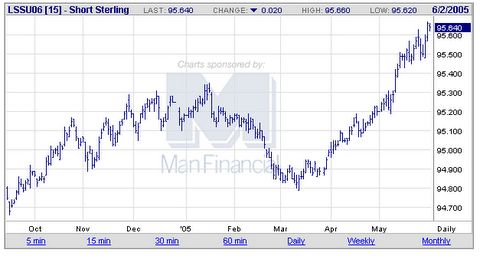
Let's take a look at New Zealand. Hmm it seems there are some problems there as well. Risks For NZ Recession Seen As Rising according to the Australian Investment review.
Using the US-developed Probit Model to quantify the risk of recession it has identified increasing signs a ‘hard landing’ is now more likely. The broker now calculates there is a 50% chance the economy will enter a recession in the current half, with risks skewed to the downside and financial conditions now contractionary rather than expansionary. The broker notes leading indicators of activity and confidence have dropped sharply in recent months, while the debt-servicing ratio is expected to continue to increase.
Here is some additional NZ data to ponder:
Good question and enquiring minds deserve answers.
According to Bloomberg the Swiss Economy is Unexpectedly Stagnating on Exports.
The Swiss economy, Europe's eighth largest, unexpectedly stagnated in the first quarter, bringing it to the edge of a recession, as slowing global growth eroded demand for exports.
Gross domestic product, the value of all goods and services, was unchanged from the previous three months, when it shrank 0.1 percent, the State Secretariat for Economic Affairs in Bern said today. Economists had predicted growth of 0.3 percent, according to the median of 12 estimates.
"We might be on the brink of a recession," said Janwillem Acket, chief economist at Julius Baer Holding AG in Zurich. "We have to brace ourselves for a very weak second quarter."
The Swiss economy is struggling to grow amid oil prices above $50 and signs of an economic slowdown in Europe, Switzerland's biggest export market. Germany's domestic economy contracted the most in a year last quarter and Italy plunged into recession. Swiss leading economic indicators fell in May to the lowest in more than a year.
Gee, let's see if I have this straight.
It seems to me you have your biggest nightmare.
You do have one more card to play after which history will be your judge. That card is called forced retirement. No doubt you will attempt to pass your hand to someone else to play, and no doubt you will be criticizing how they play it. Here is my prediction Mr. Greenspan: History will not let you get away with your last biggest bluff.
Mike Shedlock /Mish
http://globaleconomicanalysis.blogspot.com/
The Chartered Institute of Purchasing and Supply said overall UK manufacturing activity had decreased for the second successive month in May and at the fastest rate since March 2003. The manufacturing output component of the survey, meanwhile, showed its first fall for more than two years. New orders fell for the second successive month and at their sharpest pace since March 2003, as export business declined for the fifth straight month.
CIPS said factory gate prices fell in May for the first time in 20 months. The rate of input price inflation, meanwhile, eased to its lowest level since September 2003.
John Butler, UK economist at banking giant HSBC, said: "It is pretty incredible. The UK industrial sector looks as if it is heading back towards recession when it didn't experience any recovery that other countries saw. In terms of the monetary policy implications, the real danger for the economy is now (that) the consumer is slowing (and) it is difficult to see what parts of the economy are going to pick up the growth pattern.
"The industrial sector has just seen a year where we have had the strongest global growth for 30 years. It hasn't seen any recovery. It is hard to see why it should see any recovery over the next 12 months." Pointing out financial markets were now pricing-in a cut in rates within six months, Butler added: "The continuation of this type of news will only encourage the view that interest rates could be coming down in the near future."
The downturn in manufacturing in May was widespread. Consumer goods production declined for the first time in more than two years in May, capital goods output contracted at its fastest pace for nearly three-and-a-half years, and production of intermediate goods fell for the first time since April 2003. CIPS' headline purchasing managers index for manufacturing, a composite measure of activity in the sector which includes the likes of output, orders, and employment, fell from an upwardly-revised 49.5 in April to 47.3 last month to signal the second consecutive month of contraction. The City had predicted a figure of 49.8.
National Statistics said on May 25 that UK manufacturing output had fallen by 0.7% in the first quarter. With CIPS' normally more optimistic figures now showing contraction in overall activity in April and May, and a fall in the output component last month, yesterday's survey signals a high probability that manufacturing will enter recession in the three months to June on the technical definition of two consecutive quarters of decline.
Following is a chart of the LSS Short Sterling Future for September 2006. With interest rates currently at 4.75% one can see that the odds are better than even that a cut will be made by August of 2005 and at least one additional cut by June of 2006.

Let's take a look at New Zealand. Hmm it seems there are some problems there as well. Risks For NZ Recession Seen As Rising according to the Australian Investment review.
Using the US-developed Probit Model to quantify the risk of recession it has identified increasing signs a ‘hard landing’ is now more likely. The broker now calculates there is a 50% chance the economy will enter a recession in the current half, with risks skewed to the downside and financial conditions now contractionary rather than expansionary. The broker notes leading indicators of activity and confidence have dropped sharply in recent months, while the debt-servicing ratio is expected to continue to increase.
Here is some additional NZ data to ponder:
- Residential building approvals in NZ fell 33.9%, on a seasonally adjusted basis, in April.
- A net 57% of firms expect general business conditions to deteriorate over the next 12 months, the third lowest reading on record.
- Weak data caused the market to revise down its expectations for a rate hike on June 9. Market pricing now implies a 10% chance of 25 basis point rate hike, down from a 50% chance priced four weeks ago.
- The New Zealand dollar was under pressure over the week. It lost ground against all the major currencies except the Euro.
Good question and enquiring minds deserve answers.
According to Bloomberg the Swiss Economy is Unexpectedly Stagnating on Exports.
The Swiss economy, Europe's eighth largest, unexpectedly stagnated in the first quarter, bringing it to the edge of a recession, as slowing global growth eroded demand for exports.
Gross domestic product, the value of all goods and services, was unchanged from the previous three months, when it shrank 0.1 percent, the State Secretariat for Economic Affairs in Bern said today. Economists had predicted growth of 0.3 percent, according to the median of 12 estimates.
"We might be on the brink of a recession," said Janwillem Acket, chief economist at Julius Baer Holding AG in Zurich. "We have to brace ourselves for a very weak second quarter."
The Swiss economy is struggling to grow amid oil prices above $50 and signs of an economic slowdown in Europe, Switzerland's biggest export market. Germany's domestic economy contracted the most in a year last quarter and Italy plunged into recession. Swiss leading economic indicators fell in May to the lowest in more than a year.
Gee, let's see if I have this straight.
- Japan is back in recession
- Germany is in recession
- Italy is in recession
- The UK is on the brink of recession
- Switzerland is on the brink of recession
- New Zealand is on the brink of recession
- Everything is perfect for a "soft landing" in the US
It seems to me you have your biggest nightmare.
- A slowing US economy
- Manufacturing looking ready to contract
- Worldwide demand dropping
- Trading partners in or near recession
- A conundrum still fueling the US housing bubble
- A recovery that produced zero private sector jobs but still managed to produce a housing bubble
- Fed Fund interest rates at 3%
You do have one more card to play after which history will be your judge. That card is called forced retirement. No doubt you will attempt to pass your hand to someone else to play, and no doubt you will be criticizing how they play it. Here is my prediction Mr. Greenspan: History will not let you get away with your last biggest bluff.
Mike Shedlock /Mish
http://globaleconomicanalysis.blogspot.com/
Tuesday, 31 May 2005
Buy to Rent
Is the housing slowdown in the UK a harbinger of what is about to happen in the US? Let's take a look at current situation in the UK and see if we can find any parallels for the US.
Citing official figures, the BBC is reporting nearly 26,000 property repossession orders were granted in the first three months of 2005, the highest number since 1995.
"We are seeing lots of younger people coming to us for help," Frances Walker, spokeswoman for debt charity the Consumer Credit Counseling Service (CCCS). "They are often very heavily in debt as they have been able to borrow far more than in the past. The trouble is they have no assets, so when they get into difficulty they have nothing to fall back on."
As a result, Ms Walker said that CCCS's counselors were advising more people to go bankrupt, many of them in their 20s and just out of university.
Between the fourth quarter of 2000 and 2004, U.K. home prices increased 88 percent, on average, according to the Halifax house price index. "Buy-to-let" became all the rage as investors shifted funds from their traditional portfolios into rental properties. Like all rages and with little warning, the housing market dramatically cooled.
According to the Council of Mortgage Lenders, lending to "buy-to-let" investors dropped 18 percent between the first and second half of 2004. During that time, the number of investors unable to meet their mortgage payments increased 50 percent. All of a sudden people that were thinking they would rent it out and make 15 or 20 percent appreciation, were left with huge mortgage payments, negative appreciation and rent that did not cover carrying costs.
Mortgage equity withdrawal slumped to 6.9 billion pounds in the fourth quarter of 2004, the lowest since the final three months of 2001, according to Bank of England statistics. Less mortgage equity withdrawal means less finance available to households so a slowing housing market is enough to cause a turnaround in consumer spending. Loan write-offs and revaluations by banks reached 6 billion pounds last year, the highest since records began in 1993, according to central bank statistics.
Just one year ago everyone believed the supply of houses for sale simply could not keep up with demand. It was a seller's market. The mortgage industry looked great and the number of people in arrears was very low and foreclosures were at an all-time low. One year later repossessions hit their highest total since 1995.
The Bank of England trimmed its 2005 growth forecast to about 2.6 percent from 2.7 percent amid evidence that consumer spending, which has fuelled 51 successive quarters of growth, is decelerating. The British Retail Consortium on May 10 said store sales slumped the most in at least 10 years in April.
I am wondering what will happen to consumer spending when taxes pick up and housing prices further decline? It seems to me that Chancellor Brown is in denial over the state of affairs. Brown claims that the UK is on target with his self imposed "golden Rule" of borrowing only to invest. Others disagree.
"With the economy unlikely to meet Mr. Brown's forecast of three per cent growth this year we still expect taxes to have to rise after the election to put the public finances on a more sustainable footing," said Capital Economics' chief UK economist, Jonathan Loynes.
And, the Shadow Chief Secretary to the Treasury, George Osborne, said all the figures proved was that the Chancellor had got his figures wrong again. Mr. Osborne said: "These figures show the current budget deficit is half a billion pounds worse than the Chancellor said it would be in the Budget just one month ago.
"This is further backing from the Government itself for what almost all the independent experts have been saying - that there is a shortfall in spending plans that they would have to fill with higher taxes."
Higher taxes would just about kill the housing market and consumer spending as well. Already UK housing appears to be on the brink as evidenced by the April report from the Royal Institution of Chartered Surveyors (RICS) which found that 40% more surveyors experienced a fall than a rise in house prices. This is up from the 39% the previous month and not far from the 12 year high of 44% recorded last November. UK house prices have now dropped for eighth consecutive months.
In an effort to keep the UK housing bubble alive, Brown doubled the stamp duty threshold to £120,000. Is this an act of futile desperation? At some point does it really make sense to keep encouraging people to spend money they do not have on over-priced assets they can not afford?
The moves in the UK to keep the housing bubble alive seem similar to what is currently happening on this side of the ocean as reported in Should the government sell bread, orange juice, or mortgages? with President Bush urging tax credits for homebuilders and Housing and Urban Development Secretary Alphonso Jackson "absolutely emphatic" about the US government "winning back our share of the market that has slipped away to subprime lenders".
Should this really be government's role, here or there or anywhere to promote a specific kind of consumption? Will it serve to lower prices to first time buyers or will it keep them elevated up until there is a housing crash?
Bloomberg is now reporting U.K. jobless claims rose for a third month in April and wage growth eased to the slowest in almost a year amid signs expansion in Europe's second-largest economy is faltering.
The number of people claiming unemployment benefit rose by 8,100 to 839,400, the Office for National Statistics said in London today. The central bank last week trimmed its economic forecast and said a slowdown in consumer spending has "become more marked" leading to speculation of a rate cut.
In the meantime Brown's "Golden Rule" will be fighting an uphill battle with UK manufacturing conditions getting worse according to the Confederation of British Industry (CBI). A survey of small and medium-sized firms from the CBI found that trading conditions over the past quarter remain tough, with output, orders and employment all falling. The survey found that small firms reported the sharpest falls in numbers employed since October 2003 and although medium-sized firms reported broadly unchanged numbers, they expect to reduce employment over the next three months.
Meanwhile, back in the states we have a mixed bag. Home sales and housing starts are still quite strong (but in a disorderly up down up down fashion. That is a sign of a topping market. On the other hand higher, interest rates and a weak economy seem to be taking their toll as foreclosures jumped 57% from last year in some areas. The hardest hit states were Ohio, Texas, Michigan and Georgia, with more than 2,300 new foreclosures each.
Manufacturing is clearly in trouble in the UK. Enquiring minds might be wondering about the US. Let's take a look. Manufacturing activity in the New York area deteriorated sharply for the second straight month in May, the New York Federal Reserve Bank said Monday. The bank's Empire State Manufacturing index fell to -11.1 in May from a revised 2.0 in April. This was the first negative, and lowest, reading since April 2003. Readings below zero indicate contraction. The drop was unexpected. Economists were forecasting the index to rebound to about 10.7 in May from the initial estimate in April of 3.1. Given that leading economic indicators have now gone negative for the first time since early 2003, there is no war stimulus to look forward to, business tax credits expired at the end of 2004, and we have had eight consecutive rate hikes, I am inclined to think this is a sign of things to come as opposed to an outlier.
The cycle here in the US will likely follow a similar path as to what is currently happening in the UK since the "buy to let" aka "buy to rent" is now the latest fad here in the US.
They are one more sign of the magnitude of the real-estate boom in the US. Eager to cash in on one of the strongest housing markets in the postwar era, speculators and even average investors are buying homes and renting them out until they decide to sell them at presumably far higher prices.
"Housing derives value from rents and the two cannot diverge for very long," says Mark Zandi, chief economist at Economy.com. "People may care about this if the weak rental market weighs on the single-family housing market."
'Get rich' seminars
Other investors are being lured by so-called real estate investment seminars, which frequently advertise on Sunday-morning television shows. These seminars purport to show people how to get rich - by buying and renting real estate. They usually include sections on purchasing repossessed or foreclosed property. There are often promises that developers will pay many of the closing costs and provide appliances.
Yet the riches can be elusive. One woman, for instance, bought a new house in Cordova, Tenn., a suburb of Memphis, with the intention of renting it. On a real estate Internet chat room, she bemoaned that her closing costs ended up running $4,000 more than her mortgage broker had quoted two months earlier. She paid fee after fee, including $1,000 to a property manager to rent the house.
"Never did find a renter because they had 83 other properties closing in the same time frame as mine and in the same area!" she wrote. After eight months, she reduced the rent by $350 a month and eventually sold the house after a year for $10,000 less than the original purchase price. She did not return e-mails asking for more information.
I think she got out lucky. $10,000 is a costly but not fatal mistake. Those pouring it on now with "buy to let/rent" ideas will not do nearly as well.
Here is the scenario I envision:
1) Stagnant housing prices that are hard to rent
2) Decreasing cash out refis
3) Decreasing demand for manufactured goods
4) Decreasing manufacturing employment
5) Decreasing demand for housing
6) Housing speculation stops
7) Housing prices fall
8) Decreasing retail employment
9) Decreasing demand for goods and services
10) Recession
My conclusion is that we are about 4-8 months behind the UK cycle with a recession headed our way in 2006.
Mike Shedlock / Mish
http://globaleconomicanalysis.blogspot.com/
Citing official figures, the BBC is reporting nearly 26,000 property repossession orders were granted in the first three months of 2005, the highest number since 1995.
"We are seeing lots of younger people coming to us for help," Frances Walker, spokeswoman for debt charity the Consumer Credit Counseling Service (CCCS). "They are often very heavily in debt as they have been able to borrow far more than in the past. The trouble is they have no assets, so when they get into difficulty they have nothing to fall back on."
As a result, Ms Walker said that CCCS's counselors were advising more people to go bankrupt, many of them in their 20s and just out of university.
Between the fourth quarter of 2000 and 2004, U.K. home prices increased 88 percent, on average, according to the Halifax house price index. "Buy-to-let" became all the rage as investors shifted funds from their traditional portfolios into rental properties. Like all rages and with little warning, the housing market dramatically cooled.
According to the Council of Mortgage Lenders, lending to "buy-to-let" investors dropped 18 percent between the first and second half of 2004. During that time, the number of investors unable to meet their mortgage payments increased 50 percent. All of a sudden people that were thinking they would rent it out and make 15 or 20 percent appreciation, were left with huge mortgage payments, negative appreciation and rent that did not cover carrying costs.
Mortgage equity withdrawal slumped to 6.9 billion pounds in the fourth quarter of 2004, the lowest since the final three months of 2001, according to Bank of England statistics. Less mortgage equity withdrawal means less finance available to households so a slowing housing market is enough to cause a turnaround in consumer spending. Loan write-offs and revaluations by banks reached 6 billion pounds last year, the highest since records began in 1993, according to central bank statistics.
Just one year ago everyone believed the supply of houses for sale simply could not keep up with demand. It was a seller's market. The mortgage industry looked great and the number of people in arrears was very low and foreclosures were at an all-time low. One year later repossessions hit their highest total since 1995.
The Bank of England trimmed its 2005 growth forecast to about 2.6 percent from 2.7 percent amid evidence that consumer spending, which has fuelled 51 successive quarters of growth, is decelerating. The British Retail Consortium on May 10 said store sales slumped the most in at least 10 years in April.
I am wondering what will happen to consumer spending when taxes pick up and housing prices further decline? It seems to me that Chancellor Brown is in denial over the state of affairs. Brown claims that the UK is on target with his self imposed "golden Rule" of borrowing only to invest. Others disagree.
"With the economy unlikely to meet Mr. Brown's forecast of three per cent growth this year we still expect taxes to have to rise after the election to put the public finances on a more sustainable footing," said Capital Economics' chief UK economist, Jonathan Loynes.
And, the Shadow Chief Secretary to the Treasury, George Osborne, said all the figures proved was that the Chancellor had got his figures wrong again. Mr. Osborne said: "These figures show the current budget deficit is half a billion pounds worse than the Chancellor said it would be in the Budget just one month ago.
"This is further backing from the Government itself for what almost all the independent experts have been saying - that there is a shortfall in spending plans that they would have to fill with higher taxes."
Higher taxes would just about kill the housing market and consumer spending as well. Already UK housing appears to be on the brink as evidenced by the April report from the Royal Institution of Chartered Surveyors (RICS) which found that 40% more surveyors experienced a fall than a rise in house prices. This is up from the 39% the previous month and not far from the 12 year high of 44% recorded last November. UK house prices have now dropped for eighth consecutive months.
In an effort to keep the UK housing bubble alive, Brown doubled the stamp duty threshold to £120,000. Is this an act of futile desperation? At some point does it really make sense to keep encouraging people to spend money they do not have on over-priced assets they can not afford?
The moves in the UK to keep the housing bubble alive seem similar to what is currently happening on this side of the ocean as reported in Should the government sell bread, orange juice, or mortgages? with President Bush urging tax credits for homebuilders and Housing and Urban Development Secretary Alphonso Jackson "absolutely emphatic" about the US government "winning back our share of the market that has slipped away to subprime lenders".
Should this really be government's role, here or there or anywhere to promote a specific kind of consumption? Will it serve to lower prices to first time buyers or will it keep them elevated up until there is a housing crash?
Bloomberg is now reporting U.K. jobless claims rose for a third month in April and wage growth eased to the slowest in almost a year amid signs expansion in Europe's second-largest economy is faltering.
The number of people claiming unemployment benefit rose by 8,100 to 839,400, the Office for National Statistics said in London today. The central bank last week trimmed its economic forecast and said a slowdown in consumer spending has "become more marked" leading to speculation of a rate cut.
In the meantime Brown's "Golden Rule" will be fighting an uphill battle with UK manufacturing conditions getting worse according to the Confederation of British Industry (CBI). A survey of small and medium-sized firms from the CBI found that trading conditions over the past quarter remain tough, with output, orders and employment all falling. The survey found that small firms reported the sharpest falls in numbers employed since October 2003 and although medium-sized firms reported broadly unchanged numbers, they expect to reduce employment over the next three months.
Meanwhile, back in the states we have a mixed bag. Home sales and housing starts are still quite strong (but in a disorderly up down up down fashion. That is a sign of a topping market. On the other hand higher, interest rates and a weak economy seem to be taking their toll as foreclosures jumped 57% from last year in some areas. The hardest hit states were Ohio, Texas, Michigan and Georgia, with more than 2,300 new foreclosures each.
Manufacturing is clearly in trouble in the UK. Enquiring minds might be wondering about the US. Let's take a look. Manufacturing activity in the New York area deteriorated sharply for the second straight month in May, the New York Federal Reserve Bank said Monday. The bank's Empire State Manufacturing index fell to -11.1 in May from a revised 2.0 in April. This was the first negative, and lowest, reading since April 2003. Readings below zero indicate contraction. The drop was unexpected. Economists were forecasting the index to rebound to about 10.7 in May from the initial estimate in April of 3.1. Given that leading economic indicators have now gone negative for the first time since early 2003, there is no war stimulus to look forward to, business tax credits expired at the end of 2004, and we have had eight consecutive rate hikes, I am inclined to think this is a sign of things to come as opposed to an outlier.
The cycle here in the US will likely follow a similar path as to what is currently happening in the UK since the "buy to let" aka "buy to rent" is now the latest fad here in the US.
They are one more sign of the magnitude of the real-estate boom in the US. Eager to cash in on one of the strongest housing markets in the postwar era, speculators and even average investors are buying homes and renting them out until they decide to sell them at presumably far higher prices.
"Housing derives value from rents and the two cannot diverge for very long," says Mark Zandi, chief economist at Economy.com. "People may care about this if the weak rental market weighs on the single-family housing market."
'Get rich' seminars
Other investors are being lured by so-called real estate investment seminars, which frequently advertise on Sunday-morning television shows. These seminars purport to show people how to get rich - by buying and renting real estate. They usually include sections on purchasing repossessed or foreclosed property. There are often promises that developers will pay many of the closing costs and provide appliances.
Yet the riches can be elusive. One woman, for instance, bought a new house in Cordova, Tenn., a suburb of Memphis, with the intention of renting it. On a real estate Internet chat room, she bemoaned that her closing costs ended up running $4,000 more than her mortgage broker had quoted two months earlier. She paid fee after fee, including $1,000 to a property manager to rent the house.
"Never did find a renter because they had 83 other properties closing in the same time frame as mine and in the same area!" she wrote. After eight months, she reduced the rent by $350 a month and eventually sold the house after a year for $10,000 less than the original purchase price. She did not return e-mails asking for more information.
I think she got out lucky. $10,000 is a costly but not fatal mistake. Those pouring it on now with "buy to let/rent" ideas will not do nearly as well.
Here is the scenario I envision:
1) Stagnant housing prices that are hard to rent
2) Decreasing cash out refis
3) Decreasing demand for manufactured goods
4) Decreasing manufacturing employment
5) Decreasing demand for housing
6) Housing speculation stops
7) Housing prices fall
8) Decreasing retail employment
9) Decreasing demand for goods and services
10) Recession
My conclusion is that we are about 4-8 months behind the UK cycle with a recession headed our way in 2006.
Mike Shedlock / Mish
http://globaleconomicanalysis.blogspot.com/
Monday, 30 May 2005
More Concern Over Rising Foreclosures
On Saturday I wrote that foreclosures were on my mind. It seems that foreclosures are on other minds too, as evidenced by this Washington Post article. Let's take a look:
"Philadelphia, its suburbs and indeed much of Pennsylvania have experienced a foreclosure epidemic as low-income homeowners take on mortgage debt they cannot afford. In 2000, the Philadelphia sheriff auctioned 300 to 400 foreclosed properties a month; now he handles more than 1,000 a month. Allegheny County, which includes Pittsburgh, had record auctions of foreclosed homes, and officials speak of a "Depression-era" problem. The foreclosures fall particularly hard on black and Latino families."
.......
"Foreclosure rates rose in 47 states in March, according to Foreclosure.com, an online foreclosure listing service. The rates in Florida, Texas and Colorado are more than twice the national average. Even in New York City and Boston, where real estate markets are white-hot, foreclosures are rising in working-class neighborhoods."
........
Fannie Mae claims "The solution lies with more counseling and fine-tuning of mortgages for lower-income families."
No! I say one of the root causes of the rising foreclosures we see is blatantly reckless "fine tuning" as opposed to a lack of "fine tuning". We have interest only loans, 1, 3, and 5, year arms, 40 year loans, cash out refis to support consumption, loose credit standards, zero % down loans, and even 125% loans. Finally we have a huge rise in what will surely bring a rash of fraud charges in the years to come: stated income and no doc loans. What more creative "fine tuning" could possibly be next? Anyone for 50 year loans, 100 year loans, or 200 year loans? Fannie Mae wants to get anyone who could breathe into a house. Perhaps I mean Fannie Mae wants to get anyone and everyone into three houses. The reckless behavior of lenders, who are all too willing to drop the worst loans on Fannie Mae's lap, guarantees rising home prices for everyone. The Pennsylvania Banking Department seems to agree with me.
"We've had a national agenda that's putting people into homeownership who are not ready for it," said A. William Schenck III, Pennsylvania's secretary of banking and a former bank president. "This is a fact that the nation must deal with unless we want to wreck the credit of a lot of middle-class Americans."
Rest assured that president Bush's "ownership society" in conjunction with "fine tuning" and loose lending standards is going to cause one of the biggest national housing problems since the great depression.
Foreclosures seem to be on the Fed's mind as well. Since April 22, no fewer than four FED governors (Kohn, Greenspan, Guynn, and Ferguson) have all sounded alarm bells on housing. CalculatedRisk addresses this in a fine article entitled Housing, the Fed and M3.
It now seems that Greenspan is going to keep hiking until he breaks housing. Paradoxically, every FED tightening lends support to 10 year treasuries and the 30 year long bond. It seems the bond market can sense the housing debacle that is developing. I think 4% yields will look rather nice once housing implodes and takes the stock market down with it.
Already this housing boom is a bust to many. "For lots of these folks, homeownership is a dangerous, precarious existence," said Ira Goldstein, policy director for the fund. "Foreclosures can become like a contagion in these neighborhoods."
Few of these homeowners were tutored in home buying, and 70 percent relied on "subprime" mortgage brokers, which specialize in buyers with bad credit and charge interest rates between 8 and 12 percent, far above market interest rates of 6 percent or less.
Said Williams, the acting comptroller of the currency: "We've produced a new class of lenders willing to take on riskier and riskier borrowers at a very high price. Many of the products are nothing more than time bombs."
We have only just begun to see rising foreclosures. Wait until California and Florida get into the act. In the meantime party on.
Mike Shedlock /Mish
http://globaleconomicanalysis.blogspot.com/
"Philadelphia, its suburbs and indeed much of Pennsylvania have experienced a foreclosure epidemic as low-income homeowners take on mortgage debt they cannot afford. In 2000, the Philadelphia sheriff auctioned 300 to 400 foreclosed properties a month; now he handles more than 1,000 a month. Allegheny County, which includes Pittsburgh, had record auctions of foreclosed homes, and officials speak of a "Depression-era" problem. The foreclosures fall particularly hard on black and Latino families."
.......
"Foreclosure rates rose in 47 states in March, according to Foreclosure.com, an online foreclosure listing service. The rates in Florida, Texas and Colorado are more than twice the national average. Even in New York City and Boston, where real estate markets are white-hot, foreclosures are rising in working-class neighborhoods."
........
Fannie Mae claims "The solution lies with more counseling and fine-tuning of mortgages for lower-income families."
No! I say one of the root causes of the rising foreclosures we see is blatantly reckless "fine tuning" as opposed to a lack of "fine tuning". We have interest only loans, 1, 3, and 5, year arms, 40 year loans, cash out refis to support consumption, loose credit standards, zero % down loans, and even 125% loans. Finally we have a huge rise in what will surely bring a rash of fraud charges in the years to come: stated income and no doc loans. What more creative "fine tuning" could possibly be next? Anyone for 50 year loans, 100 year loans, or 200 year loans? Fannie Mae wants to get anyone who could breathe into a house. Perhaps I mean Fannie Mae wants to get anyone and everyone into three houses. The reckless behavior of lenders, who are all too willing to drop the worst loans on Fannie Mae's lap, guarantees rising home prices for everyone. The Pennsylvania Banking Department seems to agree with me.
"We've had a national agenda that's putting people into homeownership who are not ready for it," said A. William Schenck III, Pennsylvania's secretary of banking and a former bank president. "This is a fact that the nation must deal with unless we want to wreck the credit of a lot of middle-class Americans."
Rest assured that president Bush's "ownership society" in conjunction with "fine tuning" and loose lending standards is going to cause one of the biggest national housing problems since the great depression.
Foreclosures seem to be on the Fed's mind as well. Since April 22, no fewer than four FED governors (Kohn, Greenspan, Guynn, and Ferguson) have all sounded alarm bells on housing. CalculatedRisk addresses this in a fine article entitled Housing, the Fed and M3.
It now seems that Greenspan is going to keep hiking until he breaks housing. Paradoxically, every FED tightening lends support to 10 year treasuries and the 30 year long bond. It seems the bond market can sense the housing debacle that is developing. I think 4% yields will look rather nice once housing implodes and takes the stock market down with it.
Already this housing boom is a bust to many. "For lots of these folks, homeownership is a dangerous, precarious existence," said Ira Goldstein, policy director for the fund. "Foreclosures can become like a contagion in these neighborhoods."
Few of these homeowners were tutored in home buying, and 70 percent relied on "subprime" mortgage brokers, which specialize in buyers with bad credit and charge interest rates between 8 and 12 percent, far above market interest rates of 6 percent or less.
Said Williams, the acting comptroller of the currency: "We've produced a new class of lenders willing to take on riskier and riskier borrowers at a very high price. Many of the products are nothing more than time bombs."
We have only just begun to see rising foreclosures. Wait until California and Florida get into the act. In the meantime party on.
Mike Shedlock /Mish
http://globaleconomicanalysis.blogspot.com/
Friday, 27 May 2005
Foreclosures on my Mind
According to RealtyTrac Inc. the Dallas-Fort Worth area has the dubious distinction of leading the nation in foreclosures with one foreclosure for every 319 households. This is more than 5.5 times the national average.
Following are the top five foreclosure states according to this article :
1. Texas 9,672
2. Florida 9,506
3. New York 3,024
4. Arizona 2,386
5. Pennsylvania 1,790
According to the West Virginia Gazette, West Virginia foreclosures are at a 40 year high. Here is an interesting snip from the article: A West Virginia bill passed in the Legislature this year requires high schools to start teaching students the basics of personal finance, initiating them into the mundane world of balancing checkbooks, paying off loans and sweating out investments. Just seven other states have such a requirement.
These courses have long been offered as high school electives in West Virginia, but now they’ll be covered in the core curriculum, mandatory for graduation starting with the class of 2008.
That’s not a semester too soon, if you ask Treasurer John Perdue, a longtime proponent of such legislation. "Too many kids are graduating from high school who don’t know how to balance a checkbook," Perdue said. "And sometimes the credit card companies are getting to them while they’re still in high school."
Meanwhile
check out the volume of transactions in three California counties: San Mateo -18.7%, Santa Clara -11.7%, Santa Cruz -23.8%. Will volume lead price down? I think so.
According to foreclosures.com Speculators are cashing out of Las Vegas Housing Market. "Investors represented over 25% of home sales in 2004," said Foreclosures.com president Alexis McGee. "Foreclosures averaged just 607 per month for the first quarter of 2005. Now speculators have cut down on buying and are cashing out." Falling prices and rising foreclosures will follow in this writer's opinion.
Foreclosures.com is also reporting that although California Foreclosure Activity Remains Low, Pressure is Mounting.
This quote sums up my feelings on the precarious situation in California precisely. Alexis McGee, president of foreclosures.com said "We can't say when defaults will increase. We just see it coming."
Mike Shedlock /Mish
http://globaleconomicanalysis.blogspot.com/
Following are the top five foreclosure states according to this article :
1. Texas 9,672
2. Florida 9,506
3. New York 3,024
4. Arizona 2,386
5. Pennsylvania 1,790
According to the West Virginia Gazette, West Virginia foreclosures are at a 40 year high. Here is an interesting snip from the article: A West Virginia bill passed in the Legislature this year requires high schools to start teaching students the basics of personal finance, initiating them into the mundane world of balancing checkbooks, paying off loans and sweating out investments. Just seven other states have such a requirement.
These courses have long been offered as high school electives in West Virginia, but now they’ll be covered in the core curriculum, mandatory for graduation starting with the class of 2008.
That’s not a semester too soon, if you ask Treasurer John Perdue, a longtime proponent of such legislation. "Too many kids are graduating from high school who don’t know how to balance a checkbook," Perdue said. "And sometimes the credit card companies are getting to them while they’re still in high school."
Meanwhile
check out the volume of transactions in three California counties: San Mateo -18.7%, Santa Clara -11.7%, Santa Cruz -23.8%. Will volume lead price down? I think so.
According to foreclosures.com Speculators are cashing out of Las Vegas Housing Market. "Investors represented over 25% of home sales in 2004," said Foreclosures.com president Alexis McGee. "Foreclosures averaged just 607 per month for the first quarter of 2005. Now speculators have cut down on buying and are cashing out." Falling prices and rising foreclosures will follow in this writer's opinion.
Foreclosures.com is also reporting that although California Foreclosure Activity Remains Low, Pressure is Mounting.
This quote sums up my feelings on the precarious situation in California precisely. Alexis McGee, president of foreclosures.com said "We can't say when defaults will increase. We just see it coming."
Mike Shedlock /Mish
http://globaleconomicanalysis.blogspot.com/
Is the US blinking first?
Check out Snow's comments to the Senate Banking Committee:
"I don't think it's in our interests or in their interests to go to a full float. I see them on a path to a float." Hmmm Is that a blink?
Snow said the judgment on whether China was a currency manipulator would depend on how its large current account surplus with the United States developed -- as well as its large and growing surplus with the world, continued capital inflows and the buildup of its foreign currency reserves.
So far, he is refusing to say how much he wants Chinese officials to revalue the renmimbi. Others in the administration are privately demanding an immediate increase of 10 to 15 percent. "I am frankly astounded the administration continues to report the Chinese peg is not currency manipulation," said Senator Elizabeth Dole, Republican of North Carolina. "I think we're going to see action by China," Snow told members of the Senate committee but added that he "might have to eat those words" in six months.
Would someone please wake up Treasury Snow from his sleep? China has a trade surplus with the US but it is not that huge with the rest of the world. In fact, China has big trade deficits with its Asian trading partners including Japan, Taiwan and South Korea. More to the point, is Snow really bitching about China holding US$ reserves? Why the focus on China anyway? What about the US$ reserves in Japan and South Korea? Perhaps this is the correct question: Is Snow on Mars or is he on drugs?
So far China is doing the right thing: nothing.
Six months from now will we see crow eating accompanied by trade wars or just plain crow eating? Perhaps we get a token 3% move allowing the US to save face. If so China will be showing a lot more class than we have.
Here is the real (but unreported) story behind all these "snowjobs" and congressional threats: The situation in the US is nowhere near as good as it seems or we would not be doing all this bitching. Think about how much worse it will get when housing finally collapses.
Mike Shedlock / Mish
http://globaleconomicanalysis.blogspot.com/
"I don't think it's in our interests or in their interests to go to a full float. I see them on a path to a float." Hmmm Is that a blink?
Snow said the judgment on whether China was a currency manipulator would depend on how its large current account surplus with the United States developed -- as well as its large and growing surplus with the world, continued capital inflows and the buildup of its foreign currency reserves.
So far, he is refusing to say how much he wants Chinese officials to revalue the renmimbi. Others in the administration are privately demanding an immediate increase of 10 to 15 percent. "I am frankly astounded the administration continues to report the Chinese peg is not currency manipulation," said Senator Elizabeth Dole, Republican of North Carolina. "I think we're going to see action by China," Snow told members of the Senate committee but added that he "might have to eat those words" in six months.
Would someone please wake up Treasury Snow from his sleep? China has a trade surplus with the US but it is not that huge with the rest of the world. In fact, China has big trade deficits with its Asian trading partners including Japan, Taiwan and South Korea. More to the point, is Snow really bitching about China holding US$ reserves? Why the focus on China anyway? What about the US$ reserves in Japan and South Korea? Perhaps this is the correct question: Is Snow on Mars or is he on drugs?
So far China is doing the right thing: nothing.
Six months from now will we see crow eating accompanied by trade wars or just plain crow eating? Perhaps we get a token 3% move allowing the US to save face. If so China will be showing a lot more class than we have.
Here is the real (but unreported) story behind all these "snowjobs" and congressional threats: The situation in the US is nowhere near as good as it seems or we would not be doing all this bitching. Think about how much worse it will get when housing finally collapses.
Mike Shedlock / Mish
http://globaleconomicanalysis.blogspot.com/
Subscribe to:
Posts (Atom)


