Wednesday, 3 August 2005

China condemns US after failed CNOOC bid

China condemns US political intransigence after failed CNOOC bid

China's state media has condemned US political intransigence over oil group CNOOC's bid for Unocal, saying its opposition called into question the free trade dogma Washington often trumpets to the world.

'The high-profile takeover battle demonstrated to the world that the United States is not a free economy as it claimed to be,' the official China Daily said in an editorial.

'An asset for sale has not gone to the buyer that most prized it because of regulatory concerns fuelled by bogus fears and hidden interests,' it said of the deal that was aborted Tuesday.

The China Daily editorial went on to say that not only had Unocal shareholder interests been damaged but that the failure would 'poison the current prevailing mood as bilateral economic ties between China and the United States are enhanced.

'The explicit message the takeover battle sends to the world is that American business is defined by political needs,' it said.

'That practice will incur many unknown costs for foreign investors. In the long run, the casualty will be US competitiveness if the market is to play second fiddle to protectionism with political patronage.'

Following is another article on the same subject:
According to the New York Times, A Furor Was Built on Many Grudges

Byron Dorgan, a Democratic senator from North Dakota who was one of the sharpest critics of the Chinese attempt to buy Unocal, argued that the withdrawal "does not change the fact that there are policy questions that have to be answered. When a Chinese government-controlled company tries to buy an American oil company, is it a free-market transaction? The answer is no."

Pray tell why not?
Is it free market economics when Walmart wants to expand into China?
Is it free market economics when Citycorp want sto expand into Chinese banks?
Here is the real question: is it free trade when it benefits the US but something else when it doesn't?

"I think a very serious economic clash is probably in the offing this fall," said C. Fred Bergsten, head of the Institute for International Economics, a policy research organization here.

For what it's worth, I expect battles like this one to intensify. I have to admit I was surprised how quickly this one fired up right after the RMB repeg.

Patrick Mulloy, a member of the U.S-China Economic and Security Review Commission, a bipartisan advisory panel created by Congress, said Cnooc's withdrawal would force American policy makers to look at issues posed by government-owned companies.

"This is good news," Mr. Mulloy said of Cnooc's decision. "Don't call this a commercial transaction when it's not a commercial transaction. This is a government-controlled company. There was no ability for an American company to buy Cnooc; there was no reciprocity."


Trade wars and threats and bluffs and silly laws to prevent free trade are good news?
Did any US make a bid for CNOOC?
Did anyone else?
Speaking of reciprocity, is China allowing Walmart and Citycorp to expand there or not?

While we are at it, Mr. Mulloy please look up the definition of the word fungible. After you do please tell me why it matters from an oil pricing standpoint who owns Unocal.

Here is a comment that at least makes sense:
"The United States has argued persistently over the course of two decades that governments should not interfere with the ability of companies to invest," said Charlene Barshefsky, who served as United States trade representative under President Bill Clinton. "The concern I have is not only about the severe damage this does to the strength of our position abroad, but about the taking of mirror actions by other countries - and not only China."

Here is another person that "gets it":
Philip Swagel, a resident scholar at the American Enterprise Institute and a former chief of staff on President Bush's Council of Economic Advisers, said Americans were in danger of losing perspective, thinking that the economic competition between nations should somehow be seen in military terms.

Mr. Swagel pointed out that two American banks were interested in buying stakes in state-owned banks in China. While those bids have been encouraged by Beijing, it is doubtful that Washington would be so inviting of similar deals, particularly if they involved changes in control.

"Imagine if a Chinese company tried to take over Citigroup," Mr. Swagel said. "It would go to Defcon 5 here."


Following are two final comments of my own:
  • Trade wars and trade threats are quite typical of an overall economic environment with deflationary underpinnings.
  • The fact that these are happening almost immediately after they were thought to be diffused is perhaps telling.
Mike Shedlock / Mish
http://globaleconomicanalysis.blogspot.com/

Preliminary Thoughts on July Nonfarm Payrolls

July nonfarm jobs data is out Friday August 5th.
                                     Actual Briefing Market
Date Time(ET)Statistic For Result Forecast Expects Prior
Aug 5 8:30 AM Average Workweek Jul - 33.7 33.7 33.7
Aug 5 8:30 AM Hourly Earnings Jul - 0.3% 0.2% 0.2%
Aug 5 8:30 AM Nonfarm Payrolls Jul - 175K 180K 146K
Aug 5 8:30 AM Unemployment Rate Jul - 5.0% 5.0% 5.0%

175K-180K looks like rather strong expectations in light of all the mass layoffs we have seen lately. Sentiment is still strong that this economy is growing nicely in spite of a huge job miss last month and wildly unexpected mass layoff announcements. If the numbers comes in weaker (which is my expectation), I would expect to see a rally in treasuries and interest rates products in general. If there is a huge downside miss (not unlikely) there will likely be a huge treasury rally. Are treasury bears feeling lucky? Unless the numbers come in really hot, I would not expect much of a treasury selloff (as strong numbers should already priced in).

As for the market, which seems to rally on every bit of bad news lately, I am not sure what to expect. Eventually the cheerleaders are going to figure out that all these mass layoffs and job cuts are not really a good thing, regardless of how many jobs are created at Walmart to replace them. BTW, eventually means the middle of the next recession when they will all be chanting "no one could possibly have seen it coming".

Thus, no matter what the numbers are, expect for a bullish spin to be put on it. On a downside miss they will be talking about the FED pausing, on an "in the ballpark" play we will hear about the "Goldilocks Economy" and if the numbers are hot, they will say that higher interest rates will "not matter".

Those with idle time on their hands might wish to turn on CNBC and count how many times they say "Goldilocks Economy". The closer we are to a range of 150K to 190K the higher will be the Goldilocks count.

Mike Shedlock / Mish
http://globaleconomicanalysis.blogspot.com/

Tuesday, 2 August 2005

FxStreet Transcripts Available

A PDF transcript for the FxStreet.com session "The great 'Flation' debate - What's coming and how to profit from It" is now available for viewing. Andy at The Market Traders has posted it on his web site. No password is required.

Note: the transcript starts with a repeat of my blog with that title.
If you already read that lengthy article, you may wish to scroll down to the Question and Answer portion of the PDF.

Thanks to everyone that attended or submitted questions.
Thanks also to Claire at FxStreet and Andy at The Market Traders for coordinating the session.

Mike Shedlock
http://globaleconomicanalysis.blogspot.com/

What Housing Bubble?

Mr. Barsky, managing partner of Alson Capital Partners, LLC wrote an absurd opinion about housing in the commentary section of the July 28th online issue the Wall Street Journal, in which he claims there is no housing bubble.

Now, plenty of people, some just plain stupid, some with axes to grind write the same thing. Typically these opinions are not worth replying to, quite frankly because they are so widespread and so preposterous that one would spend all their time rebutting such nonsense. But Mr. Barsky is a special case for reasons we will address later.

In the meantime let's review some of the nonsense spewing forth from Mr. Barsky. Here goes:

In a free country, it is fair game for the media and economists to scare homeowners with words of gloom and doom, however knee-jerk, consensual and misguided they may be. The reality is this: There is no housing bubble in this country. Our strong housing market is a function of myriad factors with real economic underpinnings: low interest rates, local job growth, the emotional attachment one has for one's home, one's view of one's future earning- power, and parental contributions, all have done their part to contribute to rising home prices. Over the past quarter-century, there has been an explosion of second-home purchases, a continued influx of immigrants, and a significant reduction in existing housing inventory through tear-downs. Not all of these trends are accurately reflected in the unending stream of data published daily. Home prices on average have risen at a 6% annual pace since 1999, and 13% over the past year.

Hmmm.
It seems to me that Barsky is suggesting there is no bubble because prices are rising and there is an explosion of second home purchases. This is more or less the equivalent of saying there was no bubble in stocks in 2000 because prices were rising and people were buying more of them.

Barsky writes:
What we do have is a serious housing shortage and housing affordability crisis. Despite robust construction, unsold inventory stands at four months, well below its 25-year average. Private builders complain they can't get land permitted to meet demand. Low-income housing advocates complain housing prices are out of reach for many Americans, and that government subsidies have been slashed.

A shortage of housing? Exactly what planet is Barsky on?
Here is what I see: Millions of vacant homes:

National vacancy rates in the second quarter 2005 were 9.8 percent for rental housing and 1.8 percent for homeowner housing, the Department of Commerce=s Census Bureau announced today. The homeownership rate was 68.6 percent for the current quarter.

There were an estimated 123.7 million housing units in the United States in the second quarter 2005. Approximately 107.9 million housing units were occupied: 74.0 million by owners and 33.9 million by renters.

Given 107.9 million occupied units out of a total of 123.7 million housing units, my math suggests there are 15.8 million unoccupied units. The BLS does not break those units down into houses, condos, and apartments, but it does seem preposterous to be proclaiming a shortage. Also note that close to 70% of the people own their own home even though there are tens of thousands of unoccupied condominiums with 10 years worth of supply coming on in Florida in the next two years alone. Finally note that 70% ownership just might be the saturation rate given that many of the 30% are city dwellers that do not want to own and/or are just plain incapable of owning a house for economic or disability reasons. With all that in mind, it is well into fantasyland to suggest a shortage of houses.

Indeed, 36% of all houses sold in 2004 were for either as second homes or for "investment". Change the word "investment" to "greater fool speculation" and you have a clear picture of what is happening. People are chasing houses because they are going up. How many houses do people need anyway? I suppose if everyone needs two or three houses there might be a shortage of them.

Barsky writes:
"What we have never seen in this country is a collapse of home prices without also seeing local economic weakness or significant capacity growth. Absent those factors, housing markets just don't collapse under their own weight."

Obviously Barsky is no student of history. He ignores house prices falling for 18 consecutive years in Japan and he ignores what happened in the great depression, he ignores what happens in the oil bust in Texas, and he ignores what is happening currently in Australia and the UK. In short, Barsky takes a Pollyanna view that a recovery that has produced zero private sector jobs in spite of record low interest rates can go on booming forever.

Barsky writes:
"Herewith are some of the myths put forth by the housing bubble Chicken Littles.

• Myth #1. There is too much capacity: According to Census data, over the past 10 years, housing permits have averaged about 1.63 million units per year -- including multifamily units. Household formation has averaged 1.49 million families per year. So far, so good. But here is where the data gets murky. Roughly 6% of the new home sales were for second homes (I have seen estimates that the number is actually twice as high), according to UBS. And while there are no precise numbers on this, approximately 360,000 units every year were torn down either because they were nonfunctional, or because they were "tear-downs." When the latter two numbers are taken into account, the real number of new homes is closer to 1.2 million, or 19% fewer than the average number of new households formed each year."


Obviously Barsky has failed to take a look at BLS data showing 15.8 million unoccupied units. Barsky also seems to assume that every family needs to buy a home. Some people, especially in large cities simply do not want to buy a home. Others due to education and or income or disabilities will never be able to buy a home even if they do want one. In fact, it is this absurd ownership society that is pressuring people to buy homes (in conjunction with speculators driving up prices) that is playing a significant part of the bubble.

Barsky writes:
• Myth #2. Risky mortgage products are fueling house appreciation: Sages from Warren Buffett to Alan Greenspan have warned of the increased risk from the use of new mortgage products, particularly adjustable-rate mortgages and interest-only mortgages. The theory here is that buyers are extending themselves to make payments, and when their mortgages reset they will be in trouble. Put aside the fact that only a year ago Mr. Greenspan was advocating the use of ARMs ("American consumers might benefit if lenders provided greater mortgage product alternatives to the traditional fixed-rate mortgage," he told the Credit Union National Association last year), these concerns are wildly overstated. As virtually every mortgagee in the country knows, most ARMs are fixed rate for the first two to seven years. Virtually all have 2% interest-rate caps. The average American owns his home for seven years. Why pay several hundred basis points to lock in rates he is highly unlikely to take advantage of? Moreover, very little equity has been paid off by a homeowner in the first seven years of a 30-year loan, so consumers have been effectively overspending on interest rates for generations. As Mr. Greenspan said in his 2004 speech, "the traditional fixed-rate mortgage may be an expensive method of financing a home."

Anyone using plain common sense would realize that at zero% down, 100% financing, speculation will rise. Numerous FED officials have warned about that (and not taken it back). As for ARMs, common sense would dictate that if ARMs are used solely to buy a house that one otherwise could not afford, there is a huge interest rate risk. Indeed, those two year arms taken out two years ago near the bottom in rates are going to be a shock to lots of people that were not prepared for it. In bubbles, common sense goes out the window.

Barsky writes:
"• Myth #3. Speculators are Driving Home Prices: The media today is chock-full of stories of day-trading dot-com refugees who have found their calling buying homes and condos "on spec," with the hope of flipping the property for a higher price. Earlier this month, one Wall Street analyst published an article with the catchy headline: "Investors Gone Wild: An Analysis of Real Estate Speculation." Scary stuff. Here, again, some common-sense thinking is in order. In Manhattan, where I live, friends buy apartments kicking and screaming, convinced they top-ticked the housing market. Is Manhattan special? Are speculators flipping Palm Beach mansions? Bay Area three-bedroom homes? Newton, Mass., Tudor homes? I don't think so. Yet these markets are experiencing the same price appreciation as Las Vegas, Phoenix and Florida, where real estate investors are supposedly driving prices higher."

The reason we are seeing these stories is because they are happening. Entire buildings of condos are being sold in Florida that are now 80% investor owned. People are buying homes sight unseen. Apparently Barsky thinks that just because insanity is brewing in Manhattan as well, there is no bubble.

Finally Barsky writes:
"But bubbles happen when prices become unhinged from intrinsic value. Homes are not stocks; their 'intrinsic value' can only be in the eye of the beholder. A house has utility. Rational people might be willing to pay more for a water view, or for living close to work, or for a larger loo. Such voluntary economic decisions are neither irrational nor exuberant."

This is one of the silliest things he has said yet. Apparently Barsky believes it is impossible to have a housing bubble because there is no intrinsic value to a house. I am sorry Barsky, the fact of the matter is houses can not rise too far above wages or rent or people's ability to pay for them. That is what determines whether or not there is a bubble in housing.

Let's take a look at what some more sensible people are saying.
The Orange County Register suggests
Region's house of cards ready to topple as prices reach unsustainable levels.
"Looking at the four big counties in Southern California, over the past decade the percentage of households that can afford to buy the median- priced home (using conventional mortgage qualification standards) dropped by as much as 74 percent in Orange County (to 11 percent) and as "little" as 56 percent in San Bernardino County (to 24 percent)."

Hmmm. Only 11% of the people in Orange County and 24% in San Bernardino can afford a house. That's not a bubble?

The OC Register continues:
"But the most compelling evidence of a bursting bubble to come is the divergence of home prices and rents. In the United States over the past decade the ratio of home prices to rents has increased by almost 40 percent.

The increase is much higher in hot housing markets like Orange County (99 percent), where the ratio of median home price to average monthly rent now stands at 433:1.

To re-calibrate to more reasonable historical levels will require rents to rise sharply, which is constrained by household income growth, or home prices will have to fall, the only other possibility."


That's not a bubble?
I could site numerous statistics and numerous articles from numerous markets by people with far better credentials than Mr. Barsky but as I said, it is normally not worth the time responding to such clowns.

OK Mish just why are you bothering then?
Good question.
You see I left off a couple snips from that article Barsky wrote.
Let's take a look at them:

Mr. Barsky writes: "I am now a money manager. I currently own stocks in several homebuilders; so I am putting my money where my mouth is."

The article concludes with "Mr. Barsky is managing partner of Alson Capital Partners, LLC"

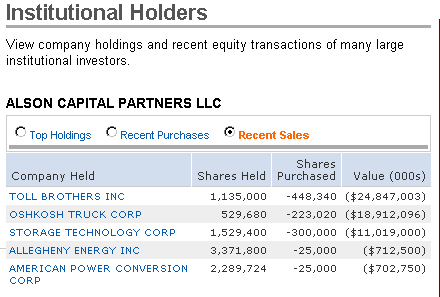
What peaked my interest in Mr. Barsky is the following chart. It is a large chart of Toll Brothers, Inc. Ownership. Click on the image and look at the second line from the bottom to see what Alson Capital Partners, LLC is doing with TOL.


That's a real eye opener isn't it?

I sense reader questions pouring in.
Yes, indeed here is a telepathically received question just now:
Mish, I see that is activity as of 03/31/2005. Is there any additional data since then?

Enquiring Mish bloggers deserve answers so let's take a look.
Hmmm. How about this?!


Let me see if I have this straight:

1) Mr. Barsky writes an article for the WSJ proclaiming there is no Housing Bubble
2) Mr. Barsky calls housing bears "Chicken Littles"
3) Mr. Barsky says "I am putting my money where my mouth is"
4) Mr. Barsky is managing partner of Alson Capital Partners, LLC
5) According to the first chart, Alson Capital Partners, LLC sold 896,680 shares of TOL in the first quarter of 2005. That was a decrease (at the time) of 28% of their original holding of 3,166,680 shares to 2,270,000 shares of TOL.
6) According to the second chart TOL reduced their shares in the second quarter by 448,340 to a total holding of 1,135,000 shares.

I am sure enquiring Mish readers are wondering what happened to the other shares since 1,135,000 + 448,340 equals 1,583,340 not 2,270,000. Unfortunately Mish has no answer to that question. At any rate that is not relevant. What is relevant is that an original holding of 3,166,680 shares has now been reduced to 1,135,000 shares. This means that Alson Capital Partners, LLC has sold 64.2% of their holding of TOL (2,031,680 shares out of 3,166,680) in the first two quarters of this year according to the charts above.

By the way, here is the source of my charts:
moneycentral.msn.com
reuters.com
Note: data may change over time which is why I captured the above charts.

Since there is a discrepancy in the numbers it not clear precisely what percentage of TOL that Alson Capital Partners, LLC has been dumping. It does seem to be huge. What is clear is the fact that two sources show Alson Capital Partners, LLC dumping TOL while a managing partner of the corporation went out of his way to defend a housing bubble in a major publication. It is also clear that Mr. Barsky failed to disclose those facts while claiming to be putting his money where his mouth is.

Given the above, I have one question for Mr. Barsky:
Is defending the housing bubble as you did consistent with Alson Capital Partners, LLC dumping huge percentages of its TOL holding?

Note: The above article originally appeared in Whiskey and Gunpowder
Mike Shedlock / Mish
http://globaleconomicanalysis.blogspot.com/

Monday, 1 August 2005

Japan imposes trade sanctions on US

Japan has decided to impose its first-ever retaliatory sanctions against the United States on 15 goods, including steel, in response to a controversial US anti-dumping law.

Japan will slap 15% retaliatory levies on US steel, Trade Ministry official Etsuo Sato said.

The percentage is in line with moves by Canada and the European Union, which have taken retaliatory actions against US products since 1 May over US legislation known as the Byrd Amendment, an anti-dumping law ruled illegal by the World Trade Organisation (WTO).

Tokyo made the decision after the Council on Customs, Tariff, Foreign Exchange and Other Transactions gave its approval on Monday.

The tariffs will amount to 5.7 billion yen ($51 million), said Sato.

The tariffs are the latest retaliation for the Byrd legislation, which redistributes levies on dumping - selling items abroad at less than the price in the domestic market - to US companies. Japan and other countries including the European Union took the case to the WTO, which last year authorized sanctions amounting to 72% of the sums reaped by the US law.

The Nihon Keizai Shimbun said last week that the tariffs would remain in place until Washington repealed its 2000 US law, which is named after US Senator Robert Byrd.


Are we supposed to congratulate Senator Robert Byrd?
First steel, then what?
For that matter, what about Japanese protection of rice and the EU protection of sugar and other crops? What about US protection on oranges, sugar, sheep, etc. What about price crop supports on tobacco of all things?

Here is the universal definition of "Free Trade":
Free Trade is that which levies duties on the competition but demands that no other country do the same on a county’s exports. In case of a tie, the vote goes in favor of the most powerful lobby.

There really is a huge lack of "free trade" and no one really wants it anyway (except for consumers who want lower prices). Then again consumers wants lower prices and jobs at the same time. Sorry folks, It's not going to happen. In the meantime, let’s see how carried away everyone gets with protectionism.

Mike Shedlock / Mish
http://globaleconomicanalysis.blogspot.com/

Wednesday, 27 July 2005

Trade Wars Yet Again?

Wasn't everyone saying that the RMB repeg would end the threat of trade wars threats with Asia for at least a while? Well here we are, three day later pondering this:

Japan says may impose duties on US goods.

Japan is considering imposing retaliatory duties on U.S. goods to counter subsidies paid by Washington to companies under an anti-dumping program ruled illegal by the World Trade Organization, Japan's top government spokesman said on Thursday.

The Nihon Keizai business daily reported on Thursday the tariffs could amount to some $76 million on U.S. steel and ball bearing products, and would be imposed from September.

"We are considering the move, in line with WTO regulations," Chief Cabinet Secretary Hiroyuki Hosoda told a news conference. But he declined to say when and what goods would be subject to the levies.

It would be a first for Tokyo to impose retaliatory duties.


The amount of money is not that significant. The fact that it is happening so soon after the RMB repeg is significant, and the fact that it would be a first for Tokyo to impose retaliatory duties is significant as well.

The WTO has declared the program to be illegal in a challenge brought by the EU, Canada, Japan and other trading partners.

Tokyo plans to keep any levies in place until the Byrd amendment is repealed, media reports said. In June, Tokyo called on Washington to repeal the amendment by the end of July.

The Bush administration has repeatedly proposed repealing the Byrd amendment, but it remains popular with many members of Congress despite the WTO ruling.


What's next? Perhaps we will see the "currency manipulator" threat before anyone thinks likely, given the rapid pace of things lately.

let's now review a chart posted here twice before.
Here goes....


Should anyone really be surprised by this sudden protectionist talk?

Mike Shedlock / Mish
http://globaleconomicanalysis.blogspot.com/

The Optimist

Lets consider an optimistic viewpoint entitled A CARBORUNDIUM - HOW TO HEDGE A RETIREMENT? written of course by "The Optimist".

Now I am not sure why an optimist would be concerned about inflation, deflation, stagflation, how to hedge, or for that matter anything else, but here it is in black and white:

The Optimist apologizes for presenting a topic which will be of little interest to investors who want to primarily protect against deflation. If the USA is on a path to deflation in the not too distant future, then there is no need to worry about hedging a retirement, or even to consider various investment strategies. A deflationist would need only to convert all assets to cash, or to a super safe T-Bond equivalent, and then wait for precipitously plunging prices of everything to multiply the purchasing power of cash. A retirement or Social Security check each month for a fixed number of fiat dollars would automatically gain purchasing power during a deflationary contraction. There would be no need to do much more investment work than to sing another verse of "Don’t worry - Be happy" as falling prices everywhere magnify the wealth of cash equivalents. The ease of positioning investments for deflation makes it tempting to convert to that belief system, but the Optimist will not yield to the easy side of the force. For the last 70 years, inflation has been the American Way of truth, justice, and financial integrity. The Optimist steadfastly continues to support that proud and time honored heritage.

The optimist "will not yield to easy side of the force" and steadfastly continues to "worry and not be happy" because inflation is a proud and time honored heritage. Good grief! Just what kind of optimist is that?

Furthermore the optimist advises people that "A deflationist would need only to convert all assets to cash, or to a super safe T-Bond equivalent, and then wait for precipitously plunging prices of everything to multiply the purchasing power of cash."

I am trying to figure out if that advice is really for optimists or pessimists or just plain worriers from both camps. Consider the following:

1) Just who would the deflationist sell out to and at what prices if everyone attempted it at the same time? Perhaps that's optimism that it could be done. Then again, if one was optimistic why would one be cashing out at all? Is "The Optimist" really an optimist or a pessimist? I guess I am generally confused.

2) The optimist being what he is, fails to consider that if most people converted their assets to cash and paid off all their debts would not have a dime left. Indeed many would be in a hole. Debt as a percentage of GDP is staggeringly high. People have enormous credit card debt, housing debt, obligations, etc. Just how much money would be left after "cashing out" (if anything) and could that possibly support retirement? Now an optimist might think that everyone could cash out and that would support retirement, but then again an optimist would see no need to do so in the first place. So once again I am confused.

3) The Optimist writes "Consider the impact if the CPI does not move up as fast as the real cost of living, as the Optimist considers likely". There you have it. That is evidence that the optimist needs to change his name to "The pessimist" on the other hand it conflicts with pervious optimistic statements.

Now perhaps this was all tongue in cheek by the optimist. Then again perhaps this is all tongue in cheek by me. Let's continue:

The "****ist" since we have no clear cut evidence of "whichisittism" writes:

After considering the monochromatic offerings the Optimist can present, however, readers might shout Nuts!, and bolt from this discussion. This is the best the Optimist can do. Buy more silver and gold. That seems to pass most of the "Does it walk like a duck?" test. If the retirement value is lost, or other investments deteriorate, or the house is destroyed, equity will remain in the gold and silver, and that equity would be easily available to use for financial reconstruction. The annual costs of owning silver and gold are relatively low, the value of silver and gold will probably rise faster than inflationary increases in costs, and silver and gold will still be there for you when many companies are fighting for position at the take a number machine outside the bankruptcy courts.

We have a leap from nowhere to "buy more silver and gold". Hmmm, is that optimistic or pessimistic? How about this? "The annual costs of owning silver and gold are relatively low, the value of silver and gold will probably rise faster than inflationary increases in costs, and silver and gold will still be there for you when many companies are fighting for position at the take a number machine outside the bankruptcy courts."

I sense general optimism in that a recommendation was made that gold and silver will "probably" rise... but what's with this probably stuff? What kind of real optimist writes "probably"? Furthermore what kind of optimist thinks that "many companies are fighting for position at the take a number machine outside the bankruptcy courts." Bankruptcy courts? Is that optimism?

Once again let's proceed looking for additional clues.
The optimist writes: "the Optimist can confess that he did briefly harbor another thought. If the coming bad times will coincide with rising long term interest rates, then a simple hedge would be to sell short a T-Bond future, and to subsequently just roll it forward. As with most simple solutions, however, his one has a potentially fatal flaw. Long term rates might not drop! Despite rising real inflation and a world wide economy that is booming (that description mostly applies to Asia of course), long term rates have persistently declined instead of rising as would be rationally expected.".

The optimist is worried about bad times with a fatal flaw? The optimist is briefly harboring bad thoughts? I am sorry, that is the final straw. The asterisks just have to go. The optimist is clearly not an optimist or an "****ist" but a deeply confused pessimist.

Is that so bad?
Personally I think not.
Besides, I kind of like the guy.
It's not easy for a bona fide pessimist to stick his neck on the line asking for comments and in bold typing "Readers will tell me where to go!".

Damn. That's optimism if I ever saw it!
PS. Jim, this was all supposed to be in good fun.
Hopefully you took it that way.
By the way, I am "mildly optimistic" on gold and silver myself, currently long both.
Cheers.

Mike Shedlock / Mish
http://globaleconomicanalysis.blogspot.com/