Tuesday, 10 October 2006

A Discrepancy in Jobs?

On October 6th the Economic Policy Institute reported Slowing economy generates fewer jobs
The nation's rate of job growth downshifted sharply last month, as employers added only 51,000 jobs, according to today's report from the Bureau of Labor Statistics (BLS). This marks the lowest month for net job gains since the Gulf Coast hurricanes disrupted the labor market last fall. Even with a large upward revision to August's job gains (188,000—60,000 more jobs than first reported), the average monthly gain this year has been 137,000, below last year's monthly rate of 165,000.

The unemployment rate ticked down to 4.6%, though the change was statistically insignificant. Employment in the household survey, which often moves quite differently than the payroll data noted above, jumped by 271,000. Here again, however, the Bureau reported that gains from this survey need to surpass 414,000 to indicate, with statistical certainty, that job growth was positive (the smaller sample and greater volatility from this survey leads to this large "confidence interval").

Two other indicators of slowing demand in the job market come from the hours' data. Average weekly hours were flat last month and have moved little this year. Combining the stagnation in weekly hours with the slowing rate of job growth, the BLS's index of total hours worked by private sector, non-managerial workers fell in both August and September.
Is there a Discrepancy?

According to Bloomberg U.S. Finds 810,000 More Jobs, Helping Explain Data Discrepancy.
Oct. 6 (Bloomberg) -- The U.S. Labor Department found employers hired almost a million more workers in the year to March than previously estimated, bringing job gains more in line with what households had been saying all along.

About 810,000 more jobs will be added to the payroll count when the figures are officially revised next February, the department estimated today. The proposed revision, the biggest since Labor started adjusting the numbers in 1991, would mean the economy created 2.6 million jobs from April 2005 through March instead of the 1.8 million now on the books.

The revision will go a long way toward solving the mystery of why households, in a separate Labor survey, were saying job gains during that period were much larger. Confirmation that employment was stronger may help explain why consumers haven't buckled when faced with record fuel prices and a decline in the housing market.

"It explains the strength in incomes that we've seen and it explains why the unemployment rate has come down to a five- year low," said Conrad DeQuadros, a senior economist at Bear Stearns Cos. in New York. "There is some support to this economic expansion."

Once a year, the Labor Department revises its payroll figures after combing through tax records from the unemployment insurance program that covers practically all businesses. Those records are only available after a lag, explaining why it takes over a year to make the tabulations.

Lack of Response

The Labor Department said it is looking into why the expected revision this time around is three times larger than the average over the last decade. Part of the investigation involves determining whether the firms that are doing much of the hiring aren't responding to their survey, said Kirk Mueller, chief of national benchmarking and special projects at the Bureau of Labor Statistics in Washington.

Another possibility is that the department's method of determining the formation and demise of businesses, called the birth/death model, may be faulty, he said.

The divergence between the two employment surveys continued last month. The household survey showed a 271,000 gain in employment for September while payrolls were up a smaller-than- expected 51,000. Because the revisions suggest the poll of households may be capturing employment gains better than the payroll survey, the job market may be stronger than it looks, economists said.
Overcoming my initial speechlessness at the idea that we added 810,000 more jobs in the year to March 2005 to June 2005, I have several questions, five actually.

Five Questions
  1. Assuming we did gain 810,000 jobs March to March, how does that affect the much ballyhooed productivity statistics? When will we see revisions?
  2. Did it really take 810,000 more people working to produce a GDP that is barely above the stall rate?
  3. If job expansion is so robust why are real wages falling?
  4. Assuming we did gain those jobs exactly what was the distribution of those jobs over time?
  5. What can we expect looking forward?
As interesting as I think question one is, the key to what is going to happen economically is more likely behind door number five.

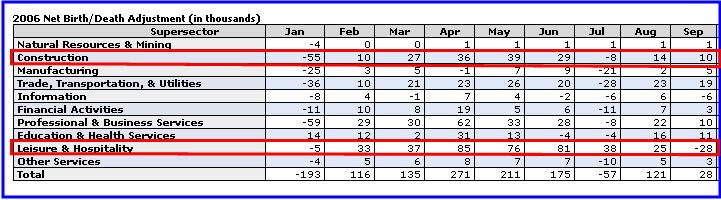
Let's look at the birth/death numbers for 2006.

CES Net Birth/Death Model


In Strike Four I questioned the Birth/Death Model, critical that it was adding jobs that simply did not exist. Now it seems that the labor department thinks 810,000 more jobs need to be added to totals that I thought were already exaggerated on the high end.

Pondering the latest Birth/Death revisions once again I see construction jobs are being added by the model. 157,000 construction jobs were added between February-September in the face of the massive housing slowdown. Is that plausible? Was construction that much understated in 2004 perhaps that the model needed to add all of those jobs in 2005? Unless the revised numbers reflect one last final push by builders to complete projects as all hell was breaking loose in sales, those numbers do not seem to make a lot of sense.

A Trend Change

Note that for the first time since January, jobs were being lost in Leisure & Hospitality. Jobs at restaurants such as Pizza Hut and Outback Steakhouse are included in that total. Is there any doubt this sector has been overbuilt? Still, the model suggests that 342,000 additional jobs (over the physical payroll data) were created between January and September 2006. Is that a plausible number? Actually a better question is “Is that a sustainable number?”

Please consider the following snip about the Birth/Death Model straight from the BLS: "The most significant potential drawback to this or any model-based approach is that time series modeling assumes a predictable continuation of historical patterns and relationships and therefore is likely to have some difficulty producing reliable estimates at economic turning points or during periods when there are sudden changes in trend."

Something is seriously wrong if 810,000 jobs have to be added on behalf of past activity. In addition, the economy has finally turned. The leading indicators think so, the yield curve thinks so, and in fact about the only things that do not think so are the stock market and the economic cheerleaders. Looking ahead, plan for more discrepancies in the numbers.

Some might suggest that commercial construction is still booming. Perhaps for now it is. But for how long? Commercial real estate tends to lag home construction by a year or so. As subdivisions build out, retailers and restaurants and gas stations start moving in. Strip malls multiply. Plans are made by Walmart and Home Depot and Lowes and Pizza hut to add stores. Those plans are set and that construction goes on, even if (as is happening now) housing is collapsing in its wake.

Housing where I live has pretty much slowed to a crawl but we still have a huge new Walmart going up nearby. That store will likely employ 500 people or more. Yet in the face of a continued slowdown, will growth of such stores continue at anywhere near the same pace? What do corporate executives think?

CEO Outlook

Investors.Com is reporting CEOs Gloomy On U.S. Outlook
Nearly half (45.6%) of CEOs polled by the Business Council and Conference Board expect the economy to worsen over the next 6 months vs. 13.2% who think it'll improve. In Jan.-Feb., 28.4% expected better times vs. 16% who were downbeat. Most expect the economy to grow 2% to 3% in '07
Are gloomy CEOs likely to be adding many jobs? More and more it seems the much ballyhooed "soft landing scenario" that commercial expansion will take over where the consumer left off is a bunch of nonsense.

Let's now see if we can tackle questions four and five above:
4) Assuming we really did gain those jobs exactly what was the distribution of those jobs over time?
5) What can we expect looking forward?

Knowing that housing peaked in Summer of 2005, I suggest most of those jobs were filled by November of 2005. Given the lag in commercial construction, the remainder of those jobs trickled in since then. Loking ahead, about the only possible bright spot is healthcare.

In other words, what was supposed to be excellent news, might really be a nightmare. It took 810,000 additional jobs just to produce anemic real GDP growth of 2.6% during the second quarter. Subtracting CPI distortions, hedonics, imputations etc, the reported 2.6% growth is likely at or under the stall rate. This brings to mind additional questions.

Still More Questions
  • If the BLS was underestimating jobs created for March 2005 thru March 2006 by 810,000 then how much are they overestimating jobs by now if the economy has turned?
  • If the Fed is basing some of its interest rates decisions on jobs, just how far behind the curve were they in tightening and how far ahead of the curve are they now?
  • If the Fed was aware that the economy was 810,000 jobs stronger than everyone thought, when did they know it, and why didn't they comment on it?
Answers to the above questions would likely show the Fed has no business setting rates at all. The Fed is forever in a pointless tail chasing exercise that causes them to wildly overshoot in both directions. Unfortunately the Fed manages interest rates on a day to day basis adding or draining reserves just to meet their own arbitrary targets, when in fact they do not know the correct interest rate any more than they know the correct day to day price of orange juice.

If perchance the economy really did create an extra 810,000 jobs in some sort of housing/credit bubble blowoff top, that discrepancy will be unwound and then some in the upcoming recession.

Mike Shedlock / Mish
http://globaleconomicanalysis.blogspot.com/

Saturday, 7 October 2006

Kara Cascade?

In Kara Mia I talked about the implosion of Kara Homes.
Following is a short synopsis.
  1. On 9/13/06 Kara was bragging about completing "two most profitable quarters in the history of our company".
  2. On 10/06/06 Less than one month later Kara filed for bankruptcy protection.
Tonight I am wondering if the rapid implosion of Kara is a significant event in the Falling Dominoes theory, or if that implosion is simply one of dozens of things that can (and will) happen before this trainwreck of an economy derails.

The reason why I am talking about a cascade effect is because Kara bankruptcy deals another blow to bank owed millions by Dwek.
Amboy National Bank has suffered its second blow this year after a home building company filed for bankruptcy Thursday.

Amboy holds $58.2 million in loans with Kara Homes Inc., one of the largest home builders in Monmouth and Ocean counties. According to the bankruptcy filing, it is the largest creditor to Kara Homes.

A bank analyst said the bankruptcy puts Amboy in a difficult financial position, and could be a harbinger of things to come for local and regional banks if the real estate market continues to decline.

"That's not good to have that kind of exposure to troubled real estate,'' said Gerard Cassidy, a bank analyst for RBC Capital Markets of Toronto. "It's manageable, but it will be very painful. These problems do not go away quickly. (Amboy) started out this year with a cold. It's now turning into pneumonia.''

Kara's bankruptcy comes only five months after real estate mogul Solomon Dwek of Ocean Township bounced a $25.2 million check and had his assets frozen by a Superior Court judge. Amboy says Dwek owes it $49.7 million, which makes it the
largest bank creditor in that case.

Cassidy said he was monitoring the Dwek situation and the Kara bankruptcy to gauge the health of regional banks. RBC has advised clients to review holdings of bank stocks with large amounts in real estate development loans.

Amboy, which is privately held, has $1 billion in loans for construction and land development, according to its federal reports on file with the Federal Deposit Insurance Corp. It has $257.6 million in capital.

According to its June 30 report, Amboy had $47.1 million in nonperforming loans. It was not clear if those included the Kara or Solomon Dwek's loans.

Amboy was not the only bank included in the Kara bankruptcy filing.

National City Bank of Philadelphia holds $48.2 million on loans to Kara. North Fork Bank of Edison holds $21.3 million; TD Bank North of Portland, Ore., holds $15.9 million; Yardville National Bank holds $7.8 million; Magyar Bank of North Brunswick holds $7.5 million; and Park Avenue Bank of New York holds $3 million in loans to Kara.
You may also wish to consider Bankruptcy is met with uncertainty Builder's woes affect others.
Kara Homes' bankruptcy filing has left scores of customers and creditors wondering if the troubled builder is going to complete the developments it has under construction and make good on its debts.

In Marlboro, Peter Rallis, owner of All About Construction Inc., said he was forced to lay off 35 of his 50 employees because Kara has not paid him $239,500 it owes him.

Experts, said Kara is an example of what can go wrong to an aggressive builder when the real estate industry collapses. After paying top dollar for land, it is not able to sell its homes at a high enough price to pay off its debts, they said.

Kara's bankruptcy marks a dramatic turnaround. The company built 590 homes and had $288 million in sales in 2005, making it the 127th biggest builder nationwide, according to Builderonline.com. It was named the fastest-growing builder in the nation as recently as 2002 by Builder Magazine.

The fallout from Kara's bankruptcy is far-reaching. The filing lists thousands of creditors. Among the largest unsecured creditors — those with no collateral to rely on — in Monmouth and Ocean counties are: RWZ Inc. Stairs & Rails of Lakewood, which is owed $890,654; Benchmark Inc., also of Lakewood, owed $876,585; and Michael J. Wright Construction Co. Inc. in Dover Township, owed $780,309.

Among the other creditors: Kara's laid-off employees who are owed back wages.
Questions Questions Questions

What happens to all those laid off because of this disaster?
What about the down payments lost if projects are not completed?
Can Stairs & Rails afford a $890,654 hit?
Can Benchmark afford a $876,585 hit?
Can Michael J. Wright Construction Co. afford a $780,309 hit?

Can anyone answer those questions?
I can't but I still have more.
What happens to those companies and their employees if the above companies can not afford those hits?
How many people are directly affected so far?
What companies are next?

Hovnanian vs. Kara

While we are all pondering that I see that a Housing slide prompts Hovnanian to cut jobs.
Faced with rising inventories of unsold homes, Hovnanian Enterprises said it plans to ax executive and field jobs to improve its bottom line and weather what the Red Bank-based home builder describes as "the steepest decline in new-home sales in our memory."

In an internal memo to employees dated Oct. 3, Chief Executive Ara K. Hovnanian said an unspecified number of staff reductions were necessary in order "to remain healthy," as the nation's eighth-largest U.S. home builder grapples with the broad downturn plaguing its industry.

"In many locations, including corporate headquarters, we have been forced to face the fact that we no longer have enough work for all of our Associates," Hovnanian wrote. "We consider this action to be a last resort, but business realities demand action in order for our company to remain healthy and to maximize our performance in a difficult market environment."

Larry Sorsby, Hovnanian's chief financial officer, said yesterday no comparisons should be drawn between his company's decision to tighten its belt and Kara Home's financial troubles.

"We are still in very good shape financially and are still very solidly profitable," Sorsby said. "No one knows for sure (how long the housing slump might last), but we want to prepare the company and our associates as if this is not going to be short term in duration."

Anthony Garofalo, president of Vintage Contracting of NJ in Belmar, has been working with Kara Homes since it started in the mid'90s. He said he has filed about $650,000 in liens against the homebuilder, but because of the size of his business, it shouldn't affect operations.
Well it seems that Vintage Contracting is able to weather this storm but questions still remain on the others. As for believing Larry Sorsby, Hovnanian's chief financial officer, a more serious question is why should we? OK as of right now Hovnanian is in better shape but for the CFO to say that "no comparisons should be drawn" while making comparisons in the next breath seems a bit disingenuous at best. Yes comparison can be made if for no other reason than Larry Sorsby, Hovnanian's chief financial officer, made them. Getting a little spooked are we?

Ground Zero

Let's now turn our attention to Ground Zero of the housing bubble bust which of course means Florida Condos. Please consider Moody's Cuts Rtgs Of WCI.
tick, tock, tick, tock..... watch the other rating agencies follow..
The following is a press release from Moody's Investors Service:
Moody's Lowers Ratings Of Wci Communities; Outlook Negative
Approximately $650 Million of Debt Securities Affected

New York, October 06, 2006 -- Moody's lowered the ratings of WCI Communities, Inc. ("WCI"), including its corporate family rating to Ba3 from Ba2 and the ratings on its senior subordinated notes to B1 from Ba3. This concludes the review that was commenced on July 24, 2006. The ratings outlook is negative.

The downgrade was triggered by a series of increasingly unfavorable developments regarding WCI's new orders, cancellation rates, and revenue and earnings generation, which could be exacerbated if the company's additional share repurchases are not balanced with sizable reductions in outstanding debt to address appropriately its relatively high current debt leverage--now in the mid-60% area.

Going forward, the ratings could be reduced again if the company were unwilling or unable to reduce debt leverage at year end to the mid-to-high 50% range, if earnings turned sharply negative, or if covenant compliance became problematic.
Going forward I expect this is what I expect:
  • Ratings to be reduced
  • WCI unwilling or unable to reduce debt leverage
  • Earnings turning sharply negative
  • Covenant compliance becoming problematic
Just the Facts Maam

*DJ WCI Communities Updates Third Quarter Earnings Guidance>WCI
*DJ WCI Communities Inc. Lowers 3Q Earnings Guidance >WCI
*DJ WCI Communities Sees 3Q EPS 'Significantly Below' Prior View Of 52c
*DJ WCI Communities Says Still Expects To Report Positive 3Q Net Income
*DJ WCI Communities Cites $13M Write-Off Tied To Land Options
*DJ WCI Communities: Write-Off Cost Co 18c/Shr
*DJ WCI Communities Sees 3Q Combined Tower, Traditional New Orders To Fall 80%

Questions Questions Questions

WCI still "expects" to report positive 3Q income.
Is that a plus or a minus or just plain funny?
What about Q4?
What if they don't?
Who will take a hit and how big will it be?
How many dominoes need to collapse before it dawns on the stock market that there just might be a problem?

Answer the last one and you answer the 64 million dollar question.

Mike Shedlock / Mish
http://globaleconomicanalysis.blogspot.com/

Occam's Razor

An interesting debate has been developing in various places as to whether or not some sort of market manipulation is taking place that has been supporting the stock market while causing gasoline prices to sink. These accusations have increased lately because falling gasoline prices as well as rising stock market prices are both viewed as favorable towards President Bush and more specifically towards helping Republicans hold the House and Senate in the upcoming mid-term elections.

This discussion is a new variation of a long standing debate about the active (or inactive) role of the Plunge protection Team PPT and GATA (Gold Anti-Trust Action Committee). The former acting at critical time to prop up the market and the latter when it comes to ideas centering around central bank suppression of the price of gold. I will leave a discussion of the PPT and GATA for a later time but will add my 2 cents to the question of stock market manipulation via treasury actions and gasoline manipulation by Goldman.

Gasoline

Let's analyze both sides of this debate starting with a recent article from the New York Times called Change in Goldman Index Played Role in Gasoline Price Drop.
Goldman Sachs, which runs the largest commodity index, the G.S.C.I., said in early August that it was reducing the index’s weighting in gasoline futures significantly. The announcement did not make big headlines, but it has reverberated through the markets in the weeks since and some other investors who had been betting that gasoline would rise followed suit on their weightings.

“They started unwinding their positions, and those other longs also rushed to the door at the same time,” said Lawrence J. Goldstein, president of the Petroleum Industry Research Foundation.

Unleaded gasoline made up 8.72 percent of Goldman’s commodity index as of June 30, but it is just 2.3 percent now, representing a sell-off of more than $6 billion in futures contract weighting.

Like many market indexes, trading in the Goldman Sachs Commodity Index is publicly available, allowing individual investors and third-party asset managers to participate in that market. The $100 billion invested comes from brokers, fund managers and individuals, probably including some of the same people who were hurt by high gasoline prices earlier in the year.

The week started with “everyone talking about $4 gasoline and ended with the market down sharply,” said Phil Verleger, an independent economist in Aspen, Colo.

In following weeks, “traders all tried to push themselves through that door,” Mr. Goldstein added.

“We saw gasoline fall 82 cents in the wholesale market over a four-week period, which is unprecedented,” he said. Mr. Goldstein said that the decline in gasoline prices helped send prices of the whole group of energy-related products down.
On the blog The Mess That Greenspan Made, Tim Iacono (speaking about gasoline prices and the above NY Times article writes about Friends in High Places
So, as far as conspiracy theories go, this is quite a good one. The motivation for the commodity index change and the impact on other energy prices will likely never be confirmed or corroborated, but it makes for an interesting story.

Make a little change that causes $6 billion in unleaded gasoline futures to be dumped onto the NYMEX, then watch prices tumble. Stand clear, watching for traders like Aramanth to implode, and get ready to mop up any other messes that arise during the process - all to relieve a little pain at the pump, prior to the polls opening.

Some at the White House may be patting themselves on the back figuring that the best thing they've done in years was to get Hank Paulson to take the job at Treasury.

It's good to have friends in high places.
Wait as second, says Greg Roberts on Minyanville in a well written rebuttal entitled Gasoline Prices: Conspiracy Theory Running on Empty.
Goldman officially announced its reconstitution for the Goldman Sachs Commodity Index (GSCI) back in June for the rolling off its Unleaded Gas contract. As part of that press release, the GSCI said it was acting in response to the transition on NYMEX from the New York Harbor Unleaded Gasoline ("HU") futures contract to the Reformulated Gasoline Blendstock for Oxygen Blending ("RBOB") futures contract. While the contracts affected began with the August roll period, the futures contract rallied more than 10% post the press release. I'm guessing there might have been several other factors involved with the August decline.

RBOB conforms to newer industry standards for reformulated regular gasoline blendstock for blending with 10% denatured fuel ethanol whereas the old unleaded contract did not and consequently is getting phased out. The committee decided to amend the GSCI by rolling 1/3 of the overall weighting in each of the last 3 months leading into Oct/Nov transition. The unleaded contract weighting will ultimately fall from roughly 7% to 2.3% on a dollar weighted basis with the remaining %, nearly 5% split up between Crude and Heating oil. Why just 1/3 of its previous size? This is mostly because of the illiquidity surrounding this new contract according to the operating committee at the GSCI and not a covert effort by the government to drive gasoline prices down. Currently the total open interest is nearly 40% greater in the RBOB than the Unleaded contract and in light of the portion rolling over, confirming the roll is near complete.

I believe these reasons, more than the conspiracy theories of government manipulation is more to blame here than some politicians trying to win their seats back.
Occam's Razor

When confronted with issues like these I often turn to Occam's Razor which states that the explanation of any phenomenon should make as few assumptions as possible, eliminating, or "shaving off," those that make no difference in the observable predictions of the explanatory hypothesis or theory. In short, when given two equally valid explanations for a phenomenon, one should embrace the less complicated formulation.

In this case the simple explanation was that pure market forces were in play. The question everyone has to answer is whether or not to believe that and to what degree. Before weighing in on the matter let's turn to the second issue at hand: whether or not the Fed, the treasury, or some other influence such as Foreign Central Banks (FCBs) have been acting to purposely prop up the US stock market.

Strange World

John Succo, one of my favorite Minyanville professors wrote an interesting article on October 4th entitled Strange World. This is what Professor Succo has to say:
In 25 years of trading I haven't seen stock prices act this way. On any disappointing number (ISM for example this morning) stocks react vehemently positively.

And it's not stock by stock, brick by brick, which is how a stable bull market is built. It is all index led. TICK data today is just another example. They hit +1000 probably 20 times today and +1500 twice. Surreal.

I trade stocks and watch them heavy only to be ripped up as futures are relentlessly bought.

I have my own theories. In a world where geo-political events are broiling, we have political structures desperate to remain in power. It is possible to believe that in such a world desperate measures like buying stocks by governments (we know Japan did this for quite a while) is certainly plausible. Given the action, I say it is probable.

The last few years is all about liquidity. Who is responsible for that?

And just in time for the elections.

I made the big leap yesterday saying governments (no price sensitivity) were buying index futures in the U.S. This is the only answer I see for the odd behavior. Stocks not in an index are severely lagging.

I am not necessarily saying the Federal Reserve of the U.S. is buying stocks. More likely, it is the central banks of other countries recycling dollars from trade "throwing" them into U.S. stock indexes.

It seems not to bother those invested in risky assets that central banks are printing money and buying things like stocks. In fact they welcome it as nominally at least they are making money as stock prices rise.

But I warn everyone that this has vast implications that do not bode well for the future, perhaps the near future.

What does it say when central banks become the elephant in the room and own risky assets? First, it interrupts the normal market mechanism of pricing risk. Investors are not putting their hard earned money in the right places by discerning proper investments; governments are making credit easy for even the worst companies. Productivity will fall over time. Debt will continue to rise from this easy credit and will eventually crowd the economy out. We are already starting to see this and a new development has passed most by: the net interest component of the trade deficit is now turning negative for the U.S. We are paying out more income than we are receiving on our investments. In addition, net disposable income, crankily not rising as we export that income to production oversees, is at an alarming level to debt service.

Central banks continue to force credit down the throats of an already indebted system as a solution to continued economic expansion. The cumulative effects continue to get worse. Central banks are now delving into buying everything from mortgages to stocks. Can they own everything? I think not. There is a limit despite what bureaucrats believe.

-Succo
When Professor Succo suggests something is strange is happening I am not going to argue. I will take it as fact that something strange is indeed happening. For those not familiar with "Tick Counts", it is a measure of stocks sold on upticks vs. downticks. Here is my number interpretation (and it could easily differ from Succo's). In normal market +1000 is a very strong tick count that one might equate to near panic buying, and tick counts greater than +1200 would represent panic buying. -1000 tick counts would constitute strong fear and -1200 tick counts panic selling. Multiple tick counts of +1500 used to be more or less unheard of but they have now been occurring regularly. No doubt about it either, +1500 is not near panic buying but sheer panic buying. Most interesting is the fact that many of these +1500's have been occurring in the face of what would normally be considered bad news. Like unheard of plunging gasoline prices, these enormous positive tick counts are indeed strange.

Treasury Operations

A discussion about Treasury and Fed operations been going on for several weeks now on Silicon Investor. Bart at NowAndFutures has been wondering if Treasury and Fed monetary injections have been used to prop up the stock market. He has been posting his charts on Silicon Investor as well as his own website. I asked him on Thursday evening if he would update his charts to make them current. Here is one of them:


The above chart shows the S&P (in green right scale) vs. short term repos and TIOs. Repos are short term injections of cash to banks by the Fed. TIO stands for Term Investment Option and is a U.S. Treasury operation. TIOs occur much less frequently than the almost daily repos. Terms typically lasting from 1 to 19 days but may last up to 90 days. Rates have been about 20 basis points below the Fed Funds Rate.

The chart shows a distinct tendency for the market to rally when these cash injections are offered and a tendency to decline when drained. The correlation is not perfect however as evidenced by the action since the beginning of the month. Past charts also show some correlation but not as strong as above.

The Fed and the Market

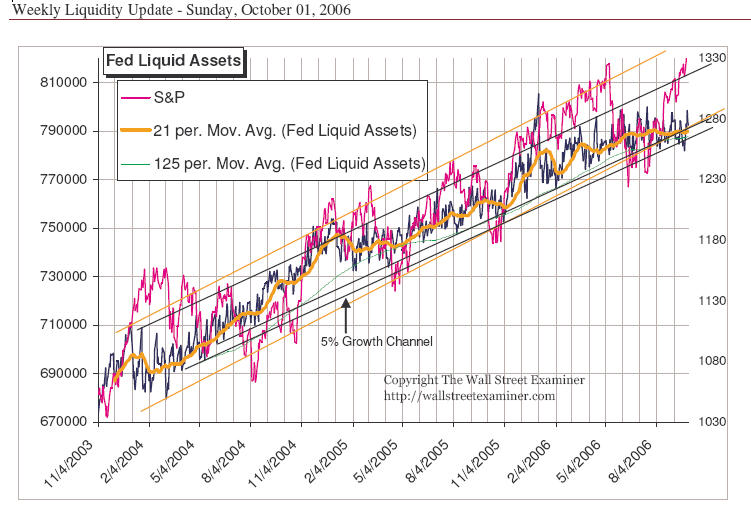
I asked Lee Adler at the WallStreet Examiner about the relationship between Fed actions and the stock market. He was kind enough to send me a copy of his latest liquidity report. Lee writes:
While maintaining a growth rate of slightly over 5% in its asset base for nearly three years, since mid-year the Fed has hewed toward the low end of the band that defined that growth rate. This acted to restrain liquidity growth. Suddenly the Fed began pumping aggressively at the end of September, just when it appeared that they were breaking the 5 % growth channel.

The level and direction of stock prices has correlated closely with the level of the Fed's System Open Market Account. The market sometimes gets ahead of the Fed or it can lag behind from time to time based on investors' liquidity preferences, but it tends to move in the direction of the SOMA with varying lead or lag times. The market follows the Fed not in terms of rate targets, but in terms of the amount of liquidity the Fed pumps into the financial markets through its daily Open Market Operations. Over the last two years the Fed has kept the SOMA growing at an annual rate of around 5.35%, with only seasonal exceptions for year-end pumping parties. Stock prices have risen at a similar rate. Since the 2004 high on January 26, 2004 the stock market's total percentage gain has been virtually the same as the percentage gain in the SOMA.

Coincidence? I'll let you look at the chart below and decide for yourself.

The relationship is clear to see but correlation is not the same as causation. Furthermore there is nothing to suggest anything was recently done out of the ordinary supportive of the idea that intervention is happening to support Republican's in mid-term elections.

On the other hand, lack of proof does not mean that it is not happening either. Clearly we have seen some rather "strange things" to put it mildly. Some of those strange things seem to have plausible explanations, others do not.

Enquiring minds may now be asking "OK Mish, who is right? Was there a "conspiracy" to manipulate gasoline prices lower and/or the stock market higher?"

Before attempting to answer that question let's address another question first: "Is it conceivable that this administration, or someone acting on behalf of this administration might consider manipulating stock market prices higher and/or energy prices lower?"

The answer is "certainly". I have no doubt that Wall Street wants Republicans in control simply because they want less regulation and less people snooping around where Wall Street does not want snoops peeking. I also have no doubts that if this administration thought that a higher stock market would help his cause that he might be tempted to "help things along".

On the other hand wanting something and doing something about it are two different things.
Judging by the number of players loaded up in commodities after a 5 year run suggests some speculators just might have been begging for a little "tough love". The economy is also slowing. Industrial commodities in general were due for a selloff. Finally, place me in the camp that says that a primary trend can not be changed by manipulation. Trends will run their course. Does anyone remember Japan attempting to stop the rise in the YEN by selling YEN on the open market and buying dollars? Did it work? Ironically the YEN did not collapse until AFTER Japan stopped its currency manipulation.

Add that all up and perhaps the simple explanation is that market just came along and punished speculators for being greedy. That is what Occam's Razor suggests.

Besides, would someone like Goldman go way out of their way just to help Bush out? That might be stretching it. Was a "conspiracy" involved? That might be stretching it even more. But what if the opportunity came along where Goldman needed or wanted to change gasoline futures in their index. Might not that be timed at a point to cause maximum effect for a certain someone? How about two someones? Why not put the maximum amount of bucks in your own pocket while giving a nice friendly push to your buddy in the Whitehouse?

One thought keeps nagging me. Lowering gasoline from 8.72 percent to 2.3 percent seems more than a bit extreme. Yes I have seen the explanation but I do not buy it. What I do buy is the idea that gasoline prices and commodities in general were due for a tumble, likely ready to fall on their own accord, but were given an extra push in the right direction at a time of maximum speculation and thus maximum effect. This is not exactly a conspiracy theory but not exactly Occam's Razor either.

As for the treasury actions go, I am struggling to see much of anything going on that is far different that what has been going on for quite some time. We do see a more positive correlation since April, but is that manipulation? If it is manipulation was it cleverly timed just to help the Republicans? It does not look like it to me. And how does one explain panic buying since October first when the TIO and repos signal is down?

What we do know is that the action is very strange but hard to pin down. I do not dismiss the election theory, I just can not find a lot of hard evidence that TIOs and repos are driving it. While we can not out and out dismiss the idea that our government is purposely manipulating the stock market on a day to day basis, the most likely explanation at this point in time is either panic by hedge funds chasing every uptick (perhaps purposely trying to force up the prices of what they already own), and/or indiscriminate buying by foreign CBs just as Succo suggests. Whatever it is, try not to get steamrolled by it or caught up in the euphoria of it either.

Mike Shedlock / Mish
http://globaleconomicanalysis.blogspot.com/

Friday, 6 October 2006

Kara Mia

I just have not been able to get a certain favorite song out of my mind tonight.
It is an old favorite by Jay and the Americans called Kara Mia.
Oops wait a second it is called Cara Mia.

Cara Mia why must we say goodbye?
Each time we part my heart wants to die
Darling hear my prayer
Cara Mia fair
I'll be your love till the end of time


Cara Mia is a tremendous song and I hate to give away my age but it is a favorite from 1964 or so. Let's flash forward to today's Kara Mia.

BANKRUPTCY CONSIDERED: Kara Homes lays off staff; talk of filing for Chapter 11 makes local clients anxious
Kara Homes Inc., one of the biggest home builders in Monmouth and Ocean counties, has filed for protection from creditors under the bankruptcy laws.

Earlier this week, at least some Kara Homes employees received a letter from the company notifying them that they were being laid off and stating that Kara "anticipates filing Chapter 11." Under that provision of the bankruptcy code, creditors claims are frozen by the court while the company can continue to operate as it attempts to reorganize.
Owners of Kara development homes lack COs, can't move in
Nick Spaltro bought a new two-story, four-bedroom house with a gas fireplace. He has painted a few rooms. Utilities were turned on weeks ago.

The only problem is, he can't move in.

Township Administrator Robert Czech said Kara Homes has, on numerous occasions, failed to complete site work the company said it would finish or has deviated from approved construction plans. Much of that site work remains to be done, he said.

Sidewalks remain disconnected; drainage problems have not been fixed; and, in some cases, driveways to houses have not been paved adequately, Czech said.
It could be business as usual, or not, for Kara
Although officials of Kara Homes Inc. have said the company could file for Chapter 11 bankruptcy on the heels of employee layoffs Tuesday, attorneys in the area caution home buyers under contract with the builder not to panic.

Two Shore bankruptcy attorneys said Thursday that it is likely that Kara will continue to operate and build.

Warren Brumel, a Keyport bankruptcy attorney, said Kara likely will honor the contracts it has made.

"Most of the time in a Chapter 11 case, the business is going to continue to operate," he said, citing the Trump casinos in Atlantic City as an example.

But that doesn't mean people should sit on their hands, said Lee D. Gottesman, a bankruptcy attorney from Dover Township.

Gottesman urged people to file a proof of claim in federal bankruptcy court if Kara files for Chapter 11. A proof of claim is a document substantiating that a creditor is owed money.

"If they sit there and do nothing, they may lose everything," he said.
Flashback 2006-09-13

Some people might not remember a flashback to the mid 60's. If you do, you do not have to admit it. But lets consider a flashback to a date that hopefully everyone here can remember.

Posted by the Ocean County Observer on 09/13/06
"Now that the long anticipated correction in the real estate market has occurred, both home builders and buyers are discovering opportunities created by the market shift. Zudi Karagjozi, president of Kara Homes, reported that the recent market slowdown has inspired valuable new incentives for home buyers while giving builders the chance to become more efficient.

"At Kara Homes, we've just completed the two most profitable quarters in the history of our company," Karagjozi said. "We've taken advantage of this temporary lull to reevaluate our business plan, streamline our operation and prepare for the market recovery which some experts are predicting will begin either later this year or in the first part of 2007."
The above snip was posted on Minyanville earlier today.

Just the Facts Maam
  1. On 9/13/06 Kara was bragging about completing "two most profitable quarters in the history of our company".
  2. On 10/06/06 Less than one month later Kara filed for bankruptcy protection.
If anyone thinks they are going to get a huge advance warning on some of these "low PE low risk" homebuilders please consider the above facts.

Kara Mia why must we say goodbye?

Mike Shedlock / Mish
http://globaleconomicanalysis.blogspot.com/

Wednesday, 4 October 2006

Still More Anecdotes

I have been gathering these anecdotes for a couple of weeks from private Emails, public responses to my blog, responses to various audio broadcasts I have done, and personal and private messages from people on the Motley FOOL, Silicon Investor, and other places.

Yes, I know that anecdotes do not make a market but the number of cities and town involved really suggests that something serious is at hand regardless of what the stock market thinks. I will have more thoughts on that idea in a later blog.

In the meantime, here are still more anecdotes:

Trans World Financial - Orange County
I am a mortgage broker here in Orange County, California. this is from my wholesale reps in the business. About a year and a half ago my reps from WAMU and COUNTRYWIDE said that up to 80% of their pipelines were filled with Option Arm Loans. Most of the ones getting these loans were coming off interest only loans who could not afford a fully amortized loan so they needed to do the option arm loan. I would guess that all the people that are coming off the short term interest only loans can only afford the option arm because their payments are have gone up too much for them to bear.

If only the National Association of Realtors could see what kind of loans are being done or have been done in the last 3 to 4 yrs they would ALL shout at the top of there lungs CRASH!

The last time we had a housing boom was in 1989. it crashed for 6 yrs. No one wants to talk about the type of loans we have today compared to then.

In 1989 the most aggressive loan we had my have been the FHA at 97% LTV. Unfortunately most could not qualify for that here in Orange County because the loans were too high. But in Riverside County almost everyone could. Where was the largest foreclosure rate back then? Riverside County.

Today, we have:
Neg Am Option Arm Loans, (Bombs)
Interest Only Loans
Stated Income/Stated Asset Loans
NO DOC LOANS
100% financing
125% financing

why doesn’t the REALTORS LOOK AT THIS? BECAUSE THEY ARE IN THE BUSINESS OF SELLING HOMES! Even on the news today, Realtors will say the market is cooling or stabilizing but never will they say that it is declining because they will never sell a home. No Realtor in the world will admit this or they will never sell a home. remember, we have 500,000 licensed real estate agents here in California.

The biggest Bomb we have to me, is Stated Income/Stated Assets to 100% LTV. I would bet 80% of these borrowers are not making anywhere near what is stated on the application and to top that off they qualify usually at 50% back end debt ratio. (Mish, if you write on anything about housing you have to mention this!) Besides this loan, the other bomb is NO DOCUMENTATION REGARDING WORK! WE DON’T EVEN HAVE TO PUT A JOB OR INCOME ON THE APPLICATION! THERE IS NO VERIFYING ANYTHING! THE LENDER JUST LOOKS AT THE CREDIT AND FICO SCORE!

I have been in this business since 1988 and I have never seen so many cheap, easy, funky, weird loan programs all that have contributed to the bubble and will eventually contribute to the biggest bust in the history of the Real Estate Market.

Please reply to this. I would very much like your opinion!

[Mish notes: The above email sender was kept anonomyous by request. I responded in private as well. Whether anyone asked or not, all names were removed from these anecdotes. Later in this blog hear from a real estate broker from Birimgham Alabama and see snips from an internal email circulated at the Kaiser Foundation Health Plan and Hospitals.]

Detroit Suburbs
Housing is back pretty much to 2000 levels in our suburb. We did a whirlwind buy-a-house-in-four-days relocation tour when we moved here in 2000. One of the houses we seriously considered is 4 blocks from the house that we eventually bought. I walk past it almost every day. They wanted $205,000 in 2000, and they sold it soon after, so I assume they got close to their asking price.

Three years ago I helped a friend with her house hunting. We looked at a house two down from that one we almost bought. They were asking $250,000 and it wasn't in the shape that the first house was. That also sold within weeks.

This year, the house between those two went on the market. $199,000. Even I couldn't believe it. I took a flyer and from the pictures it looked nicely renovated. Same size, same floor plan.

Here's an interesting quote from the Detroit area: "I recently sold a house in Rochester Hills," Waquad says. "It was purchased a year ago by the seller for $615,000 -- a newer house. He changed all the appliances, the carpets and painted. He never lived in it. He must have spent at least $20,000 to $30,000 fixing it. We got it for a buyer for $440,000."

http://articles.moneycentral.msn.com/Banking/HomebuyingGuide/WhenHomeownersAreDesperateToSell.aspx?page=2

We really, really wanted to buy in 2005. That could easily have been us.

No comments on what a dump Detroit is, please. These are beautiful suburbs and lovely homes that you would find anywhere in the U.S. The downturn in housing is taking place with the rest of the U.S. but has been worsened by years of incompetence at the Big 3 coupled with the rapid globalization of the industrial sector.

Myrtle Beach Florida
Just got back from a weekend in Myrtle Beach for my brother's bachelor party. Flew down Thursday and came back Sunday. I haven't been there in about 2 years and alot has changed since then. And I mean a lot. Here's some observations:

(1) First thing I noticed is, of course, tons of new construction. Everything from roads to condos to amusement parks to clubs, its all under construction. Now this is no doubt a growing vacation destination so I can understand the need for building (its not just a golfers paradise anymore - there's lots for the young adults now too -- not the best for kids yet but its getting there). But there were still some troubling signs.
(2) Tons of signs for condos for sale. Only $170,000 if you stop by today.
(3) Lots of popular places have been closed down since my last visit and re-opened by a new owner with the same type theme. For example a great sports bar we used to hang out Yesterday's is now gone and being replaced by a new one I believe. The old Planet Hollywood is now Club Kryptonite or something. Now there was a reason these establishments went under in the first place.
(4) The Granddaddy golf course (Pine Lakes) is shutting down in November for 2 years to allow for the construction of condos and townhouses on the grounds. The Granddaddy is the oldest golf course in Myrtle Beach and still has the charm and character of the old days. And to see that being breeched by the greed of the money hungry condo-builders is pretty sad, but it shows that (a) everyone has their price (b) there's always a bigger sucker out there.
(5) Lots of current condos that have been up for maybe 5 years were having their exterior worked on (and probably the interiors as well). Like new windows and doors being put on. Refacing the brick siding on some of them. What's the reason for this? Was it shoddy construction to begin with? And is this "renovation" actually propping the economy a little longer by keeping some of the new construction workers employed?
(6) I live in New Jersey and picked up a couple of my brothers friends from the airport on Friday. First thing 1 of the guys said was "Wow, only $170,000 for a condo down here. God there's a ton of money to be made." This guy is 27 and is not very financially well off and is a perfect example of the mentalilty of Joe 6-pack. I tried to explain to him that this is probably not the best time to be buying real estate, but he wasn't having any of it. He was too busy running the numbers of how much he could make by buying it and renting it out all year. Now mind you I found 2 large 2 BR, 2Bath townhouses for the weekend for $105/night last minute. And I had my choice of any room I wanted in any hotel up and down the coast. This is not busy season, but I'm sure this is more the norm than sell outs are, especially with all the new construction going on.

It just goes to show that this bubble will be perpetuated until the mentality of Joe 6-pack is changed from wealth creation to wealth preservation.

Orange County California
Well the condo conversion projects in Orange County are starting to feel some pain I think. Just got a postcard in the mail: Auction for 34 remaining 'homes' with minimum bids up to 38% off last sale price. lol I can't remember how many condos there are there but I think it's about 120ish.
http://www.canyonvillas.info/
Oh and for the first time in 3 years I'm seeing rental properties advertise several hundred dollar finders fees to get people to move in. I got one on my door. You would think with all the apartments that have been converted to condos in this area just this year, they wouldn’t have any problem finding renters.
Oh wait, I forgot, they are building a boatload of apartments in Irvine and Newport.

Jersey City
FWIW, a real estate agent friend, who left IT to sell real estate in the formally hot downtown Jersey City market, has bought a hot dog stand. We run our four legged dogs together in the park and he was, formally, one of those always optimistic sales types. He said they have had hardly any customers coming into his office for the last six months, he is broke, and he needs to earn some money.
He also needs to sell both his Harleys fast to make is monthly nut.

New York City
the big new-build jobs are still going strong but as the pipeline ( many years of development for any new NYC work) is built out that is slowing. Many of the trades unions have stopped accepting travelers (union members from other locals outside of the area) which means the job flow is decreasing.

My company is predominantly residential, mainly in Manhattan but also in Westchester, Brooklyn and occasionally on Long Island. I maintain those licenses. The phone went dead during the summer and remains moribund. I had a very nice piece of work go all the way to a start date when the owner decided not to proceed with anything other than a very small cosmetic update. Two other very live recent buyers chose to only do the bare minimum prior to moving in rather than the full kitchen/bath upgrades they first envisioned. My current activity is follow-on bits and pieces from previous customers, a developer grade spruce-up on a recently vacated apt.and constant collection activities from customers happy with their work but now stretching out payments unmercifully.

My pals in the business are all singing the same song and our workers are partly employed these days. There are many very professional guys at every supplier's door offering cards and looking for work.

I needed a particular stone to match existing counters at an upper westside apt. recently which called for numerous trips to many stone yards looking for the closest alternative. The activity level at these yards was substantially down from recent times. I eventually found a stone that would work but was told that all the slabs were committed to other contractors. The next day a senior salesperson called me to say that if I produced a check I could take whatever slabs I wanted immediately because the other buyers were not forthcoming. Not only was I happy to secure the stone, but I realized when I cut the check that the price was only somewhat high from a yard notorious for always being ridiculously overpriced.

Boston
I just spoke with my realtor buddy from outside Boston. he said it is dead. Homes that were 800k a year ago won't move at 600k this year.

Troy, MI
I went to the Palm restaurant for dinner last night. The place was empty. Maybe five tables were occupied, and there were a few people in one of the private rooms. Two years ago it would have been packed on a Thursday night.

Palm Beach Florida
Deflation is here, in Florida. Just got home from a bar in Palm Beach County. Bottles of beer were 0.25, as they are every Thursday. This is 1982 pricing. The place was packed, quite the party. People were getting so drunk there were fights in the parking lot and people passed out everywhere. The point, however, is that this place had to give away the beer for free just to stay in business. I can't remember the last time I paid less than $4.00 for a beer in Palm Beach.

Central Florida
I am visiting Central Florida, and have gone to numerous retail outlets. The place is vastly over-retailed. I have not seen even a half-full restaurant or more than 2 people in a grocery line or more than a couple of rows of cars at the mall.
So far from retail expansion, I think we can expect massive retail consolidation, at least if Central Florida is any indication.

Boston Suburb
Peabody, MA, a suburb north of Boston
I had two contractors ask me this morning if I had any work coming up for them, one a plumber the other an electrician. They said work was really slow and they were starting to worry. These same guys I couldn't get a return phone call for the past 5 years.

Just an aside I just talk to the electrician I mentioned earlier, about an hour ago and he told me he had lowered his prices by 25%, just to keep busy. He said things were getting worse week by week and he was really worried about keeping his bills up.

Kona Hawaii
The vacation rental bloodbath is in full swing this year and more owners are opting to try long term...w/o success of course!

Sterling Heights MI
My daughter just brought a house in Sterling Heights, MI on Monday. She got married in June of this year and had these nesting instincts to move out of the one bedroom apartment that she and her fiancée were renting for $500 per month with water and heat.
They picked up a two year old house with new houses under contract for $317,000 being built next door and in the sub. The house that they picked up sold in 2004 for $324,000 and the owner put in a $15,000 to $20,000 brick deck with nice boulders and trees. The owner put the home on the market June 10 at $350,000. She was relocated to Tennessee and had two house payments. My daughter and her husband paid $266,000 or a 24% discount to the asking price in June of this year. Oakland County is foreclosing 2400 homes per month. We went to a bank auction in May and a foreclosed home with a transfer tax stamp of $212,000 in February of this year went for $135,000. The buyer has put it on the market for $175,000 but has yet to sell the house.

Palm Beach
An anecdote: The Border's I usually visit in Boynton Beach shut down. I went to one at the Palm Beach Mall and they didn't have anyone manning the registers, all purchases were made through the single person manning the coffee machines.
In west palm beach I'm seeing a lot of for sale signs that have morphed into for rent signs. Some have both of them up.

Los Angeles
The restaurants we frequent here in Los Angeles have been nearly vacant or experiencing greatly reduced business for the past two months.
Even the exceptions are down. One example is the Wood Ranch restaurant at The Grove, which appears to be as full as it usually is, but their bar is now handled by one or two bartenders, down from four a few months ago.
So I expect sales are down even in places that still look busy.
As a restaurant investor said on "The Restaurant" which appeared last year on CNBC, "Everybody thinks that a busy restaurant is a successful restaurant, but I can tell you from experience that a busy restaurant is just a busy restaurant."

Auburn Hills Michigan
(in reference to More Anecdotes)
I am in Auburn Hills, Michigan. It is an outer northern suburb of Detroit. The north suburbs of Detroit are much wealthier than the southern suburbs, having the vast majority of the high tech auto industry. Chrysler headquarters are a 30 minute walk away. Pulte headquarters are just down the street (one township south).

That's very odd that you talk about a secular trend away from consumption in that article. Was just thinking about that last night...in a nearly empty K-smears...after visiting a Home Depot where there were more employees than customers (more CASHIERS than customers!). Started wondering what I was doing there. Haven't "needed" to buy anything from there in many months, and in the past few months haven't bought anything but food and gas. I have all the material possessions I want...and then some.

Auburn Hills Michigan (second anecdote)
Hey Mish, I have an even more interesting anecdote for you, involving landscaping. Every fall I go to a stone dealer because they are trying to liquidate what they couldn't sell during the summer. The prices are great but selection is normally very limited. Not this year. They had all kinds of stuff on liquidation, and a lot of it was premium. Ordered some stuff and went to the backup yard to pick it up. There were pallets everywhere, and that yard is normally almost empty this time of year. I asked the guy what was up. He said it was all liquidation material. They are trying to get rid of more stone than they normally sell in a summer. They had ordered 4,000 pallets of stone in spring, expecting a blockbuster summer. Didn't work out that way. They have been liquidating for a month and they have 2,000 pallets of stone left to liquidate.

I have also noticed the same restaurant trend as your poster. The recent change is not as severe here but I'll give you an example. We occasionally go to a restaurant I really like called "Little Daddy's". The food is really good and the prices are fairly cheap. We normally park at the bank next door because the restaurant lot is always full on Saturday and Sunday. We have gone on two weekend days in the past month and both times it was over half empty. Papa Vinos hasn't been as busy on Sizzlini Tuesday as it used to be either.

I don't give a darn what Wall Street says. People are cutting back on spending fast. Recession is unavoidable, and it feels like we are already in one.

Kaiser Foundation Health Plan and Hospitals
Mish, I love the blog and your analysis, keep up the good work! Here's something you might find interesting.

I'm working at a large healthcare provider on the west coast right now. 2 weeks ago an email message was sent from the CEO to all senior managers for distribution to their subordinates, it was dated August 31.
I can't give you the entire email since it was labeled confidential, but I'll give you the highlights. Anyone who doesn't believe the economy is in for tougher times right now is either ignorant or in denial, or both.
............I am writing to ask for your help and cooperation at an important point in our organization’s history. For the past few years, we have been growing nicely. We’ve continued our mission of providing affordable, high-quality health care services and improving the health of our members and communities.........Our progress has not been perfect, but overall we are on track and moving in the direction our strategic plan calls for us to go.
...........The problem is this: for 2007 and 2008, our revenue from Medicare will be basically flat, with some possibility of an even lower number in 2008. We are one of the largest Medicare recipients in the country—Medicare generates roughly 30% of our revenues. Given all of the cost pressures on the U.S. government from so many directions, we think it’s unlikely that the Medicare funding stream will improve for 2009 and beyond.......
...........More specifically, we need to face that reality for 2007 and 2008. Assuming we meet our current 2006 goals, we will need to deliver trends in the 5 percent range for 2007 and continue equivalent aggressive cost management trends into 2008. If we do not meet our 2006 objectives, it will create an even greater challenge for us to bend our cost trends in 2007. Shifting our revenue needs to the private marketplace is not an option. That means we need to manage our cost increases for 2007 and 2008 down to a trend level we haven’t seen since 1998. Health care costs in this country are rising to unaffordable levels. The marketplace is feeling the pain of prior-year cost increases, and we need to do whatever we can to alleviate that pain. Maintaining our market share will be contingent on the success of that effort.
...........We can’t wait until 2007 to start that cost-trend reduction process. So, we need to start now. We will begin today to take steps to get our expense trend down. We will start with a few basic budget control steps. We will put an immediate freeze on additions to staff, effective September 1, our goal is to not grow our staff from September 1 through the remainder of the year.
...........We will also stop purchases of new furniture and comparable kinds of expenditures.........Our furniture expenditures aren’t very high, but the symbolism of controlling hires and then redecorating an office could be misread. We will, however, save some real money by also freezing upgrades or replacements for nonessential PDAs and laptops. We have more than 40k laptops alone in this organization, so freezing upgrades/replacements will save money fairly quickly. We also are cutting back on a number of corporate meetings and gatherings. We will try, for example, to bring 200 people to meetings where we used to bring 400, and we will use less expensive alternatives/locations. Again, travel expenses and meeting expenses both add up and make a visible statement about cost constraints.
.......The spending constraints I mentioned above are just the first steps. The real work will be done through eight new regional two-year financial plans and through new two-year plans for each division. We’ve identified a dozen potential, major initiatives and opportunities to help the regions achieve the 5 percent trend, we will be working to evaluate the approaches and get the best of the new plans in place as quickly as possible.
This organization employs over 140k people in 9 states, all of them received this email. What the email doesn't tell you is that 300 contractors in Southern California were terminated just prior to this, and they are still looking to cut more contractors. They haven't frozen hiring, they are outright letting people go.

Northern New Jersey / NYC
There are some interesting things going on in my part of the country--ie. North NJ, just outside of NYC.

Despite the fact that this is allegedly one of the wealthiest parts of the country, the popular radio station has an interesting promotion. Instead of offering cash, listeners send in their largest bills, and those lucky ones who are selected have the radio station pay them off.

They are also running a few humorous spots that, in my view, point to growing popular awareness of the vast amounts of consumer debt, and the strain of energy prices. Example: a guy goes in to buy gas for his car. The clerk asks: cash, credit, or mortgage.

A walk around the bookstore shows more and more shelf space being devoted to consumer debt, and its social effects. The mood (and perhaps time preference) in this part of the country, is certainly starting to shift, in my opinion.

One more anecdote. I work in health care. I have a patient who I see for a hand injury who happens to work in sales. He has 2 jobs. He sells both autos and mortgages. He told me almost a month ago he had a lot of sales. Now, he hasn't sold a car in 2+ weeks. He also says the mortgage business is slow as well. It looks like it is going to get a lot slower, once winter comes around.

Your deflation call is looking more clairvoyant. I'd appreciate your thoughts on the recent PPI numbers that were released (significantly below expectations), as well as your take on the sell off in energy.

FWIW, I think the sell off in oil could be a symptom of a slowdown in Asia, particularly in China. I don't trust their economic numbers, and it would seem to me that one of the few ways to detect a slowdown might be through the action of the commodity markets.

Keep up the good work.

Detroit Area Suburbs
My wife has been offered a few listings lately and she turned them down. Sales are so uncommon it's just not worth the time required or the stress of dealing with harried owners. You can drive down many streets and see every fourth house for sale. I suspect there are very, very few actual sales with prices higher than five years ago. I am sure some sales are at prices no higher than in the late 90s.

Having just retired from the swimming pool equipment business (a direct competitor of Pentair), I can verify that the pool business is cooling very fast (pun intended). Until the big run up in housing in the Sun Belt around 2000, the pool business was basically a no growth but very stable business. That changed to the point that nearly everybody in the business put on those "beer goggles" and came to believe that the fast growth was permanent. In fact, it was just a reflection of the massive mania in the housing business. The ability to borrow huge amounts of money using the equity in your house as collateral turned our sleepy little business into a "growth business". This period has now ended, and I expect lots of lay offs and bankruptcies for the foreseeable future.

Birmingham Alabama

I've been in the mortgage business in Birmingham, AL for almost 28 years and the last 16 of those years have been as owner of my own small brokerage operation. I have been blessed beyond measure for the majority of those years and have closed in excess of over $100 million in loans since 2000. Needless to say, business has been great! However, in the last few years, many folks have jumped on the mortgage bandwagon and like most cities, Birmingham became deluged with lenders almost overnight. I went to church with a guy who was delivering pizza's as a full-time job, only to get hired on with one of my competitors as a loan originator. He even managed to eek out a living over the last 24 months without ever having been in this industry. He became a branch manager for this company in short order and had a staff of 4-5 originators working with him. All this business out there has allowed people like him to flourish with the rest of us until this downturn began to get some teeth here. This company has since gone out of business and I've lost track of what became of my friend. My own business has dropped off to the point that I made 4 loan applications last month and one of those was to a couple that has to sell a home that they had not even put on the market yet. I've taken two loan apps so far in the month of October and things are not looking good for the end of the year. I've seen many new guys coming into the area of Birmingham that I have worked for years and wonder how they are going to make ends meet. Most, if not all of the agents I've worked with for many years are saying they've never seen things so slow and the newer agents are simply befuddled as to what they are going to do after having obtained their real estate licenses. This downturn is for real and I think it may only be the tip of the proverbial iceberg. I just hope to be able to hold on and get through it for whatever time frame we have to endure and come out on the other side with at least the opportunity for a bigger piece of the pie that remains!
Keep up the good work....
Mortgage Guy

Mish Comments:
The above was just a representative sample of some of the emails I have been receiving.
Chiming in were some places I never even thought about such as Birmingham Alabama and snips from an internal email from the Kaiser Foundation Health Plan and Hospitals, a huge company I never even knew existed.

Perhaps the latter suggests that health care employment as an economic driver is about to go down the tubes along with housing. Yes, I am aware that these are just anecdotes, yet I caution you to ignore them at your own risk.

This recovery is over. All we need is a confirmation from the stock market to confirm it.

Mike Shedlock / Mish
http://globaleconomicanalysis.blogspot.com/

Tuesday, 3 October 2006

Falling Dominoes

The Sentinel is reporting State targeting abusive lenders.
The [Massachusetts] state Division of Banks is cracking down this month on what it sees as abusive business practices by mortgage lenders and brokers.

The agency issued a series of new emergency regulations earlier this month, requiring better documentation from lenders and prohibiting them from pressuring consumers into taking out mortgages they can't afford or working without their own independent lawyers. It also forced four companies -- two of them located Worcester -- to close immediately and place all pending mortgages with another, more established lender.

Commissioner of Banks Steven L. Antonakes said in a recent interview that division examiners found a pattern of deceptive business practices by some lenders during their most recent round of company inspections.

"We want to spell out in very plain English to send a message to lenders and brokers that these specific acts, whether they're very obviously unfair or deceptive, or more subtle, they weren't going to be tolerated," he said. "And you would put your license at risk by engaging in this kind of activity."

Abusive lending practices can destabilize the entire real-estate market. As an example, he described a hypothetical street containing 10 homes, each worth a certain amount of money.

"If loans were originated for two of those homes, in which the loan was made that the broker knows the consumer has no hope of repaying those loans, very likely the borrower will become delinquent," he said. "In the worst case, the home will be foreclosed upon, and that kind of activity could result in the home being sold for less than its value and before you know it, you have a domino effect."

But the slowdown has also put lenders in a tough position, said Christopher J. Iosua, president of the Mortgage Connection Inc. "When business slows down the way it has in the past six to nine months, new loan originators and those without a strong base of customers do things they probably wouldn't normally do," he said.
The idea that lenders are doing things they may not have done in "normal conditions" may have some merit for some lenders but when 40% of the loans sold in California before the bust started were either stated income loans or pay option arms, I think the idea is more fiction than fact. Anything and everything was done to keep the bubble booming, and that was happening well before the bust.

With every bubble comes fraud. The two go hand in hand and housing is not unique in this respect. We are only beginning to scratch the surface of the fraud that supported this bubble. Lending standards are going to tighten as a result, and will continue to tighten as more and more of the fraudulent activity is exposed. I consider fraud and tightening of lending standards to be two big dominoes that are now falling. Tightening of lending standards was previously discussed in Lending Guidelines / Credit Squeeze and The Blame Game.

Consumer Spending

Consumer spending has been propping up our economy for so long so let's take a look at the current state of affairs with that oversized domino. The associated Press is reporting Consumers Cut Back Spending in August.
Feds Say Consumers Cut Back Spending by 0.1 Percent in August, Largest Amount in Nearly a Year.

WASHINGTON (AP) -- Battered consumers, faced with weak income growth and rising inflation, trimmed their spending in August by the largest amount in nearly a year. The Commerce Department reported Friday that consumer spending, after adjusting for inflation, dropped by 0.1 percent last month, the first decline since a 0.3 percent fall in September 2005, a month when business activity was disrupted by Hurricane Katrina.

Incomes, reflecting lackluster gains in employment, rose by just 0.3 percent in August, the weakest performance in nine months. Core inflation, which excludes energy and food, was up a worrisome 2.5 percent compared to a year ago, the biggest year-over-year increase in more than a decade.

The new report underscored how much the economy is slowing this year as consumers have been battered by record-high gasoline prices and a cooling housing market. Falling home prices are making Americans more cautious about spending money because they feel less wealthy.

The overall economy grew at an annual rate of just 2.6 percent in the April-June quarter, the government reported Thursday, and the new report on consumer spending indicates that growth will likely slow even more in the current quarter.

However, most economists believe the country will be able to escape an outright recession, in part because trends in recent weeks have been more favorable with gasoline prices falling rapidly, helping to boost consumer confidence.

That development is expected to bolster consumer spending in the final months of this year, giving retailers a decent Christmas sales season. Consumer spending is closely watched because it accounts for two-thirds of total economic activity.

Consumer spending before adjusting for inflation showed a tiny 0.1 percent rise, far below the 0.8 percent jump in the previous month.
Premature reports of the "death of the consumer" have been heard for quite some time now from various people, and I must admit that group includes me. Consumers have been spending more than they have been making for 16 consecutive months. We have seen our first yearly negative savings rate since the great depression. For a nice graph of the negative savings rate, as well as a neat picture of the mythical Eeyore please consider July Personal Spending.

Mortgage Equity Withdrawal

One of the dominoes propping up consumer spending is called Mortgage Equity Withdrawal. In simple terms people have been treating their house as a ATM, taking cash out at refinancing and spending it. That source of funding is drying up. CalculatedRisk talked about MEW in GDP Growth: With and Without Mortgage Extraction.

The recent Flow of Funds report showed that household mortgages increased $220.3 Billion in Q2 2006, and $436.4 Billion for the first half of 2006. Using a simple formulation(1) for Mortgage Equity Withdrawal (MEW), MEW was $81.6 Billion in Q2 2006. This is substantially below the record $180.1 Billion of MEW in Q3 2005.

CalcualtedRisk went on to say the "declining MEW over the next few years will be a significant drag on GDP growth." I agree. That falling domino makes it more likely that this downturn in consumer spending is finally the real deal.

Jobs

Another key domino that is tipping but has not completely fallen over yet is jobs. I recently wrote about Jobs in No Hard Landing. Following is a snip from No Hard Landing, quoting Mike Morgan of MorganFlorida (a Florida Real Estate Broker).
Will there be a hard landing? No!
Will there be a crash landing? Absolutely!

For the last two weeks I’ve been receiving daily calls from desperate mortgage brokers, real estate attorneys, insurance brokers, title companies and subcontractors looking for deals and work. This week I spoke with a real estate attorney closing his office and returning to the corporate world. And several of the smaller builders have called me offering triple commissions to entice sales of their inventory. It doesn’t end there.

Who will the housing crash effect? Everyone. Real estate agents will be first. As a group, they’ve made a ton of money during the housing boom, and they’ve spent millions on new cars, vacations, restaurants, clothes, and everything else that comes with excessive discretionary income. That’s over now. Agents are not buying the luxury items that helped feed the economic boom, and they are cutting back on business spending like advertising and marketing. That hits the vendors and newspapers revenues.

But this is all old news for us. The other shoe is dropping now. Loss of hundreds of thousands of jobs created from housing will act like a virus and spread throughout our economy. As real estate agents, attorneys and mortgage brokers reign in their spending, it will effect restaurants, car dealers, advertising companies, jewelers, remodeling contractors, furniture manufacturers, bank profits, electronic retailers, clothing and the list goes on and on and on.

As the primary players are affected, and they cut back on spending, so will the secondary players in this market. These companies will be forced to lay off employees, and the cycle will grow like a virus. Is that it? Not a chance.
The reason this domino has not completely fallen over yet is that homebuilders are still building homes at a high rate. Yes, year over year rates show huge declines, but homebuilding remains brisk on a historic basis. Thus homebuilding is still providing jobs even as it increases inventories and downward price pressure. So while housing related trade jobs are slowing, they have not yet collapsed. They will. It is just a matter of time.

Countrywide

The Ventura County Star is reporting Countrywide may cut jobs by 10%.
The end of the real estate market boom is forcing one of Ventura County's largest employers to cut 5 percent to 10 percent of its work force over the next few months, a top executive told workers Tuesday.

Countrywide Financial Corp., the country's largest mortgage lender with about 5,700 workers in Simi Valley, Thousand Oaks and Westlake Village, instituted a 60-day hiring freeze and plans to reduce staffing in several areas, Dave Sambol, president and chief operating officer, said in a memo obtained by The Star.

The memo does not mention layoffs, but several workers leaving the company's Westlake Village office as security guards roamed the parking lot declined to discuss layoffs or said they were told not to talk with the media.

layoff rumors that had been swirling on the Countrywide campus for weeks were confirmed Tuesday morning. "You found out because your vacation time on your paycheck was gone," said [a Thousand Oaks woman].

‘Bloodbath levels of decline'

"Sales of single-family homes for the year through July were down 27 percent, condos are down 60," said economist Mark Schniepp of the California Economic Forecast Project in Goleta. "These are bloodbath levels of declines. I don't see how you can call that kind of a market healthy. There are direct casualties from this downturn."
I had the pleasure of talking to George Noory with CoastToCoast radio last Thursday evening. I briefly mentioned Countrywide while talking about housing. I was surprised to receive this Email the next day:
“Mr. Shedlock thank you for your presentation last night on Coast To Coast.

My husband has been a loyal employee of that company for five years. He has been in the mortgage and lending industry here for almost 20 years. He's had outstanding performance reviews and was recognized repeatedly for running a very profitable branch FOR COUNTRYWIDE.

Mid Summer without ANY WARNING whatsoever, and after years of outstanding performance reviews his branch was summarily closed. He and his production staff were RIFED, then BROUGHT BACK into a failing branch that had been recently started up just a few miles from his branch.

You see over the course of several years (and through an ever revolving door of Area Managers who were amply rewarded for OPENING NEW BRANCHES) his management had established offices within one or two miles of each other in the same footprint. This was fine during the boom times of low interest rates, but you can imagine the cannibalism for trained qualified staff and accounts that raised it head during times of ever increasing interest rates. Instead of working in concert with existing branch managers to establish a consolidation plan, SUDDENLY AND WITHOUT WARNING BRANCHES WERE SHUT DOWN employees were rehired with DEMOTIONS into cramped, tiny start up offices.”
Countrywide Insider Sales


The above is just a snip of insider sales and it was taken mid-september. Here is a link to all recent insider transactions thanks to Yahoo. One look will show that CFC insiders are massively voting with their feet (making tens of millions of dollars in the process).

A National Bubble?

Is it just Florida, Boston, Phoenix, Las Vegas, and California affected by this? Even if it was, that would still be a lot wouldn't it? Let's look at California alone. CalculatedRisk reported back in May of 2006 California: Real Estate Licensees Surpasses 500,000. In other words, one out of every 55 adults in California is a RealEstate agent. That's a lot of jobs isn't it? The question to ask next is "How many of them have had any sales lately?" Technically they are still employed even though many agents in many states have no money coming in. The unemployment numbers produced by the BLS are a joke for many reasons and this is just one of them.

But returning to the initial question, the answer is no. This is not just affecting the coasts and the deserts but places like Minneapolis and Madison Wisconsin as well.

If you have not yet seen this video about Billings Montana, please take the time to play it. It is a stunning example of the overbuilding that still continues today in spite of sinking demand. It continues in all of the bubble markets as well. Condos and houses are still going up everywhere. Once that building stops, official unemployment rates will soar.

Retail Expansion

The falling domino from slowing homes sales will soon tip the domino of retail store expansion.

Retail expansion, primarily around new subdivisions going up in outer suburbia, supported a multitude of jobs at places like Pizza Hut, Bennigans, Outback Steakhouse, Walmart, and Home Depot. With the slowdown in housing activity, the slowdown in strip malls will follow with a lag. Retail store expansion is in its final phase.

Global Wage Arbitrage

But pressure on jobs is not just on manufacturing and housing. We are being hit from multiple angles. I wrote about teaching jobs in Outsourcing Homework and medical outsourcing in Medical Tourism, the Healthcare Fiasco, and the Healthcare Fiasco Continued.

As you can see, there are many dominoes in various stages of tipping. Right now it seems like we may be headed for a mass collapse all at once as opposed to a more linear progression of falling dominoes. In the meantime hardly anyone in the mainstream media seems to be able to see the recession that is headed our way.

Mike Shedlock / Mish
http://globaleconomicanalysis.blogspot.com/

Monday, 2 October 2006

Gold, Mortgages, & Bigger Things

I encourage everyone to listen to the keynote address at the Denver Gold Forum 2006 September 25 - 26, 2006 by Robert McEwen former Goldcorp CEO and Goldcorp's largest shareholder. This tip is thanks to Adam Michael who posted the link on Minyanville. Scroll down to the 12:00 NOON hour and click the audio play button.

The comments that follow are mine.

You will hear McEwen talk about Goldcorp, Kinross, Newmont and Barrick. He also talks about Wheaton River and Glamis. But that is not what McEwen's message is really about.

McEwen could just as easily have been talking about Countrywide Financial, Chorus Bank, Washington Mutual, Providian, Golden West, and Wachovia. Indeed, his keynote address (for those who really listened) has nothing to do with gold at all.

McEwen's Message is about
  • Corporate culture
  • Shareholder value
  • Growth at any cost
  • Management stake
  • Making shareholders smile
  • Perfect deals
  • Paying rent to shareholders
  • Losing sight of what's important
If you look at the above list you will see nothing that pertains to gold. Instead you will see a philosophic approach to managing a company, any company. McEwen also put together a video mocking the Goldcorp Glamis situation. Adam Michael noted that the Denver Gold Forum responded by suspending McEwen from future shows.

If one equates the Presidency to that of a CEO and taxpayers to shareholders, the proper conclusion is that McEwen (or someone like him) should not be running Goldcorp but the country. Instead we have a president that squashes dissent, continually squanders shareholder value, and mortgaged our future for a bunch of worthless IOUs.

McEwen's speech was about much bigger things than gold, but I wonder how many at the conference managed to hear the real message.

Mike Shedlock / Mish
http://globaleconomicanalysis.blogspot.com/